Opistognathus aurifrons
Spot yellowhead jawfish in the Cayman Islands, Bahamas and Florida in warm 25-28 °C waters from May through December. Here's where to look.
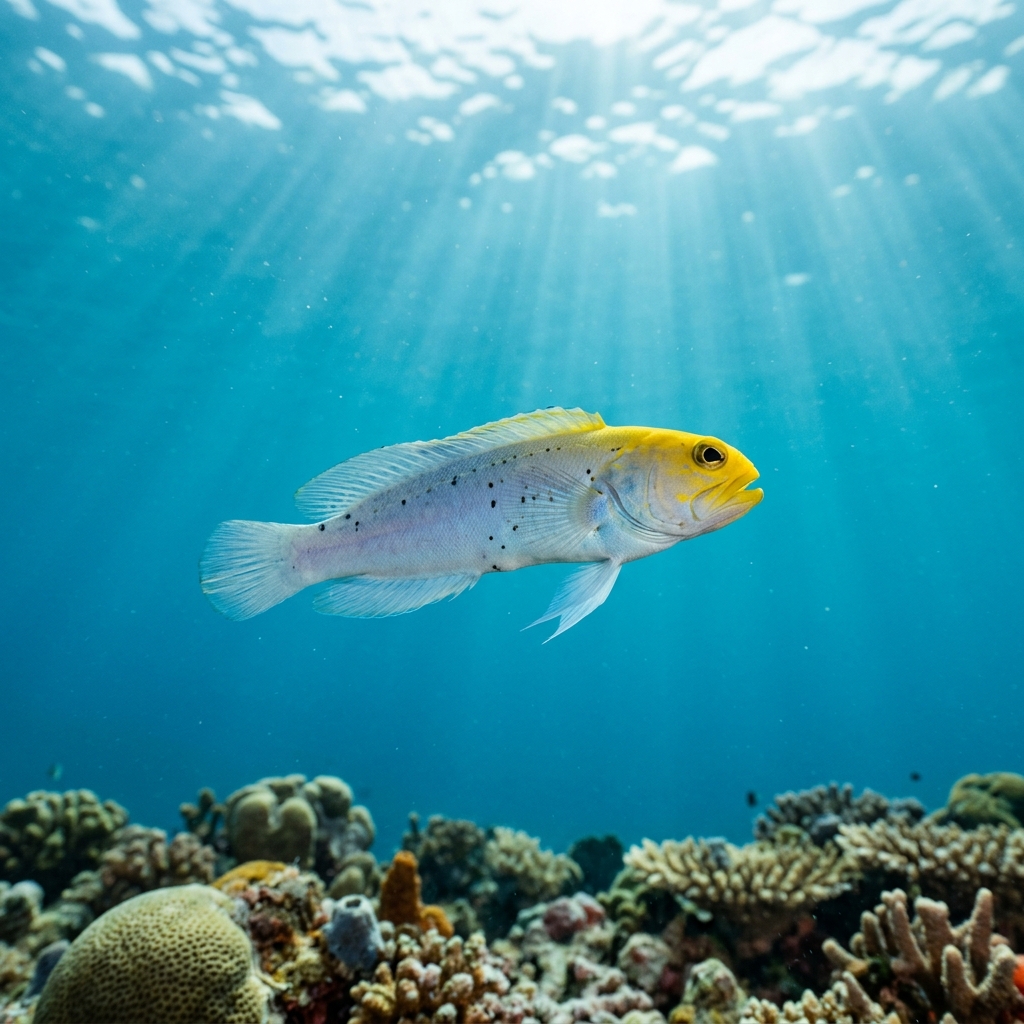
A small, elongated fish that hovers nearly vertically just above the seafloor, with a vivid yellow head that fades into a pale blue-white body. The oversized mouth is the most eye-catching feature, and you will often see it held open wide. Look for it on sandy or rubble patches at the edges of reef, rarely straying more than a body length from its burrow.
Almost always seen hovering vertically at the entrance of a self-excavated burrow in sand or rubble, retreating tail-first the moment a diver moves too close. Approach slowly and hold your position a metre or so away; it will often pop back up within seconds of you going still. Mouthbrooding males are occasionally spotted holding a clutch of eggs, visibly tumbling them inside their open mouths.
Males incubate fertilised eggs entirely inside their mouth, aerating them by rolling them around until they hatch. If you see a jawfish with a noticeably bulging, open mouth, you are watching one of the more remarkable parental strategies on the reef.
Northern Hemisphere sightings concentrate from May through December, aligning with warmer water in the 25-28 °C range. In the core Caribbean and Florida range, aim for late spring through early autumn for the most activity.
Most reliably logged across the Caribbean, with the Cayman Islands, Cuba, and the Bahamas leading the count. Strong records also come from the US Virgin Islands, British Virgin Islands, and Florida's southeast coast, and there are healthy populations along the northeast coast of Brazil and in Venezuela. Within those regions, Grand Cayman and Tortola stand out as particularly consistent spots.
Mapping where Yellowhead Jawfish is logged…
The best places are scattered across the Caribbean and the western Atlantic. The Cayman Islands, Cuba, Bahamas, US and British Virgin Islands, and Florida's southeast coast all have strong records. Brazil's northeast coast and Venezuela are also well-documented sites.
In the northern Caribbean and Florida, sightings peak between May and December. Water temperatures in the 25-28 °C range seem to correspond with the most active periods, so late spring through early autumn is a reliable window.
Look for a small fish hovering nearly upright just above a burrow in sandy or rubble substrate. The bright yellow head contrasting with a pale blue body is distinctive, and the disproportionately large mouth is hard to miss. It rarely moves far from its burrow, which makes it easier to find once you know the habitat to search.
They are small fish, typically reaching around 10 cm in length. Their compact size means they can be easy to overlook on the reef, so scanning sandy patches slowly pays off.
Yes. Males are mouthbrooders, meaning they hold the fertilised egg mass entirely inside their mouth until hatching. You can sometimes spot a brooding male with a visibly swollen, gaping mouth as he rolls the eggs to keep them oxygenated.
Not at all. They are shy and will retreat into their burrow if approached too quickly. The only risk is accidentally disturbing the burrow by hovering too close to the substrate, which stresses the fish and can cloud the sandy bottom.
Site and sighting data is aggregated from diver logs, iNaturalist and GBIF. For taxonomy and conservation status:
Soldierfish
3,612 sites