Gerres cinereus
Silver and shape-shifting, the Yellowfin Mojarra turns up on sandy patches from the Yucatán to Bonaire in warm 23-28C water, year-round.
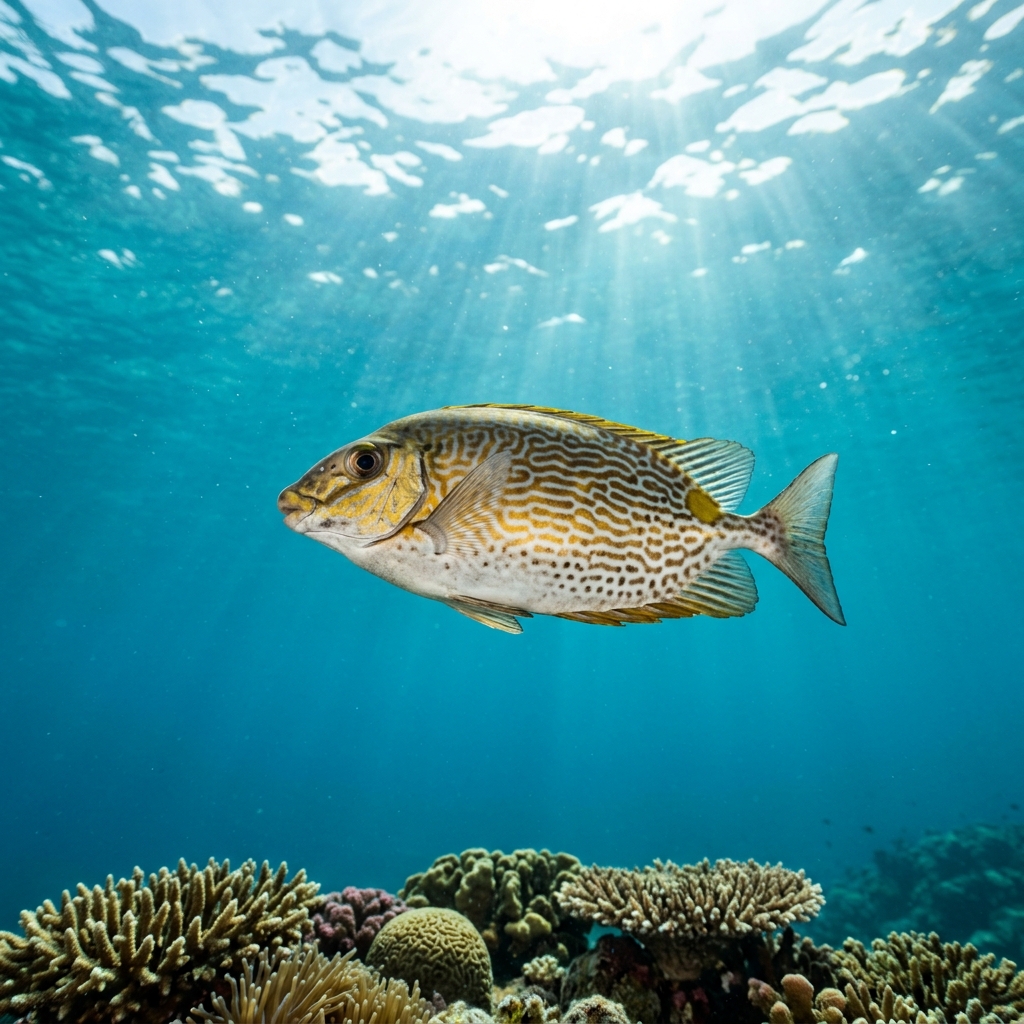
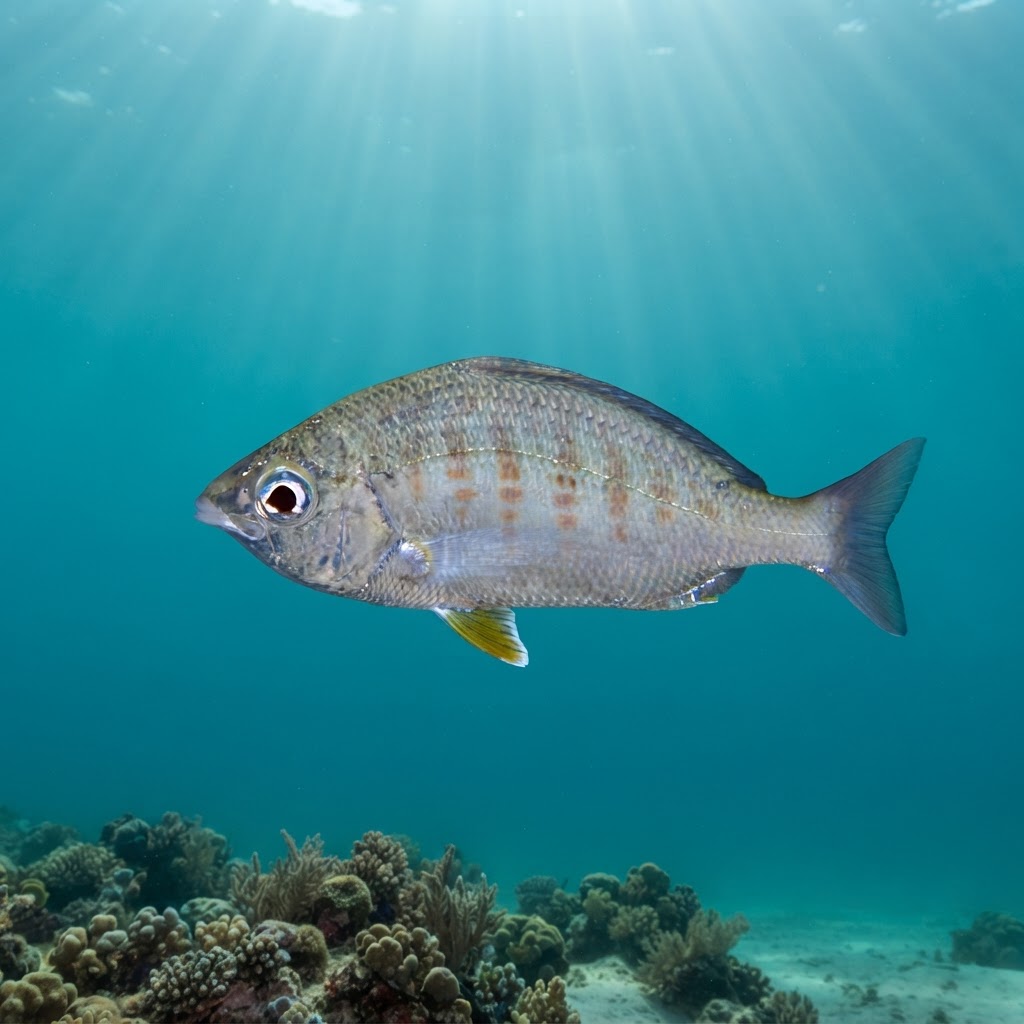
Look for a silvery, laterally flattened fish with a steeply sloped forehead and a mouth that shoots straight downward when it feeds, almost like a tube. Faint dusky bars often show along the flanks, and the fins carry a pale yellow wash that gives the species its name. At around 28 cm it is a mid-sized reef fish, usually seen alone or in small loose groups hovering just above sand or rubble rather than tucked into coral.
Most divers find it hovering just above sand or seagrass at the edge of a reef, tilting nose-down to root through the substrate for buried worms, crustaceans and small molluscs. It's an unhurried fish that tolerates a slow approach but will drift off rather than let you get close, and it's most active by day, often solo or in small loose company with others of its kind.
The downward-pointing, highly protrusible mouth is built for vacuuming prey out of sand, and this fish can flush its colour from pale silver to a blotchy, almost barred pattern within seconds depending on its mood and surroundings.
Sightings don't show a clear season, and with a comfortable range of about 23 to 28C, this fish is present on Caribbean reefs all year. Any time you're diving the Yucatán, Florida or the Bay Islands, there's a fair chance of crossing paths with one over a sandy patch.
This is a Caribbean and western Atlantic fish, most reliably logged in the Yucatán Peninsula in Mexico, throughout Florida, and around the Bay Islands of Honduras. It also shows up consistently on Bonaire's Leeward Coast, in Curacao around Willemstad, and on reefs in the US Virgin Islands, Martinique and Guadeloupe.
Mapping where Yellowfin Mojarra is logged…
It's a Caribbean regular, most commonly logged around Mexico's Yucatán Peninsula, throughout Florida, and in Honduras's Bay Islands. Bonaire, Curacao, the US Virgin Islands, Martinique and Guadeloupe also have strong populations on their reefs.
There's no strong seasonal pattern, and with a water-temperature comfort zone of roughly 23 to 28C, it's around on Caribbean reefs throughout the year rather than tied to a particular month.
Watch for a flat-sided, silvery fish with a sloped head profile and a mouth that extends downward when feeding over sand. Faint dark bars and a pale yellow tint on the fins are the giveaways, along with its habit of hovering nose-down over sandy patches.
Adults typically reach around 28 cm, making them a medium-sized presence on the reef, usually seen singly or in small loose groups rather than large schools.
Its mouth extends into a downward-pointing tube it uses to probe and vacuum sand for buried worms and small invertebrates, and its body can shift from plain silver to a blotchy barred pattern in seconds.
No, they pose no threat to divers. They're calm, retreat rather than confront, and are entirely safe to observe or photograph at a respectful distance.
Site and sighting data is aggregated from diver logs, iNaturalist and GBIF. For taxonomy and conservation status:
Soldierfish
3,612 sites