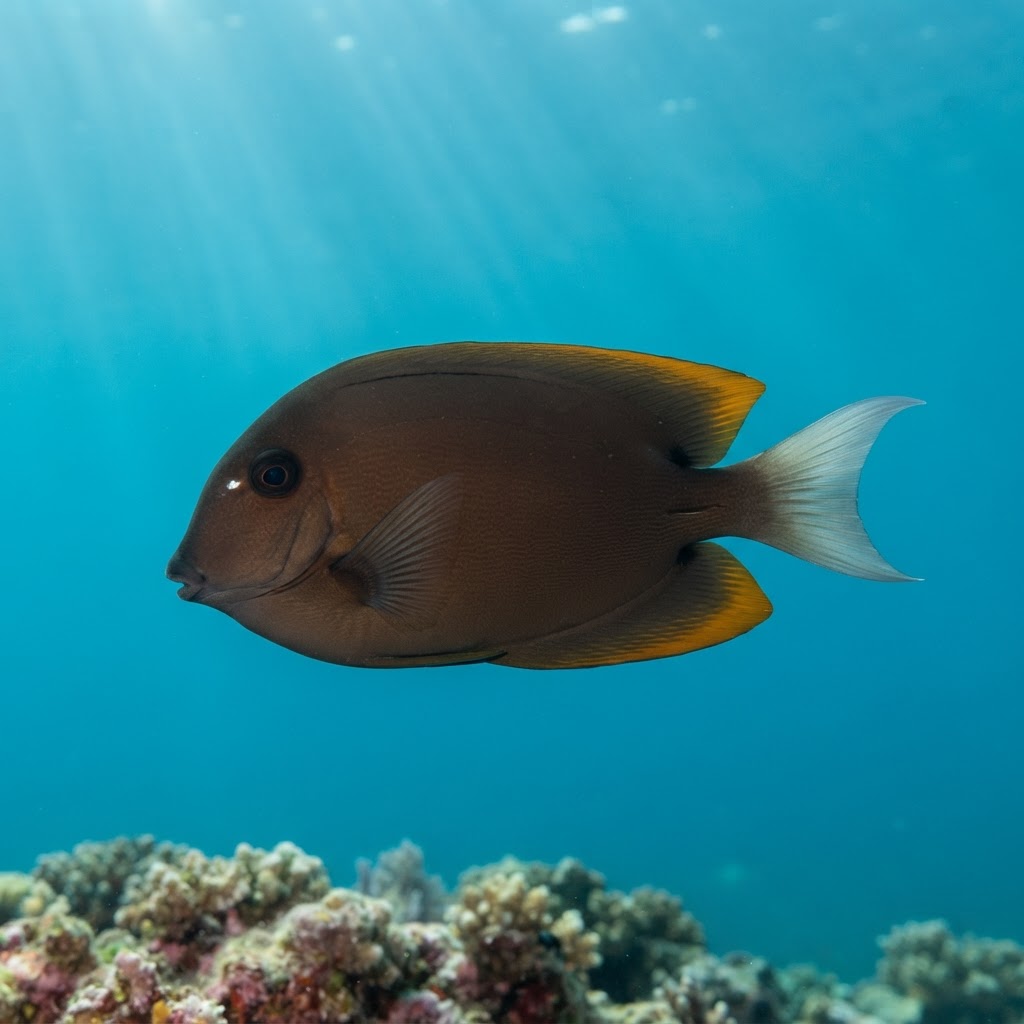
Ctenochaetus tominiensis
Look for its orange-ringed eye and blue-flecked body on reefs in Sulawesi and Bali, an uncommon find year-round in 27-29C water.
A small, oval-bodied surgeonfish around 11cm, dark brown to blackish overall with fine pale blue speckling that gets denser toward the tail. The giveaway is the bold orange ring circling the eye, which stands out even from a distance in open water. Look also for the orange edging along the dorsal and anal fins, and the small scalpel-like spine at the base of the tail shared by all surgeonfish.
Usually seen grazing alone or in loose small groups low over reef structure, picking algae and detritus off rock and dead coral rather than schooling in open water like some of its relatives. It tends to stay close to cover and will duck into crevices or move off steadily rather than bolt when a diver approaches. Divers tend to log it as an uncommon but not rare find, so patience scanning the lower reef slope pays off more than searching midwater.
Like other Ctenochaetus species, it feeds by combing loose sediment and detritus off the reef surface with comb-like teeth rather than grazing algae directly off rock, a feeding style that sets the genus apart from other surgeonfish.
Sightings show no clear seasonal pattern, so treat this as a year-round resident rather than something tied to a particular month. It sits comfortably in water from 26.7 to 28.9C, which describes tropical Indo-Pacific reefs for most of the year.
Reef neighbours a diver could mistake it for. Use the identification notes above to tell them apart.
Most reliably logged on reefs across Sulawesi, Indonesia, with Bali also producing regular sightings. It also turns up in the Visayas region of the Philippines and around Tufi in Papua New Guinea, making it a fish tied firmly to Coral Triangle reefs.
Mapping where Tomini Surgeonfish is logged…
It is most consistently found on reefs in Sulawesi and Bali, Indonesia, with additional sightings in the Visayas region of the Philippines and around Tufi in Papua New Guinea.
There is no strong seasonal pattern in sightings, so it is best treated as a year-round resident of warm Indo-Pacific reefs sitting around 27 to 29C.
Look for a small dark brown fish around 11cm with fine blue speckling and a bright orange ring around the eye, usually seen grazing low over the reef.
They are a small surgeonfish, typically reaching around 11cm in length, so they are easy to miss unless you are looking closely at the lower reef.
No, they pose no threat to divers. Like all surgeonfish they carry a small defensive spine near the tail, but it is not a concern unless the fish is handled.
Its genus feeds by combing detritus and fine sediment off the reef surface with specialised comb-like teeth, a distinct feeding style compared with surgeonfish that graze algae directly.
Site and sighting data is aggregated from diver logs, iNaturalist and GBIF. For taxonomy and conservation status:
Striped Surgeonfish
3,289 sites