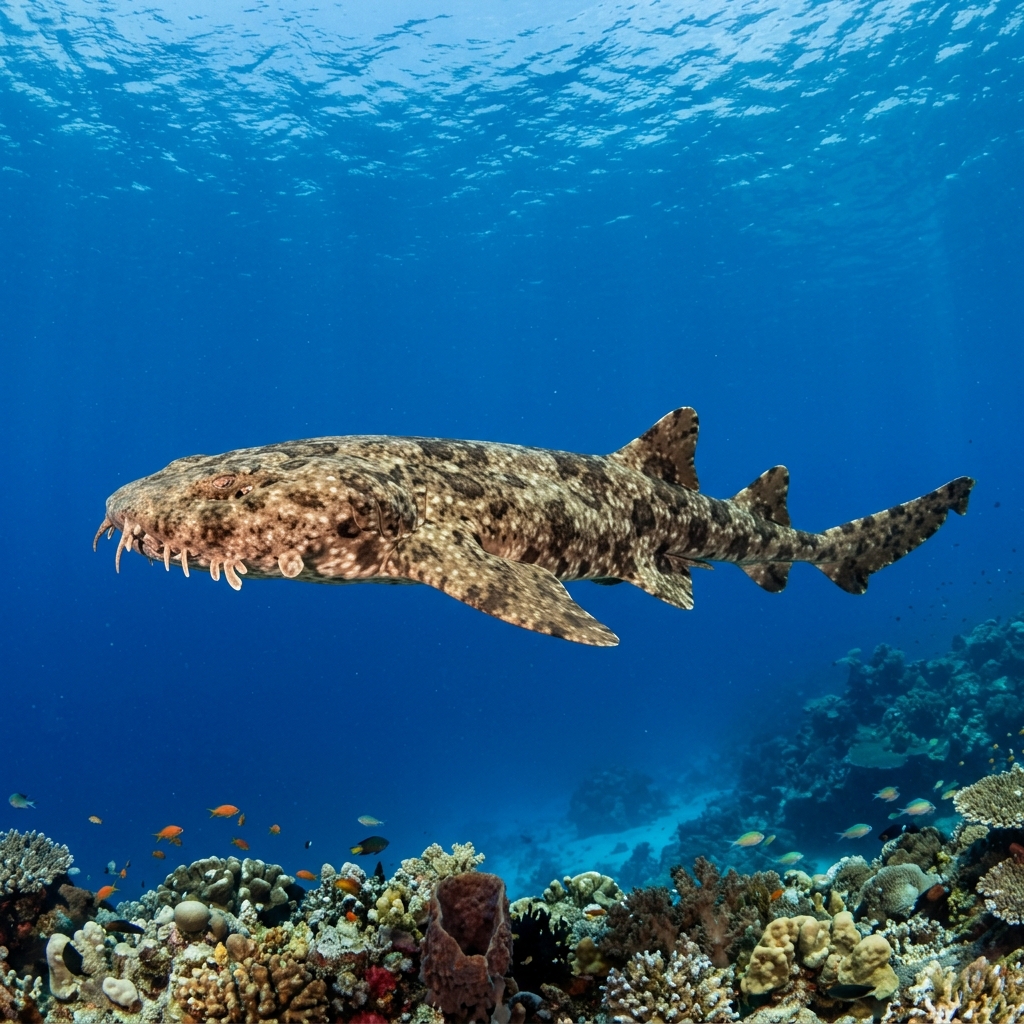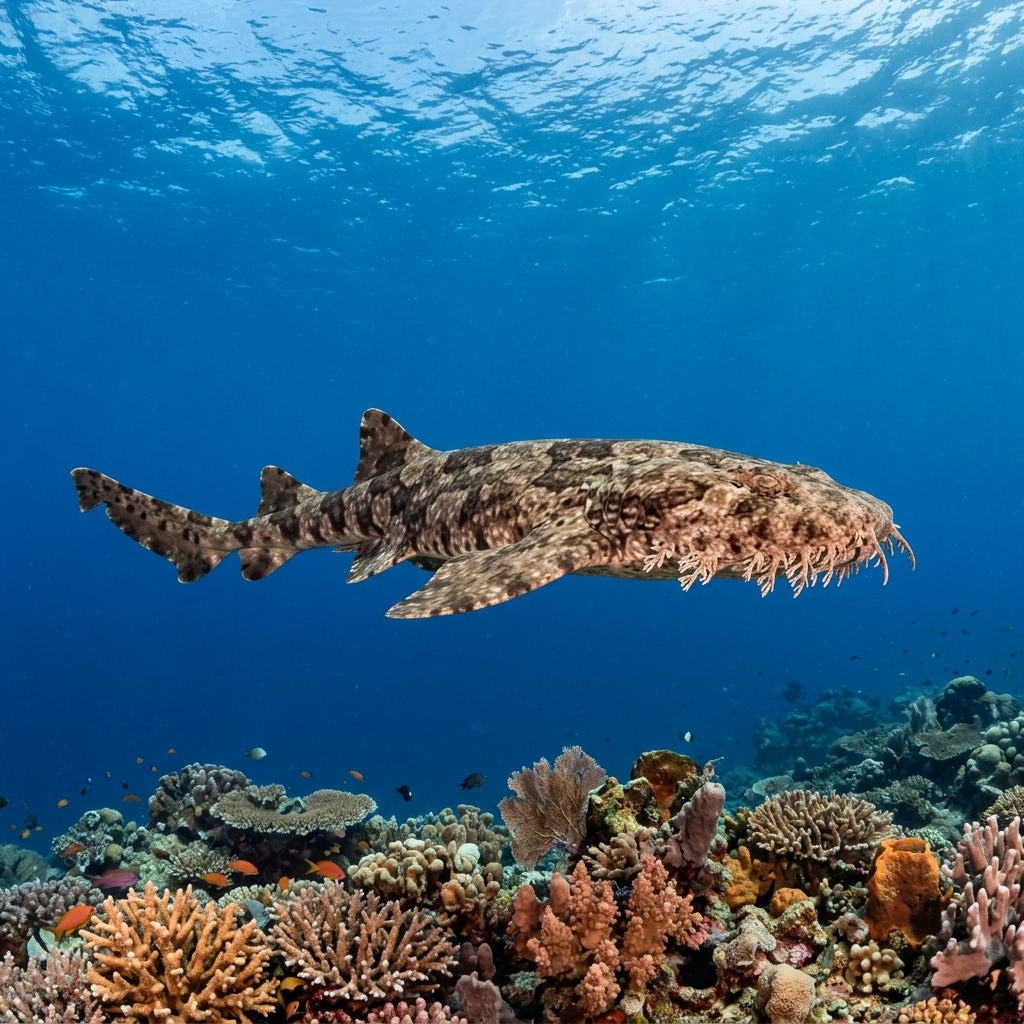
Eucrossorhinus dasypogon
Spot the tasselled wobbegong on reefs in Queensland and Papua New Guinea. A master of camouflage in warm 26-29 °C waters, year-round.
Safety warning
This shark is listed as dangerous to divers, and the risk is almost entirely about accidental contact. Its bite reflex is fast and powerful; a diver resting a hand on what looks like a rock, or accidentally cornering one under a ledge, can receive a serious wound. Give it at least a metre of clearance, look before you place your hands, and never attempt to handle or move it. It will not chase you.
If you're bitten
BiteGeneral first-aid guidance, not a substitute for professional medical care. In an emergency, call your local emergency number.
Few sharks are harder to spot on a reef: it lies completely flat, its brown, tan, and grey body covered in an intricate pattern of blotches that mirrors the encrusting coral beneath it. The giveaway is the fringe of branching dermal lobes (skin tassels) running all around the head and jaw, making the outline of the shark nearly invisible against the seafloor. At up to roughly 2.5 metres it is a large animal, but you will usually see it coiled or pressed against a ledge, not swimming. No significant colour difference separates juveniles from adults at typical diving distances.
Most encounters begin with someone nearly kneeling on it: the tasselled wobbegong lies motionless on a ledge or patch of coral rubble, relying on its camouflage rather than flight. It is primarily nocturnal but can be found resting on the reef at any hour. When divers approach slowly and calmly, it rarely moves; sudden disturbances or physical contact are a different matter.
The elaborate fringe of tassels around its head is not just camouflage: research suggests it also functions as a lure, with small fish attracted to what looks like a clump of algae or worms before the shark strikes.
No clear seasonal peak has emerged from the data, so this species is treated as a year-round resident. It occupies warm tropical reefs in the 26-29 °C range, which remain stable in Queensland and the Coral Triangle throughout the calendar year.
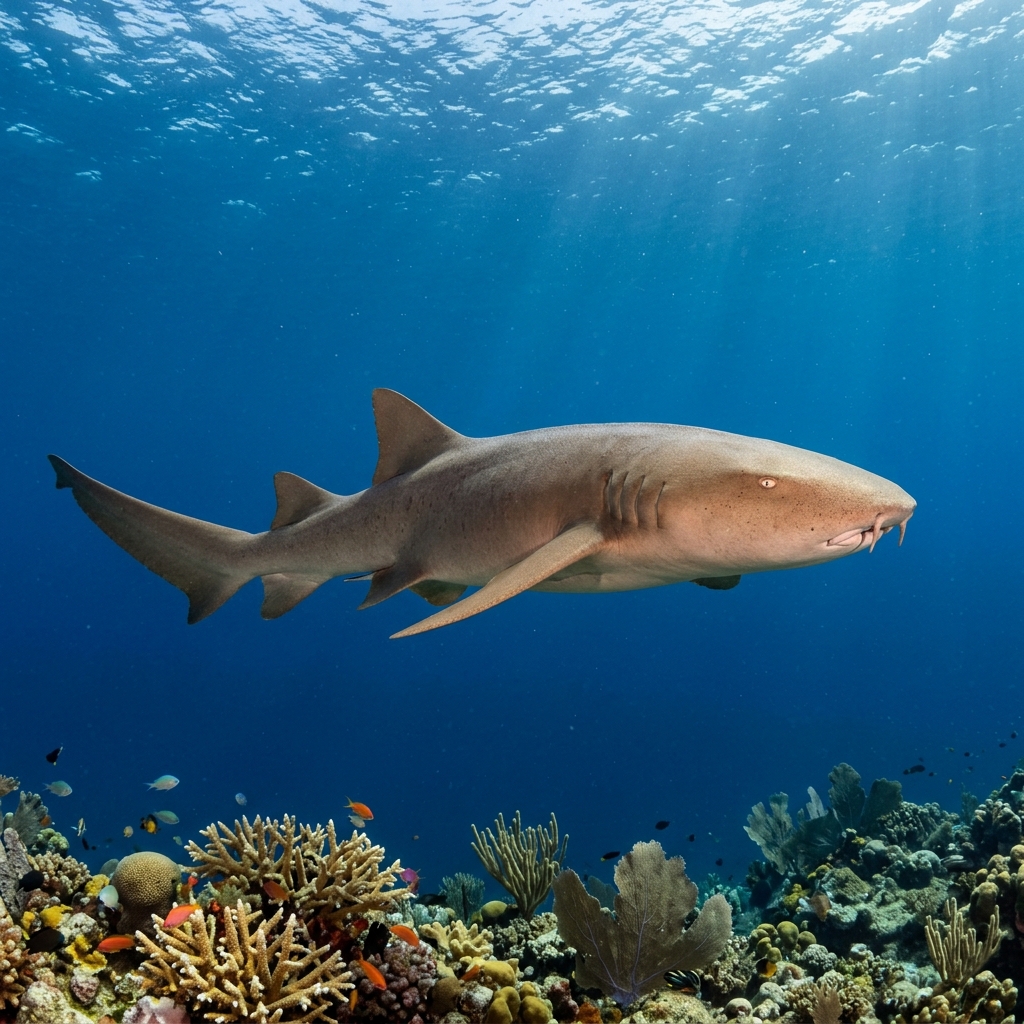
Reef neighbours a diver could mistake it for. Use the identification notes above to tell them apart.
Most tasselled wobbegong sightings come from Australian waters, with Queensland and the Northern Territory leading the count, followed by Western Australia. Outside Australia, divers encounter it across the Maluku and Papuan islands of Indonesia, at sites around Tufi and Madang in Papua New Guinea, and on reefs in the Solomon Islands.
Mapping where Tasselled Wobbegong is logged…
The species is most consistently logged in Queensland and the Northern Territory of Australia, with additional records from Western Australia. Divers in the Maluku and Papua region of Indonesia, around Tufi and Madang in Papua New Guinea, and in the Solomon Islands also encounter it, typically on shallow to mid-depth coral reefs.
There is no single peak season in the data. Because the species lives on warm tropical reefs that sit between roughly 26 and 29 °C year-round, diving for it in Queensland or the Coral Triangle is viable in any month. Night dives give you the best chance of catching it actively hunting.
Look for a large, flat shark pressed against the reef with a full fringe of branching skin tassels around its wide, flattened head. The body pattern of brown blotches and reticulations is extraordinarily detailed. Other wobbegongs lack the continuous, heavily branched tassel fringe that completely obscures the jaw line.
Adults typically reach around 1.8 metres, with the largest confirmed individuals approaching 2.5 metres. In the water a fully grown animal looks very broad and thick-bodied for its length because of its flattened, rug-like shape.
They are not aggressive hunters of divers, but they can bite hard if disturbed, cornered, or accidentally touched. Most incidents happen when a diver places a hand or foot near its head without seeing it first. Maintain a clear distance, watch where you rest your hands on the reef, and never handle one.
Site and sighting data is aggregated from diver logs, iNaturalist and GBIF. For taxonomy and conservation status:
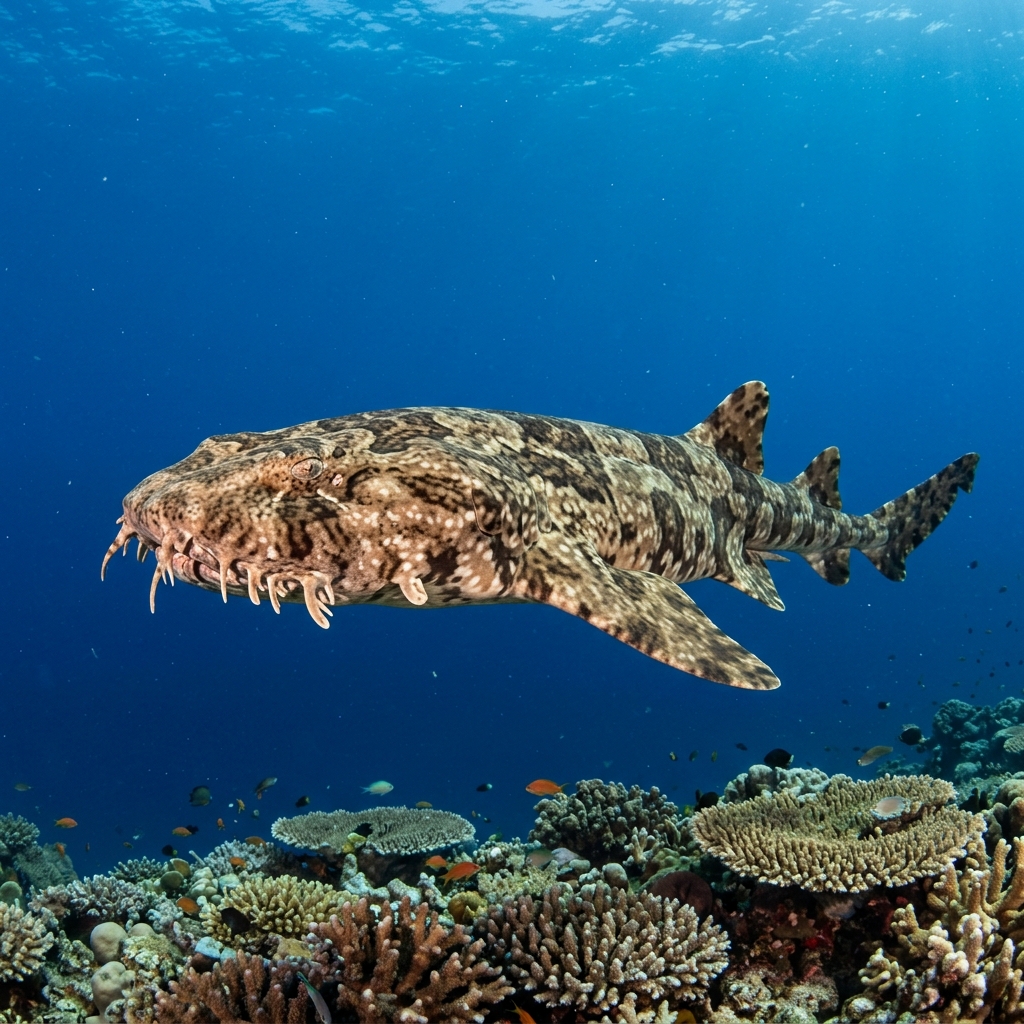
Ornate Wobbegong
291 sites