Ginglymostoma cirratum
Spot nurse sharks resting on reefs across Florida, the Yucatán Peninsula and the Bahamas. Year-round presence in warm 22-28 °C waters makes them reliable company.
Safety warning
Nurse sharks are slow-moving and generally unbothered by diver presence, but bites do occur and are well documented, almost always triggered by harassment or a diver grabbing the tail or fins. Their jaws are short but powerful, and they can hold on tenaciously. Give them a clear metre of space, never restrict their exit route, and treat a resting animal as you would any large predator: observe without contact.
If you're bitten
BiteGeneral first-aid guidance, not a substitute for professional medical care. In an emergency, call your local emergency number.
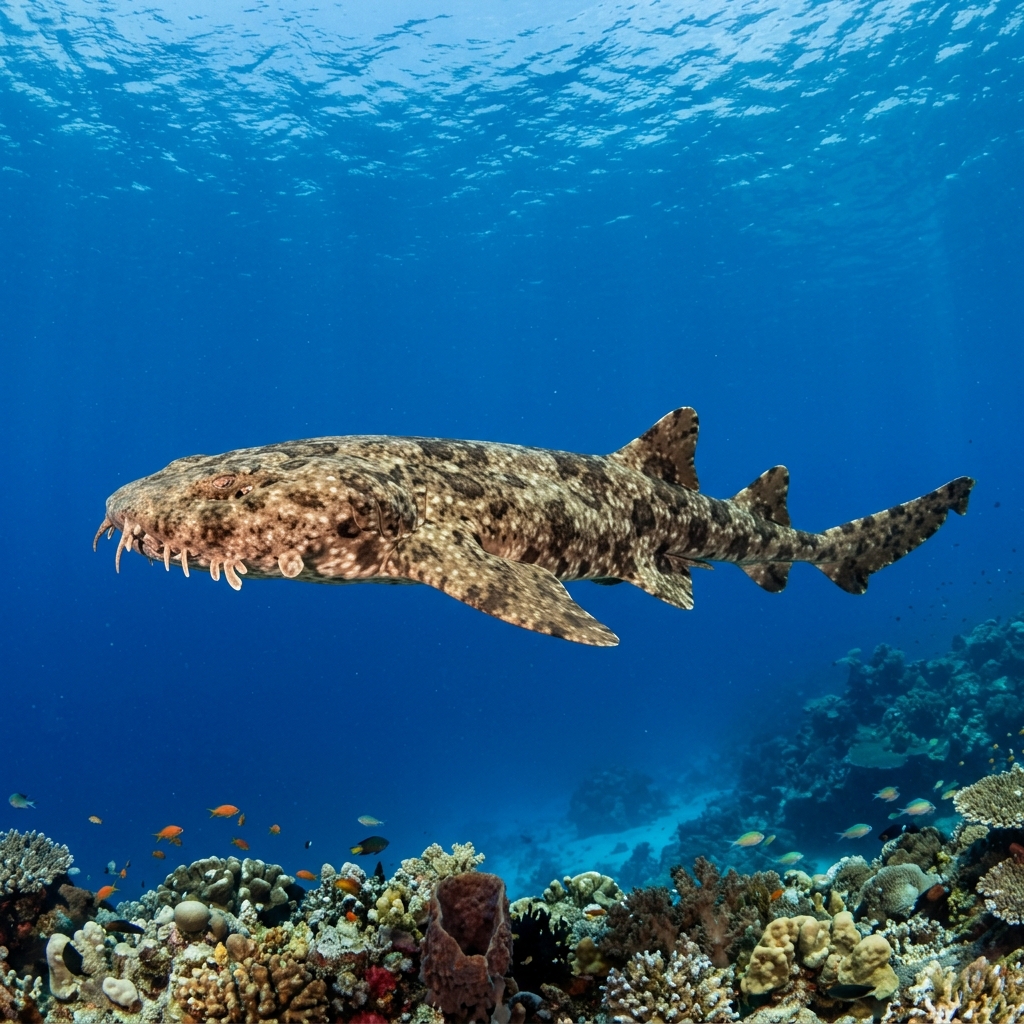
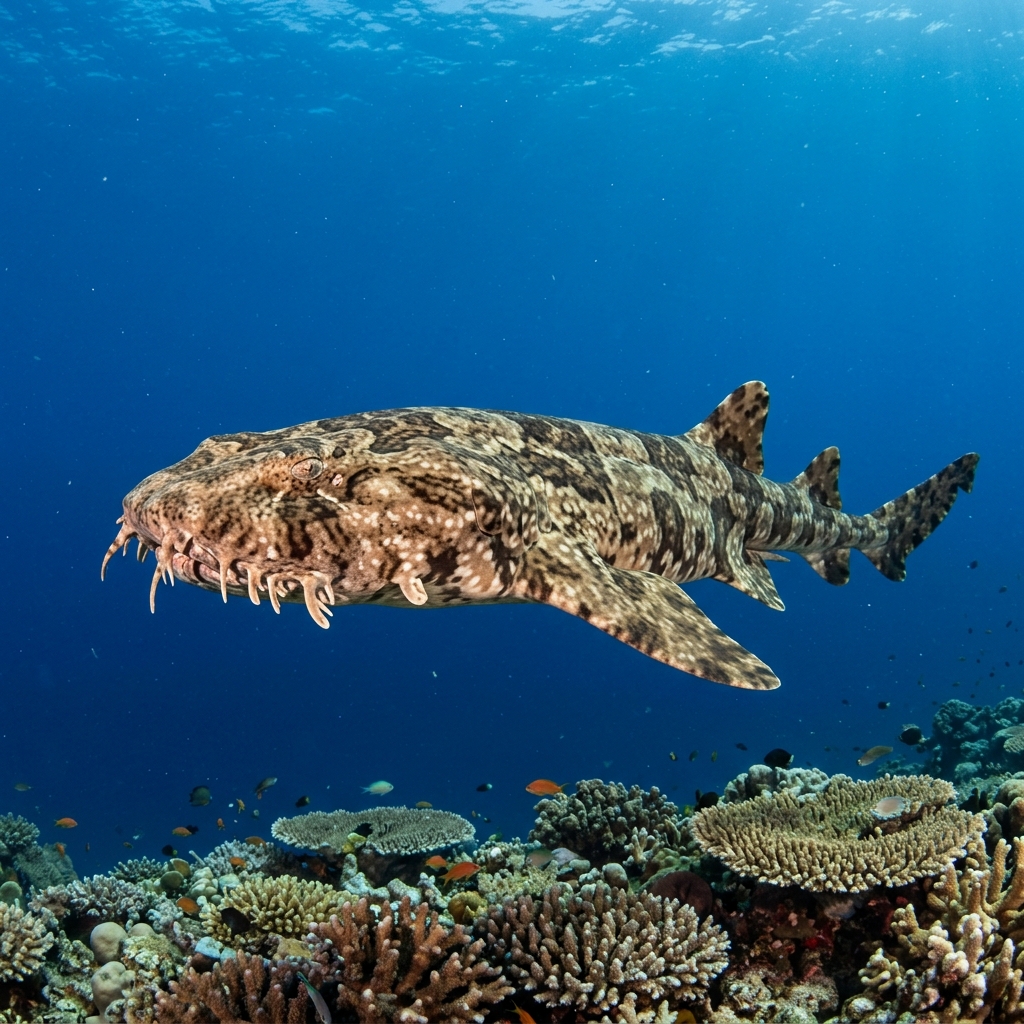
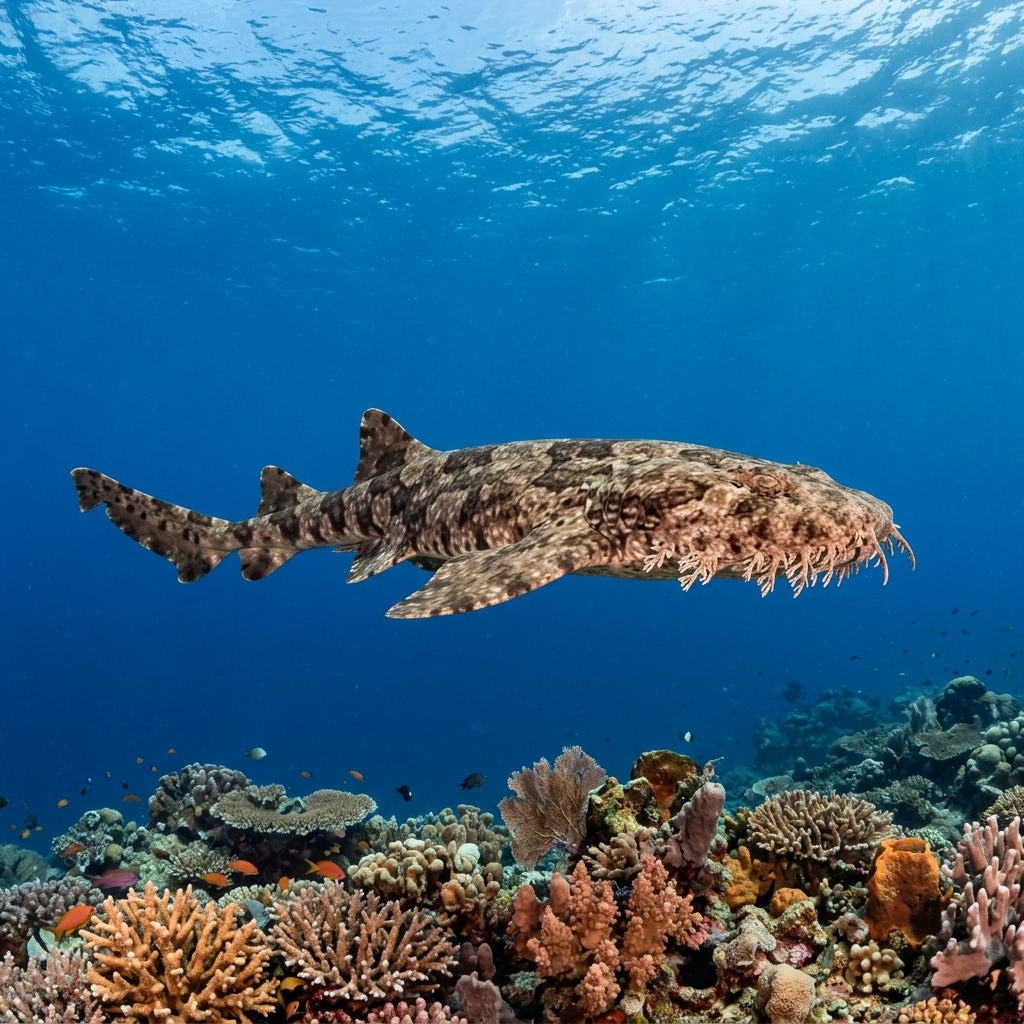
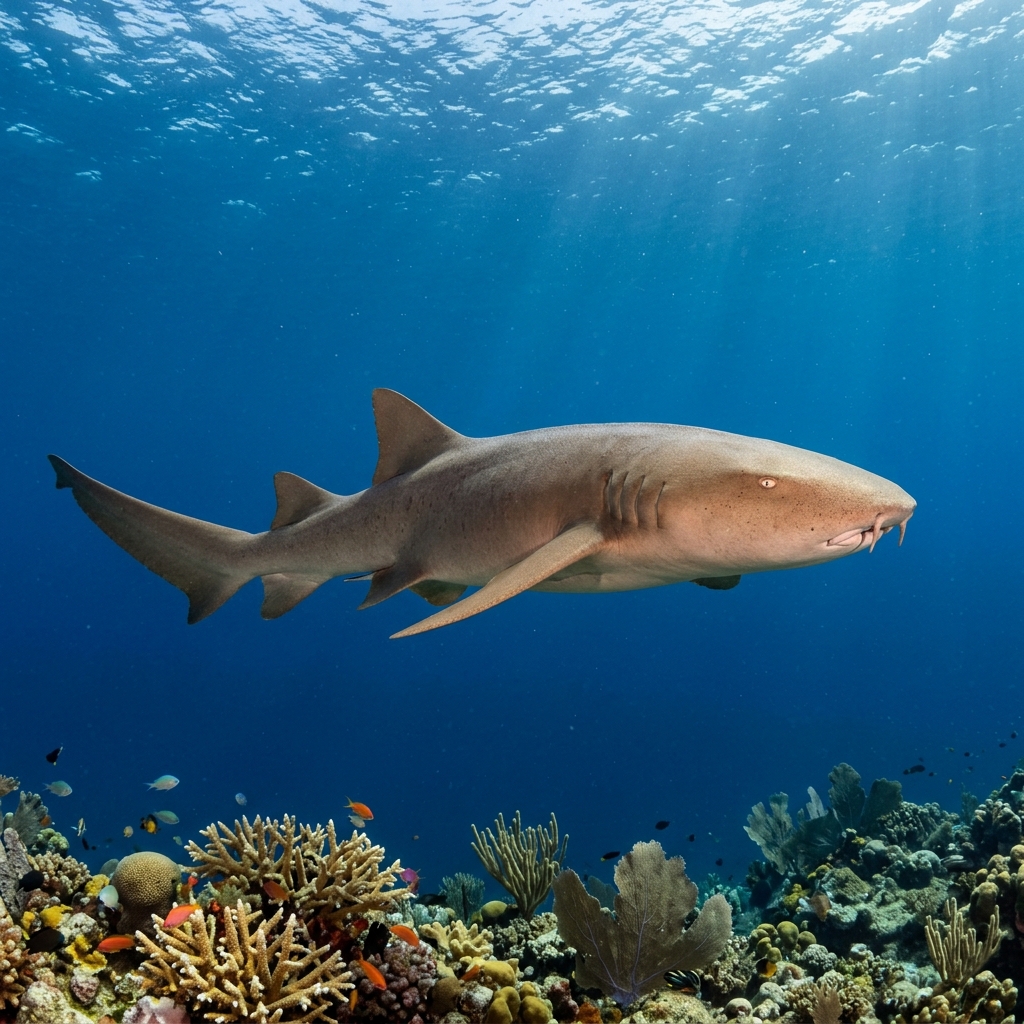
A broad, flattened head with two short fleshy barbels (whisker-like sensory projections) dangling from the nostrils is the instant giveaway. Body colour runs from tan to grey-brown, sometimes darker above and paler below, and adults routinely reach around three metres. The tail is long and asymmetric, with an upper lobe noticeably larger than the lower. Juveniles carry small dark spots that fade as they grow.
During daylight hours, nurse sharks are typically found resting motionless on sandy patches or tucked under reef ledges, sometimes in loose piles of several individuals. When stationary they actively pump water across their gills, so you will often see the jaw and gill slits working even on a shark that looks fast asleep. After dark they shift into foraging mode, using those sensitive barbels to probe crevices for sleeping fish, octopus, and crustaceans.
Nurse sharks are one of very few sharks known to use suction feeding: they create a rapid vacuum with their small, specialised mouths and literally hoover prey out of tight reef crevices, sometimes producing an audible pop.
In the Northern Hemisphere, nurse sharks are present year-round, which aligns with their preference for warm tropical and subtropical water between 22 and 28 °C. Southern Hemisphere divers see a concentration of sightings from August through October.
Most heavily logged across Florida, the Yucatán Peninsula, and the Bahamas, with strong populations also recorded in Belize, Cuba, the Cayman Islands, and Grenada. Brazil's northeast coast and Colombia's San Andrés and Providencia add solid Southern Hemisphere and Caribbean options. Within those regions, Grand Cayman, New Providence, and Tortola consistently produce sightings.
Mapping where Nurse Shark is logged…
The strongest concentrations are in the Caribbean and western Atlantic. Florida, the Yucatán Peninsula, the Bahamas, Belize, Cuba, and the Cayman Islands are the most reliable destinations, with Grenada and Brazil's northeast coast also producing regular sightings. They are logged across a wide spread of countries in total.
In the Caribbean and Florida, nurse sharks are resident year-round thanks to consistently warm water, so there is no peak season to chase. Divers in the Southern Hemisphere see the most activity between August and October.
They are not aggressive, but they are not completely docile either. Bites happen when divers grab or corner them. Their jaws grip hard and can hold on, so a bite, though rarely life-threatening, is a serious injury. Keep your distance, never touch, and always leave a resting shark a clear escape route.
Look for the two short fleshy barbels hanging from the nostrils and the broad, rounded head. The overall colour is a uniform tan to grey-brown. At up to three metres long with a notably long tail, they are hard to miss when resting on the sand, which is exactly where you will usually find them during the day.
Adults typically reach around 2.5 to 3 metres in length. At that size they are one of the larger sharks a reef diver will encounter in the Atlantic and Caribbean, though their slow, heavy build makes them look bigger than a fast-moving species of the same length.
They are classified as Vulnerable by the IUCN. Populations have declined in parts of their range due to habitat loss and bycatch. They are legally protected in several countries including the United States. Responsible dive behaviour, including no touching or riding, directly supports their welfare.
The Nurse Shark is listed as vulnerable by the IUCN. Observe from a distance, avoid touching or feeding it, and report sightings to local marine research organisations.
Listed as Vulnerable on the IUCN Red List, nurse sharks face pressure from habitat degradation and incidental capture. Divers can help by reporting sightings through citizen science platforms and by advocating against any hands-on interaction that habituates sharks to diver contact in ways that make them more vulnerable.
Site and sighting data is aggregated from diver logs, iNaturalist and GBIF. For taxonomy and conservation status:
Gulf Wobbegong
199 sites