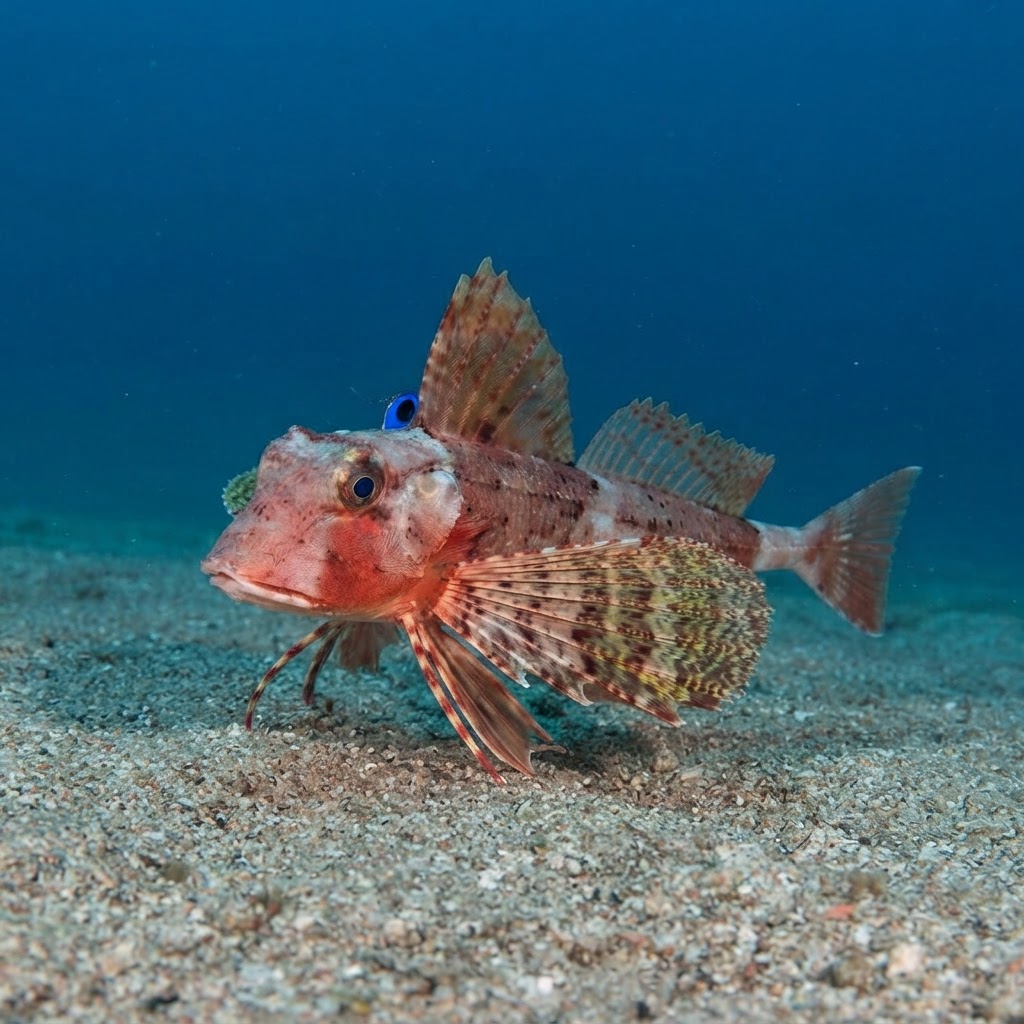
Chelidonichthys lastoviza
Winged, walking fish found on sand and rubble from Kvarner to the Lisbon Coast, year-round in waters from 9 to 26C.
Grows to around 28 cm, with a reddish-brown to pinkish body streaked with darker bands along the flanks. The giveaway is the pair of large, wing-like pectoral fins edged in electric blue, which fan out as it moves and fold flat when it settles. A bony, armoured head and a blunt, sloping snout give it a distinctly angular profile compared with typical reef fish.
Typically found resting on sand, mud or rubble bottoms rather than swimming in open water, often at first glance mistaken for a patch of seabed. When disturbed it can flick open its blue-edged pectoral fins and skitter a short distance before settling again, using the leading fin rays almost like fingers to feel across the substrate. Divers usually spot it on slow bottom sections of a dive rather than mid-water.
Those separated lower pectoral fin rays aren't just for show, they act as sensory feelers that let the fish probe sand and rubble for buried prey without needing to see it.
Sighting data shows no strong seasonal pattern, and it's recorded across a wide temperature range from 8.9 to 26C, so it's effectively a year-round find wherever it occurs.
Most commonly logged in Spain, particularly Andalusia, Catalonia and Valencia, and a reliable sighting in Croatia's Kvarner region and along Portugal's Lisbon Coast. Also turns up with fair regularity in France, Turkey's Turquoise Coast, Italy, Madeira and the Canary Islands.
Mapping where Streaked Gurnard is logged…
Spain is the strongest bet, especially Andalusia, Catalonia and Valencia, with Croatia's Kvarner region and Portugal's Lisbon Coast also reliable. Smaller but consistent numbers are logged in France, Turkey, Italy, Madeira and the Canary Islands.
There's no clear seasonal pattern in sightings, and it tolerates a wide temperature range from roughly 9 to 26C, so it can be found on sandy and rubble bottoms at any time of year.
No, they pose no threat to divers. They rest quietly on the seabed and simply move off a short distance if approached too closely.
Look for a reddish, streaked body resting flat on sand or rubble, with large blue-edged pectoral fins that fan open when it moves. The bony, armoured head and blunt snout are also distinctive at close range.
They typically reach around 28 cm in length, making them a modest-sized bottom-dwelling fish rather than a large or dramatic sighting.
They have separated pectoral fin rays that work like feelers, letting them probe sand and rubble for hidden prey such as small crustaceans, effectively letting the fish feel its way across the seabed.
Site and sighting data is aggregated from diver logs, iNaturalist and GBIF. For taxonomy and conservation status:
Soldierfish
3,612 sites