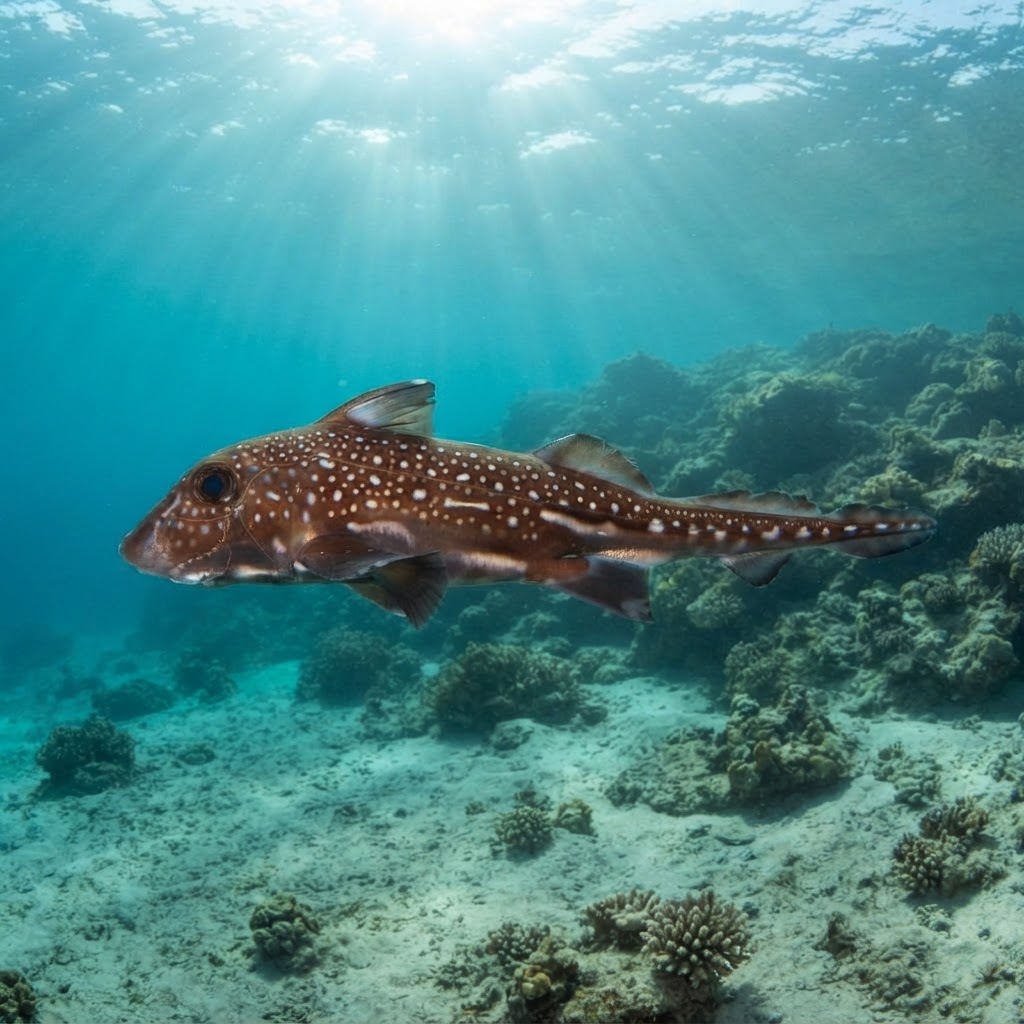
Hydrolagus colliei
Ghostly, big-eyed and iridescent, spotted ratfish turn up in the cold, silty waters of the Pacific Northwest and British Columbia year-round.
Safety warning
The dorsal spine can deliver a painful, venomous jab if handled or pinned against carelessly, so admire from a distance and never grab one for a photo. Injuries are rare and mostly come from divers trying to touch or move the animal.
If you're stung
Venomous dorsal spineGeneral first-aid guidance, not a substitute for professional medical care. In an emergency, call your local emergency number.
Look for a slender, tapering body that ends in a long, whip-like tail, topped off with an odd rabbit-like snout and huge, reflective green eyes. Skin tone runs bronze to dark brown with scattered pale spots and a metallic sheen that catches a torch beam from a distance. A tall, venomous spine sits right in front of the first dorsal fin, a useful ID point if you get a side-on view. Males have a retractable club-shaped structure on the forehead used in mating, absent in females.
Divers typically find them cruising slowly just off the bottom or resting near rocky ledges and silty slopes, often at night when they seem more active. They're unhurried around divers, rarely bolting, which makes for a good long look if your light finds one. Most encounters are solo animals rather than groups.
That spine in front of the dorsal fin carries a mild venom, one of the few defences on an otherwise slow-moving, soft-bodied fish that relies on camouflage and cold, deep water to avoid predators.
Sightings show no clear seasonal pattern, so treat it as a year-round possibility on cold-water dives. It's logged consistently in waters between about 5 and 10C, which describes the Pacific Northwest and British Columbia for most of the year.
Most consistently logged in the Pacific Northwest of the United States, with a solid secondary presence in British Columbia, Canada. Sites cluster around cold, current-fed waters typical of Puget Sound and the wider Salish Sea, where divers report it more often as an uncommon-to-rare find than a guaranteed sighting.
Mapping where Spotted Ratfish is logged…
They're most reliably reported in the Pacific Northwest of the United States, particularly around Puget Sound, with further sightings across British Columbia, Canada. Look for cold, current-swept sites with rocky or silty bottoms.
There's no strong seasonal pattern in the data, so they're considered a year-round sighting. Cold water between roughly 5 and 10C suits them, which matches Pacific Northwest and British Columbia conditions most months.
They're generally calm and slow around divers, but they carry a mildly venomous spine in front of the dorsal fin. Keep hands off and injuries are essentially a non-issue.
Look for a bronze body with pale spots, an iridescent sheen, big green eyes, a rabbit-like snout, and a long tapering tail. The spine just ahead of the dorsal fin is a reliable confirming feature.
Adults typically reach around 70cm in length, including the long tail, making them a modest-sized, slender fish rather than a bulky one.
They're chimaeras, cartilaginous fish related to sharks but on their own evolutionary branch, and males have a retractable club on the forehead used during mating, a structure found nowhere else on a typical shark or ray.
Site and sighting data is aggregated from diver logs, iNaturalist and GBIF. For taxonomy and conservation status:
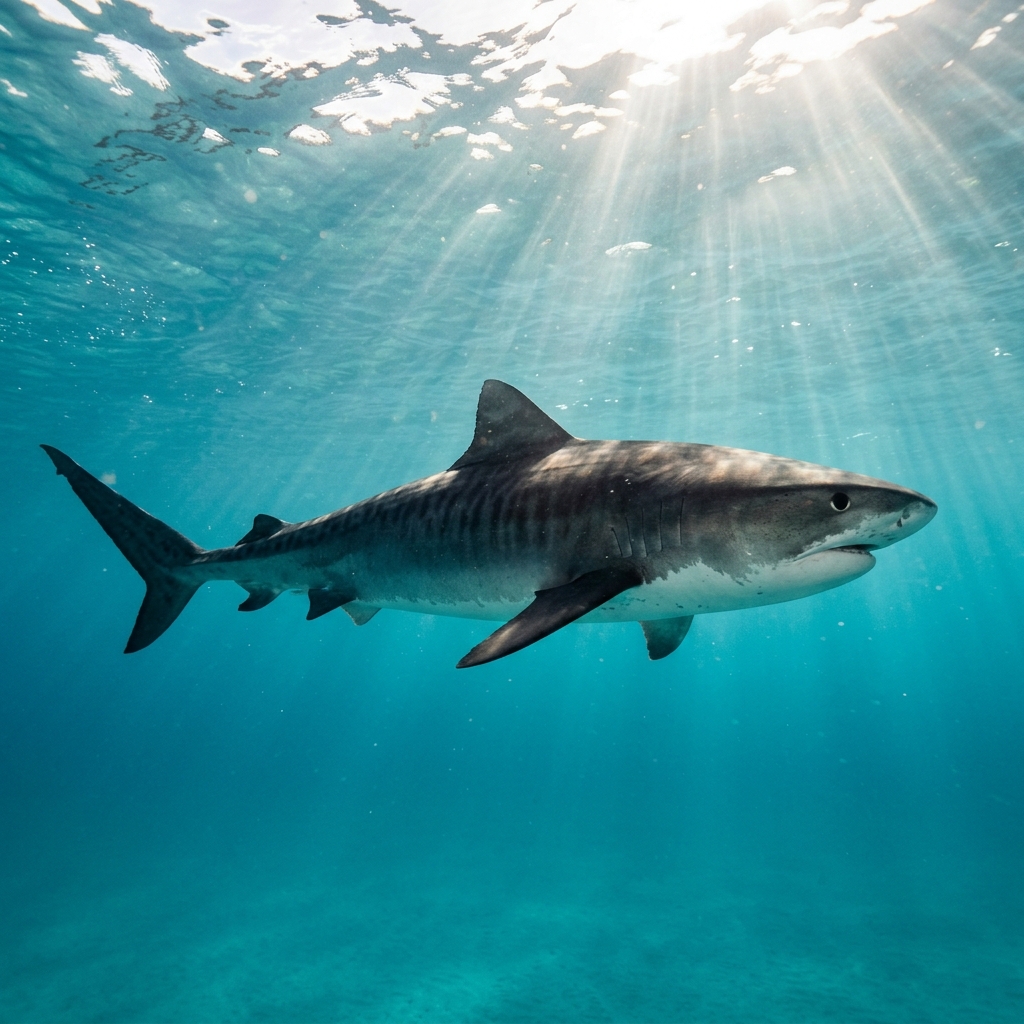
Tiger Shark
1,616 sites