Sanopus splendidus
Spot the Splendid Toadfish in Cozumel and across the Caribbean at 27-28 °C. An Endangered reef oddity worth seeking out.
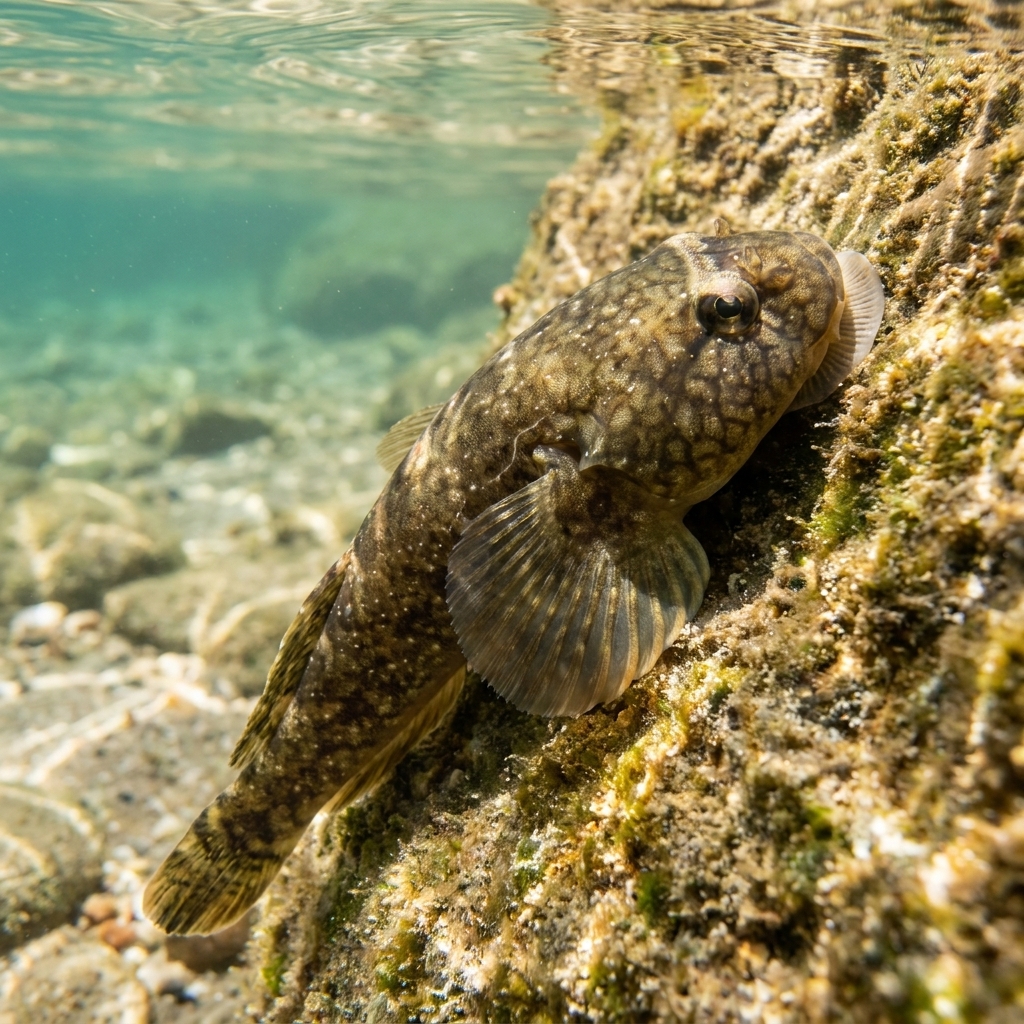
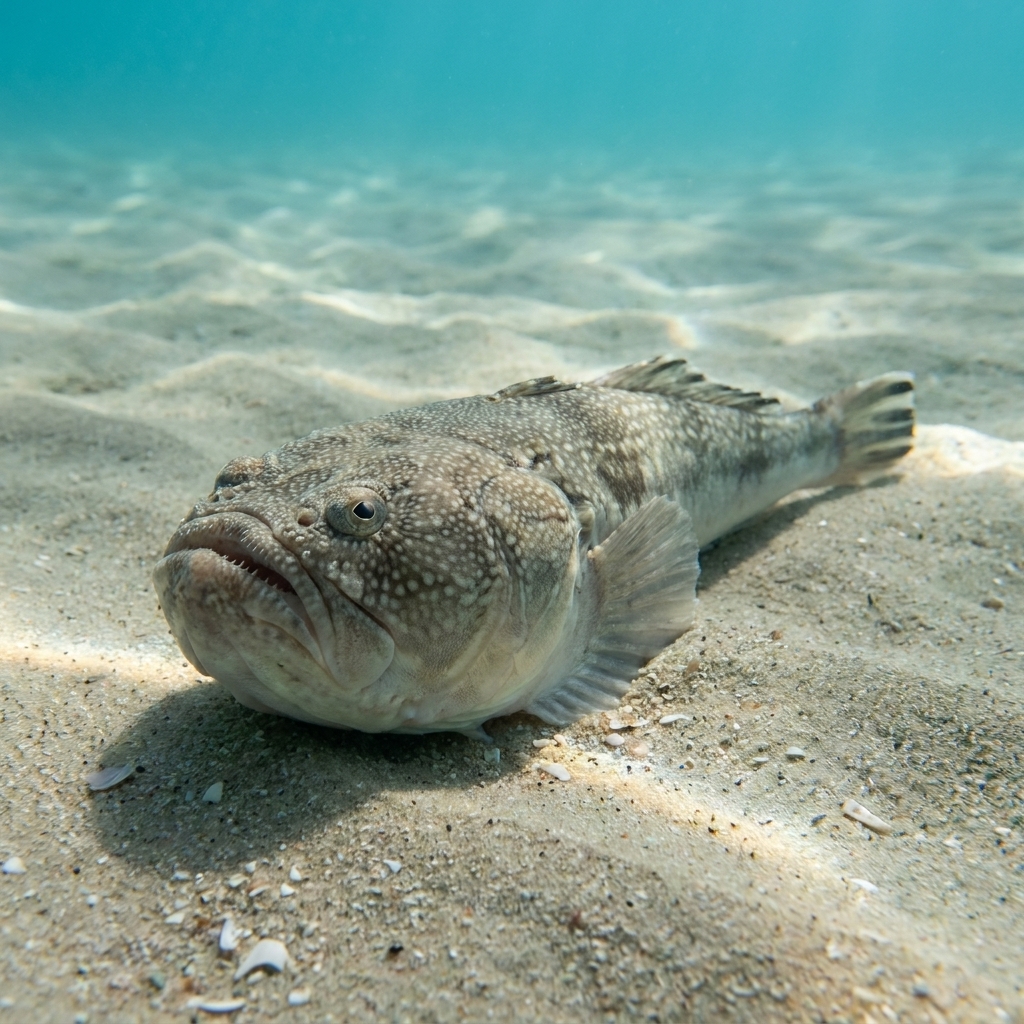
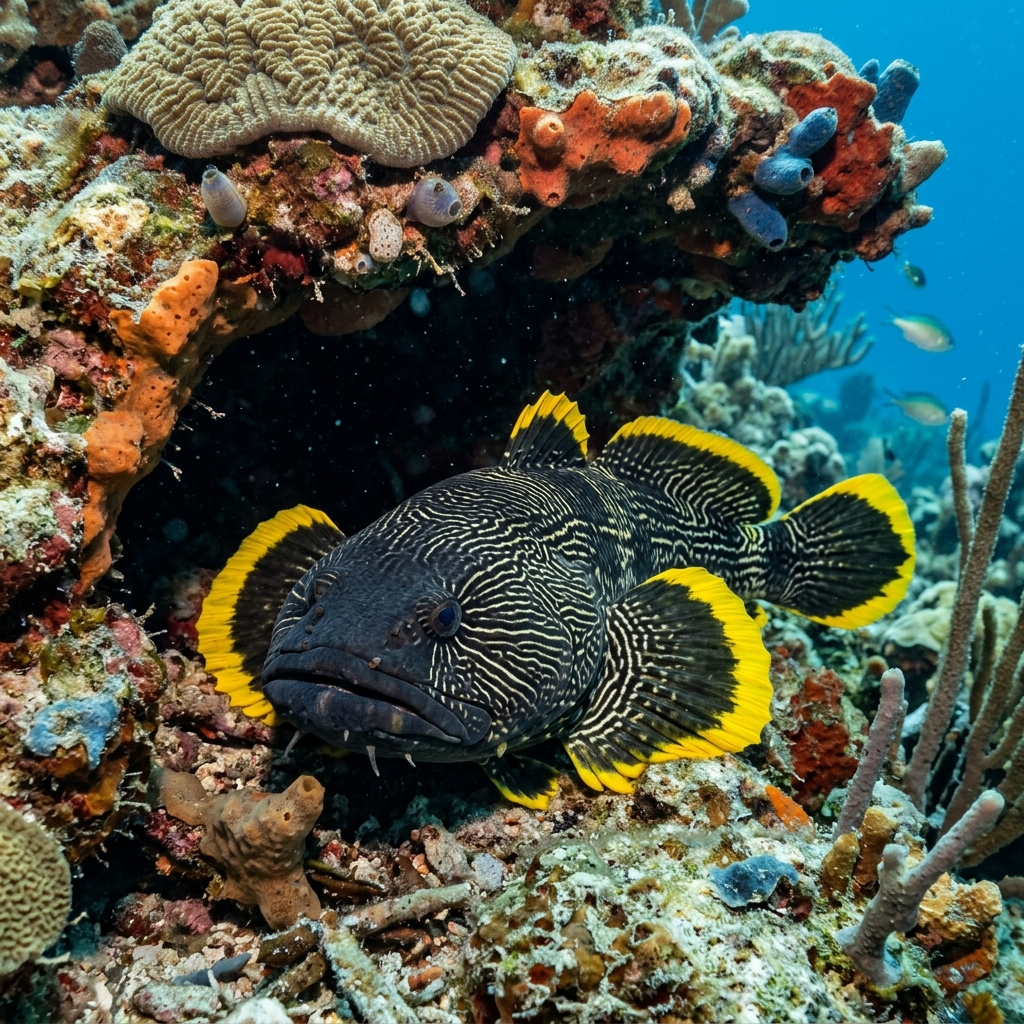
Bold, unmistakable colouration makes this one of the Caribbean's most recognisable reef fish: a stout, flattened body striped in vivid yellow and white, with a broad, frog-like head edged in fleshy barbels (whisker-like skin filaments) and a wide, downturned mouth. It rarely moves far from its hiding spot, so look for that striking striped pattern tucked under a ledge or inside a crevice. The large, forward-facing eyes and heavily decorated head set it apart from anything else on the reef.
Splendid Toadfish are ambush sit-and-wait predators, spending most of their time motionless inside reef crevices, under ledges, or wedged into rubble where their flattened body fits snugly. When approached by divers they tend to hold their position rather than flee, which makes patient observation possible if you move slowly and avoid shining a torch directly at them. Males are famously vocal, producing a loud foghorn-like call to attract females during spawning, though you are far more likely to see one than to hear it underwater.
Splendid Toadfish are famous among researchers for being almost entirely restricted to Cozumel, Mexico, making them one of the most geographically limited reef fish in the Atlantic. That extreme endemism is a key reason the species carries an Endangered conservation status.
No clear seasonal pattern emerges from the data, so this is treated as a year-round resident. Its observed water temperature range of 27 to 28 °C fits stable, warm Caribbean reef conditions throughout the year.
The species is most strongly represented across Cuba, particularly in the Jardines del Rey and the Canarreos Archipelago, and throughout the Bahamas including New Providence and Grand Bahama. Strong records also extend to Venezuela's Central Coast, Belize, the Dominican Republic, the Turks and Caicos, Colombia, and Mexico's Yucatán Peninsula, reflecting its distribution across the wider Caribbean.
Mapping where Splendid Toadfish is logged…
The best-known encounters come from Cozumel on Mexico's Yucatán Peninsula, where this species is considered a local icon. Broader range modelling suggests it may also occur across Cuba, the Bahamas, Belize, Venezuela, and other Caribbean nations, though confirmed diver sightings remain concentrated around Cozumel.
There is no strong seasonal peak in the available data, so encounters are possible year-round. The species favours stable warm water around 27 to 28 °C, which describes Caribbean reef conditions throughout most of the year.
Look for a chunky, flattened fish with vivid yellow and white body stripes and a broad, heavily fringed head lurking inside a reef crevice or under a ledge. No other Caribbean reef fish combines that bold striped pattern with the toadfish's distinctive frog-like face and fleshy barbels. It rarely swims openly, so the ID is usually made on a stationary animal.
No, they pose no threat to divers. They are passive sit-and-wait animals that rely on staying hidden rather than fleeing or attacking. Simply approach slowly and give them space.
Yes, the species is listed as Endangered by the IUCN. Its extremely limited natural range, centred on Cozumel, makes it particularly vulnerable to reef degradation, habitat disturbance, and localised events such as bleaching or pollution.
It is one of the most geographically restricted reef fish in the entire Atlantic, found almost exclusively around Cozumel, Mexico. Males produce a loud, resonant call, similar to a foghorn, to attract mates during spawning, a behaviour rare among reef fish and shared across the toadfish family.
The Splendid Toadfish is listed as endangered by the IUCN. Observe from a distance, avoid touching or feeding it, and report sightings to local marine research organisations.
Listed as Endangered on the IUCN Red List, largely because of its very restricted natural range. Divers should avoid disturbing resting individuals, never attempt to handle them, and report sightings through citizen-science platforms to help track population health.
Site and sighting data is aggregated from diver logs, iNaturalist and GBIF. For taxonomy and conservation status:
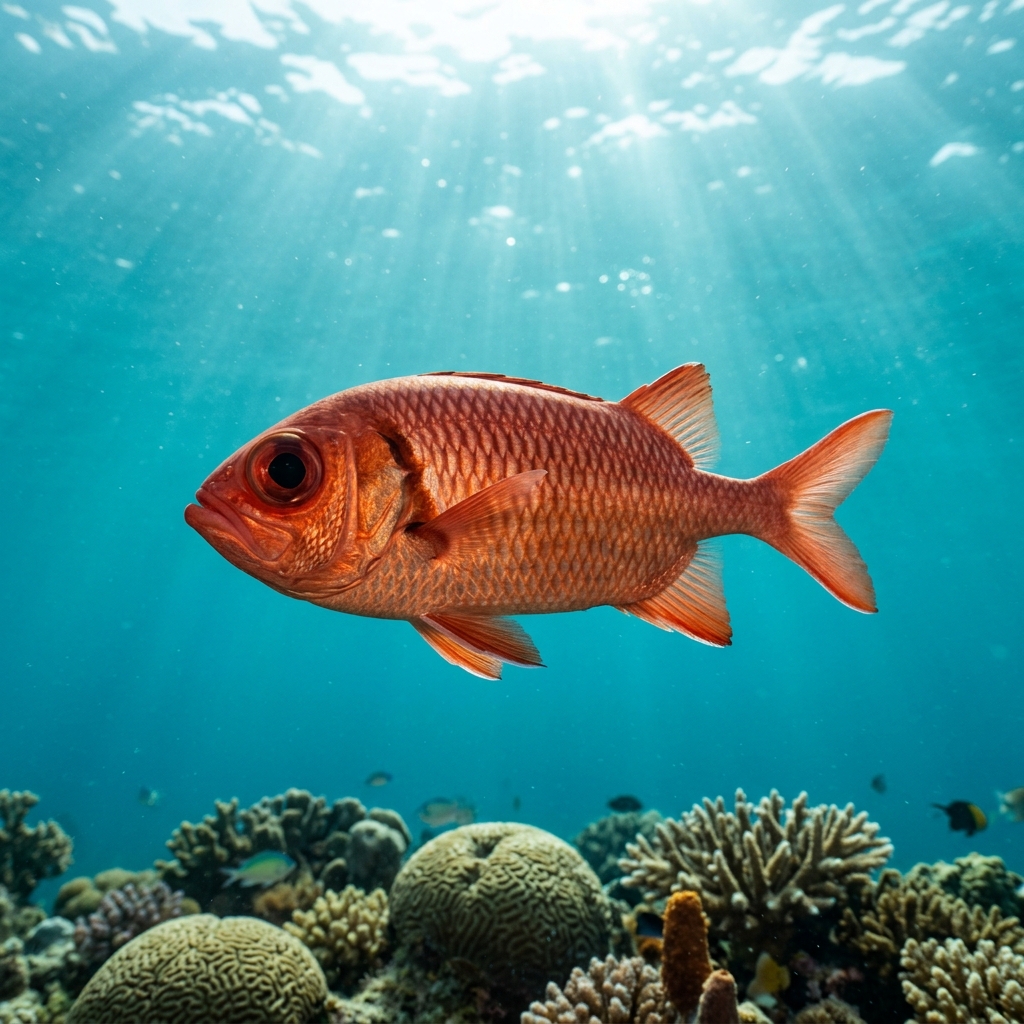
Soldierfish
3,612 sites