Trachinops caudimaculatus
Small orange reef fish in cool water shoals, most reliably logged around Victoria and Tasmania at 12 to 18C year-round.
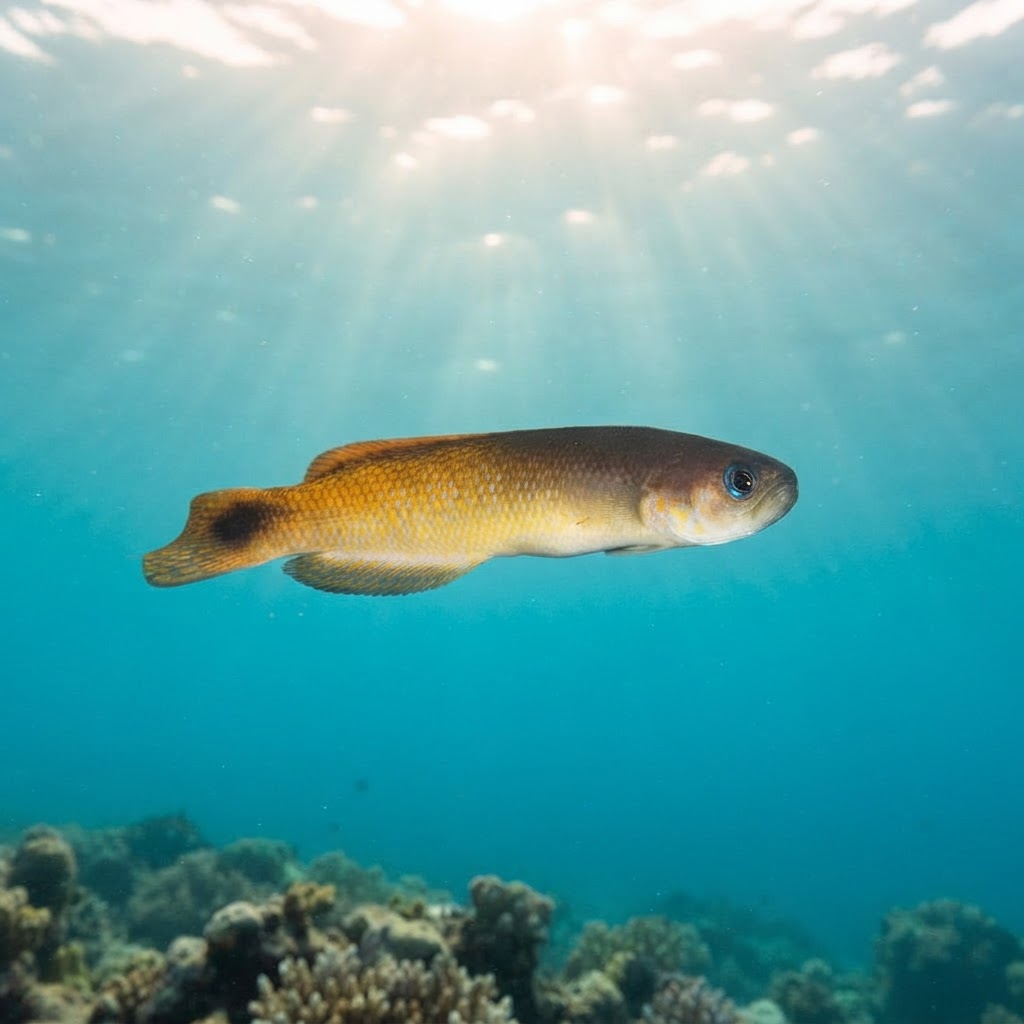
A slim, torpedo-shaped fish around 10 cm long, usually orange-brown to olive with a pale stripe along the flank dotted with electric blue spots. It hangs in loose midwater groups just off the reef face rather than sitting on the bottom like most reef fish this size. The tail often carries a dark spot or blush, which is where the species name (caudimaculatus, tail-spotted) comes from.
Look for them hovering in loose, drifting shoals a metre or so off reef walls and under ledges, picking at plankton in the water column rather than feeding off the substrate. They rarely bolt from divers, just drift and reshuffle position, which makes them an easy, low-stress subject once you slow down and hang at their depth. Most sightings are on shaded structure such as jetty pilings, overhangs and sponge gardens rather than open sand.
They are almost always seen in loose aggregations rather than alone, a shoaling habit that is typical of the genus and one of the easiest ways to pick them out from solitary temperate reef fish nearby.
There is no clear seasonal pattern in the sightings, and with a comfort range of roughly 12 to 18C it is a cool-temperate resident that divers log across the year in Victoria and Tasmania.
Almost every logged sighting comes from Australia, with Victoria the strongest region and Tasmania a close second. Sites around Port Phillip Bay and the Tasmanian south coast turn up this fish most often, usually on sheltered rocky reef and under jetties rather than open coast.
Mapping where Southern Hulafish is logged…
They are logged almost exclusively in Australia, with Victoria the most consistent region and Tasmania not far behind. Look for them on sheltered rocky reef, jetty pilings and overhangs rather than open coastline.
There is no strong season in the sightings data, so they are considered a year-round fish on Victorian and Tasmanian reefs where water sits between about 12 and 18C.
Look for a small orange-brown fish around 10 cm long with a pale, blue-spotted stripe along its side, hovering in loose shoals off the reef rather than resting on it. The tail often shows a dark spot, matching the species' tail-spot name.
They top out at around 10 centimetres, a small schooling fish best spotted by looking for its shoal rather than a single individual.
Sighting logs mark them as rare at most sites and uncommon at the rest, so they are not a guaranteed encounter but a realistic target if you dive their core Victorian and Tasmanian sites.
Site and sighting data is aggregated from diver logs, iNaturalist and GBIF. For taxonomy and conservation status:
Meagre
1,159 sites