Equetus punctatus
Recognise the spotted drum by its dramatic stripes and polka dots on Caribbean reefs. Strong populations in Cuba, Colombia and the Bahamas year-round.
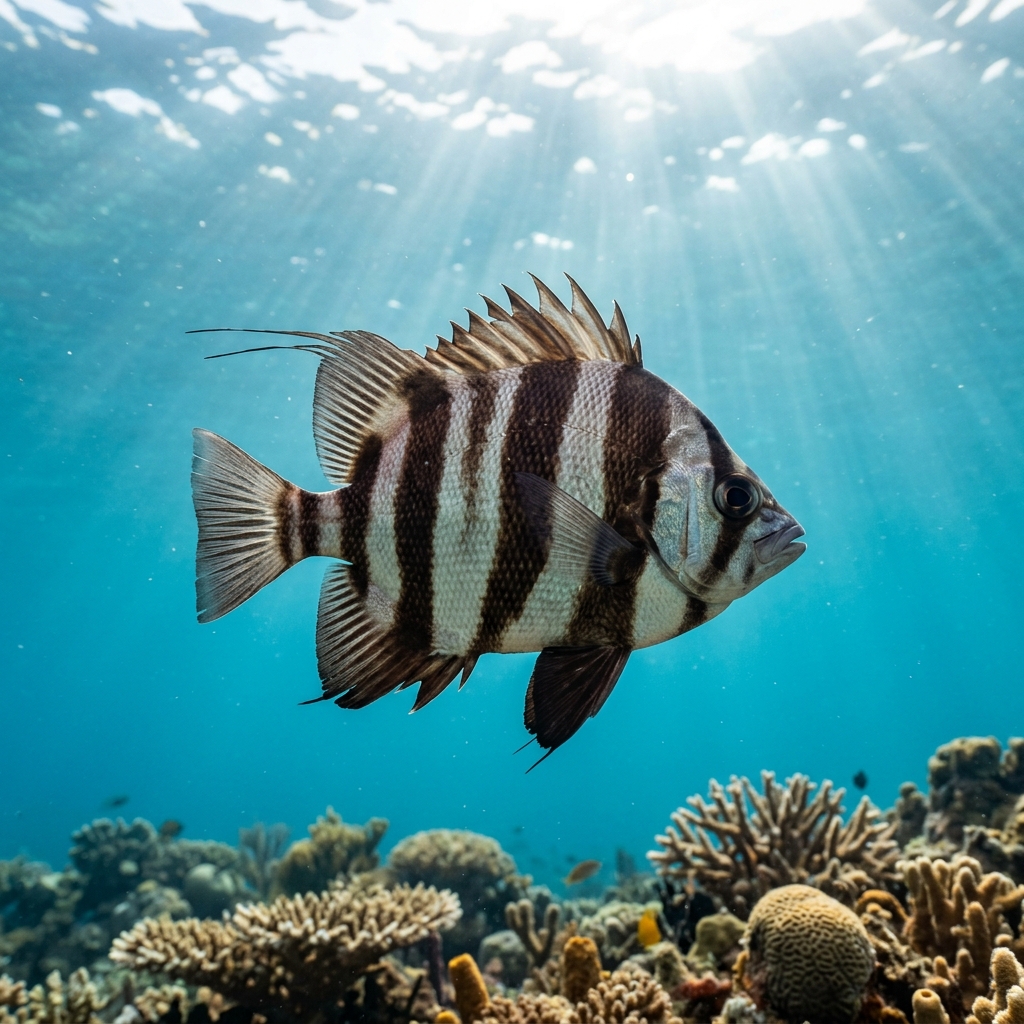
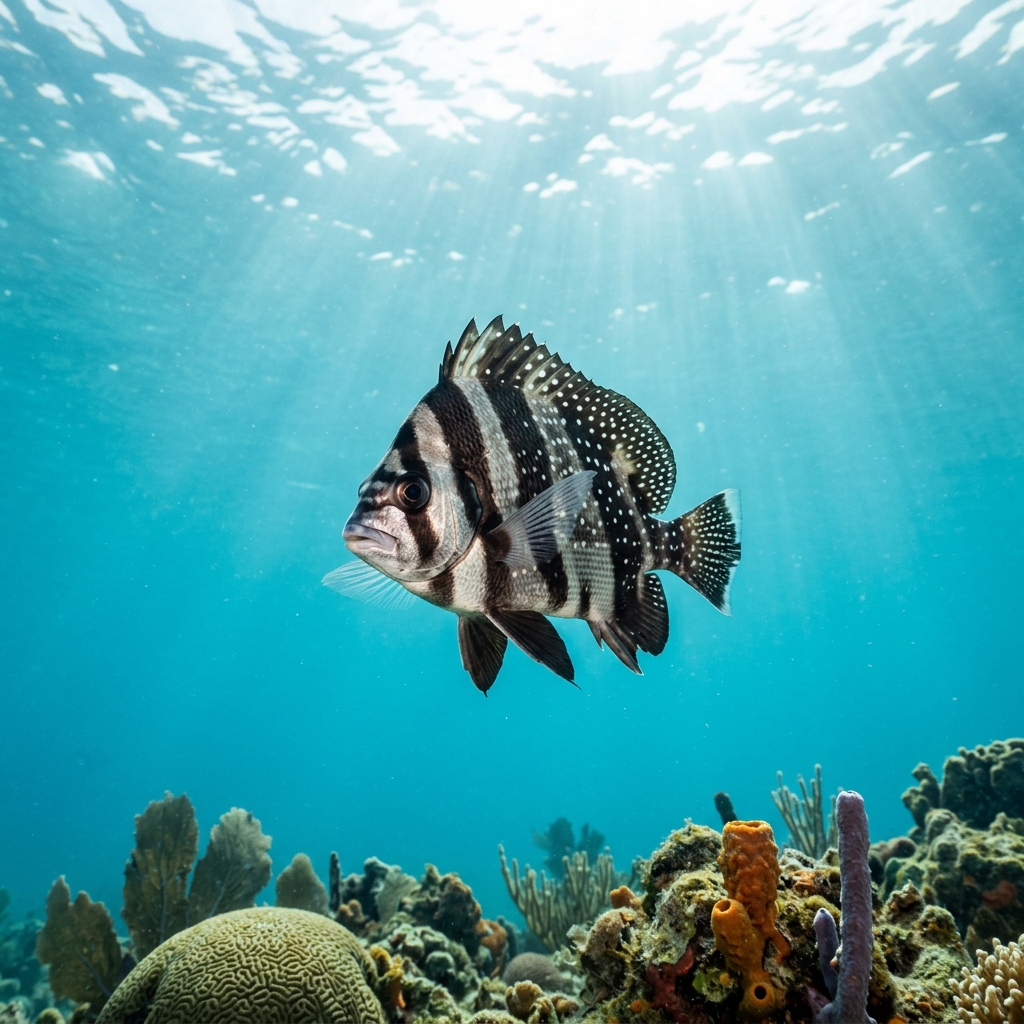
Bold black and white vertical stripes sweep across the head and elongated dorsal fin, while the rest of the body is creamy white scattered with distinct black spots. That impossibly tall first dorsal fin is the one feature that locks the ID underwater, no other common Caribbean fish carries it. Adults typically hover in the mid-water just off the reef structure, making them easy to approach and examine.
Spotted drums tend to hover close to the reef, often tucked under ledges or near coral heads, and are most commonly encountered during the day resting in sheltered spots. They move with a slow, undulating swim and are generally unbothered by divers who approach calmly. At dusk activity picks up as they emerge to feed, so the last dive of the day often yields the most animated views.
Juveniles are among the most recognisable fish larvae in the Caribbean: they carry an exaggeratedly long dorsal fin that can exceed their body length, which they wave as they drift near the reef in a behaviour thought to mimic the motion of a flatworm or nudibranch, a neat bit of predator misdirection.
Sighting data don't point to a narrow season, so this is effectively a year-round species on Caribbean reefs. Its observed water-temperature range of roughly 25 to 29 °C matches the consistent warmth of the tropical Caribbean throughout the year.
Virtually all recorded sites lie within the Caribbean basin, with the strongest presence in Cuba, particularly around Jardines del Rey and the Canarreos Archipelago, followed closely by Venezuela's Caribbean Coast, Colombia, and the Bahamas. The United States (Florida and the Southeast), Belize, Mexico's Yucatán Peninsula, and the Dominican Republic all have solid representation too, giving divers plenty of options across the region.
Mapping where Spotted Drum is logged…
Spotted drums are a Caribbean species through and through. Cuba, Venezuela, Colombia, and the Bahamas have the most recorded sites, with strong showings also in Florida, Belize, Mexico's Yucatán, and the Dominican Republic. Any healthy Caribbean reef dive is a reasonable bet.
They appear to be resident on Caribbean reefs year-round, consistent with their preferred water temperatures of around 25 to 29 °C, conditions the tropical Caribbean maintains in every season. No single peak month stands out in the data.
Look for that tall, dramatic first dorsal fin striped in black and white on the front half of the fish, with a white body covered in black spots towards the tail. No other common Caribbean reef fish combines stripes and spots in quite this way, making it one of the easier IDs on the reef.
Adults typically reach around 25 to 35 cm in length, though they often appear smaller when hovering in the shadows under a ledge. Their tall dorsal fin can make them look larger than they are at first glance.
Young spotted drums develop an extraordinarily elongated dorsal fin that can be longer than their entire body. The waving motion of this fin is thought to mimic a toxic flatworm or nudibranch, deterring predators from taking a closer look.
Site and sighting data is aggregated from diver logs, iNaturalist and GBIF. For taxonomy and conservation status:
Boarfish
936 sites