Mictyris longicarpus
Bright blue soldier crabs march across Queensland and NSW tidal flats, best found at low tide year-round in water around 18 to 25 C.
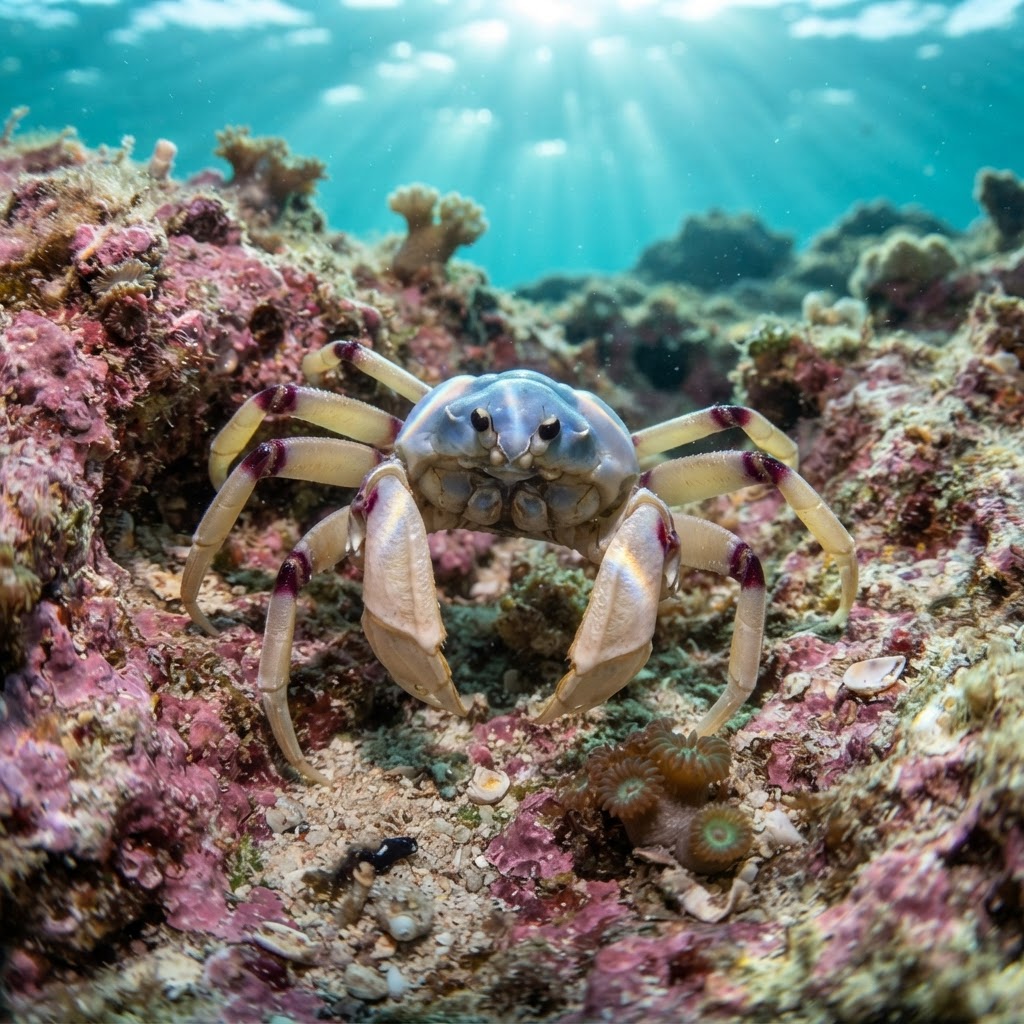
A small, rounded crab with a domed carapace usually in shades of blue-grey or slate, unlike the flatter, sideways-scuttling shape of most shore crabs. It walks forward rather than sideways, which is the single easiest giveaway underwater or on the flats. Look for it moving in loose groups across open sand rather than hiding under rocks or in burrows during the day.
Soldier crabs are famous for moving in dense, synchronised troops across exposed sand flats as the tide drops, giving the sand a rippling blue-grey sheen. They are shy of movement and will vanish into the sand almost instantly, spinning down like a corkscrew rather than digging a burrow first. Most encounters happen in shallow water or on wet sand rather than on a typical dive, since they surface to feed only when the flat is exposed.
Soldier crabs breathe partly through gills kept moist by trapped water and mucus, which lets them stay active out of the water on exposed flats for as long as the sand stays damp, something most marine crabs cannot manage.
Sightings do not show a clear seasonal pattern, and the observed water temperature range of roughly 18 to 25 C spans most of the year in the regions where it is found, so it is reasonably treated as a year-round species. Timing your visit to low tide matters far more than the month.
Logged almost exclusively in Australia, with the strongest records from Queensland and New South Wales. Sightings across these regions are mostly on shallow sand and tidal flats rather than at classic reef dive sites, so it is more of a snorkel and low-tide find than a deep-water encounter.
Mapping where Soldier Crab is logged…
Soldier crabs are most reliably found in Australia, particularly on tidal sand flats in Queensland and New South Wales. They are a shallow-water and low-tide species rather than a deep dive-site animal.
There is no strong seasonal pattern in the sighting data, so they can turn up any time of year in water from about 18 to 25 C. Timing a visit to low tide, when the sand flats are exposed, matters more than the season.
Look for a small, rounded, blue-grey crab walking forward in groups across open sand, rather than scuttling sideways like most crabs. Their habit of disappearing into the sand with a corkscrew twist is another quick tell.
They are a small crab, easily fitting in the palm of a hand, though exact size measurements were not confirmed in the available data.
They can survive out of water on exposed sand by keeping their gills moist with trapped water, letting them forage and march in groups on tidal flats long after the sea has pulled back.
Site and sighting data is aggregated from diver logs, iNaturalist and GBIF. For taxonomy and conservation status:
European Green Crab
2,469 sites