Monodactylus argenteus
Flat, silvery schools common in the Seychelles' Inner Islands and along Malaysia's east coast, year-round in warm shallow water.
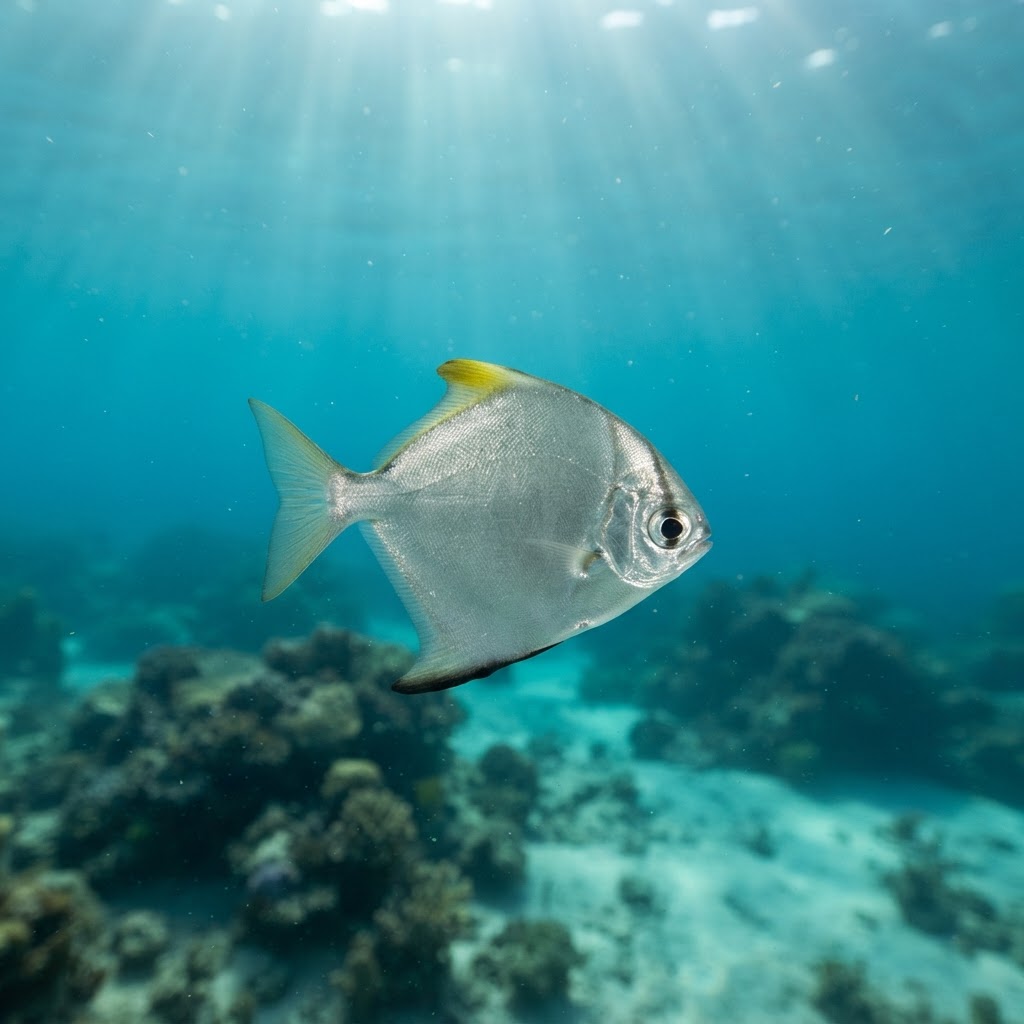
Look for a thin, disc-shaped body that's almost as tall as it is long, flattened side-to-side like a coin standing on edge. Colour is bright silver overall, often with a faint yellow-green wash near the head and dorsal fin, and the fins have a dark or dusky edge. They grow to around 18 cm and are usually seen in loose schools rather than alone, drifting in mid-water over shallow reef and sand.
Divers most often find them hovering in loose, unhurried schools over shallow reef flats, under jetties, or around sandy patches close to shore, rather than tight to the coral. They're generally unbothered by divers and will let you approach fairly close before drifting off as a group. Most sightings are in the shallows within 12 metres, often near structure that offers a bit of shelter from current.
That flattened, disc-like body isn't just for looks: it lets them turn almost on the spot and slip sideways through narrow gaps in reef structure and jetty pilings where a more torpedo-shaped fish couldn't manoeuvre.
No strong season shows up in the sighting data, and with a comfortable range of roughly 23 to 29 C, they're present on shallow tropical and subtropical reefs all year round.
Most reliably logged in the Seychelles' Inner Islands, along Australia's New South Wales and Queensland coasts, and on Malaysia's east coast peninsula. Also a regular find in Thailand, the Red Sea Riviera in Egypt, Muscat in Oman, and the UAE's East Coast.
Mapping where Silver Moony is logged…
They turn up widely across the Indo-Pacific, with the strongest sightings in the Seychelles' Inner Islands, along Australia's New South Wales and Queensland coasts, and Malaysia's east coast. Thailand, Egypt's Red Sea Riviera, Oman, and the UAE also log regular sightings.
There's no clear seasonal pattern in the sightings, and they tolerate a broad warm-water range of about 23 to 29 C, so they're seen on shallow reefs throughout the year.
Look for a thin, coin-shaped silver body, taller than it is long, with a faint yellowish tinge near the head and darker fin edges. They're usually spotted in loose schools hovering over shallow reef or sand rather than as lone fish.
They reach around 18 cm, making them a small to mid-sized reef fish that's easy to overlook individually but noticeable when schooling.
No. They're harmless, non-aggressive fish that tend to keep a loose distance from divers and pose no sting or bite risk.
Their extremely flattened, disc-shaped body lets them manoeuvre through tight reef gaps and jetty structure that most fish their size can't fit through, which is part of why they're so often found sheltering near pilings and reef edges.
Site and sighting data is aggregated from diver logs, iNaturalist and GBIF. For taxonomy and conservation status:
Soldierfish
3,612 sites