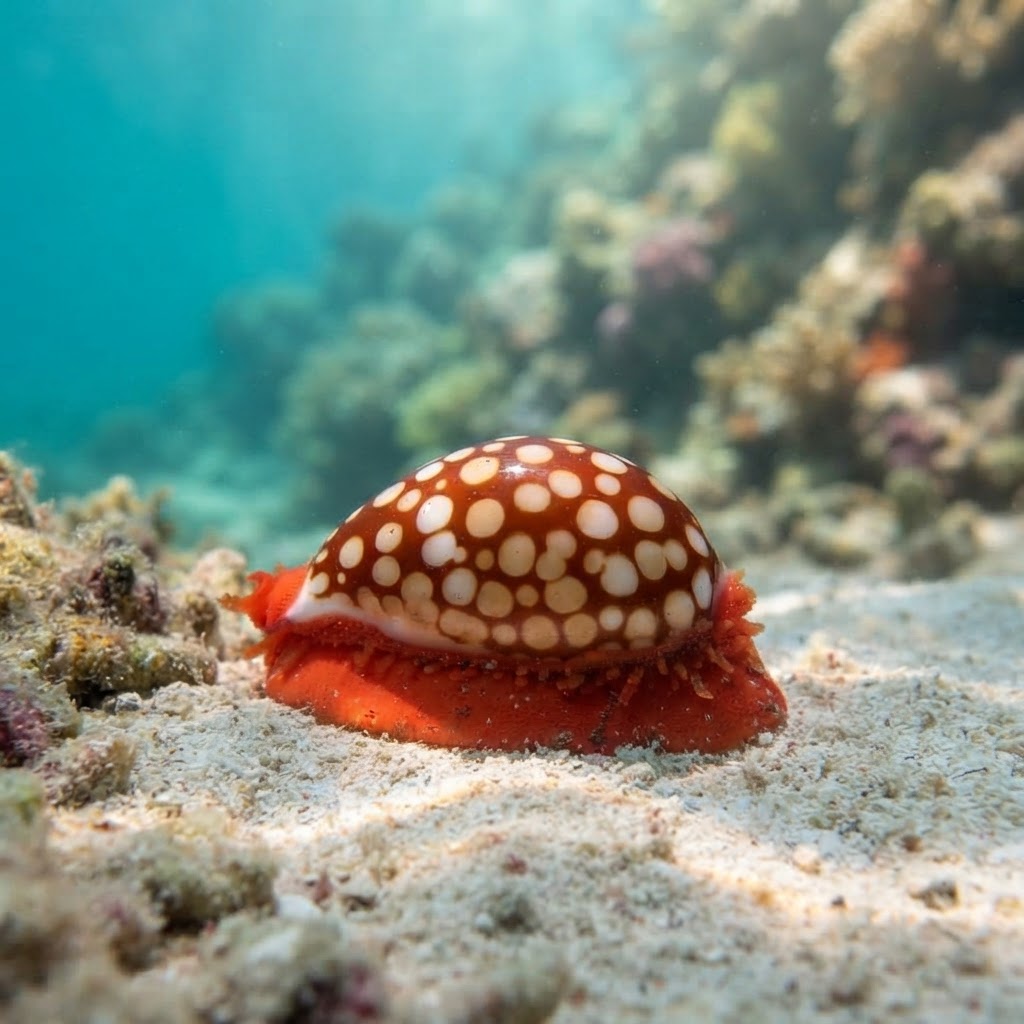
Cribrarula cribraria
Rare, pinhead-patterned cowrie logged mostly around Kwajalein Atoll, Marshall Islands, in warm 24-30C reef water year-round.
Small, glossy, oval shell rarely more than a couple of centimetres long, tan to pale brown with a scatter of small dark rings that give it a sieve-like, perforated look. The shell has the classic cowrie shape: smooth, humped back and a narrow ventral slit lined with tiny teeth. Its low profile and cryptic pattern mean it usually blends into rubble and coral rock rather than standing out.
Look for it tucked into crevices, rubble patches, or the undersides of coral rock during the day, when it is far less active. Like other cowries, it is a slow, night-active grazer, so daytime divers are mostly finding it at rest rather than moving. It shows no reaction to divers beyond withdrawing into its shell if disturbed.
Cowries like this one secrete a soft mantle that wraps up over the shell while they are active, which is what gives the polished, glossy finish typical of the family.
No clear seasonal pattern shows in the data, and water temperatures at recorded sites range from 23.6 to 29.6C, comfortable year-round on tropical reefs, so there is no known best month to target it.
Most records come from Kwajalein Atoll in the Marshall Islands, which accounts for nearly all logged sightings and is by far the most reliable place to look for it. A single confirmed sighting also comes from Queensland, Australia, so it is worth watching for on Great Barrier Reef sites too, though far less consistently.
Mapping where Sieve Cowrie is logged…
It is most reliably logged around Kwajalein Atoll in the Marshall Islands, with a single sighting reported from Queensland, Australia. Outside these areas it has not been documented, so Kwajalein is the strongest bet.
There is no detected seasonal pattern, and it sits in water between 23.6 and 29.6C, so it can turn up on tropical reefs at any time of year.
Look for a small, glossy, oval shell with a tan to pale brown base covered in scattered dark rings, giving it a sieve-like texture. It usually sits low in rubble or under coral rock rather than out in the open.
Exact size data is not confirmed for this species, but like most members of the cowrie family it stays small, typically only a few centimetres at most.
Yes, most divers who log it describe it as a rare find, with only a handful of sites reporting it as uncommon or common. Patience and slow, close looking at rubble and crevices improve your odds.
Site and sighting data is aggregated from diver logs, iNaturalist and GBIF. For taxonomy and conservation status:
Triton Shell
2,297 sites