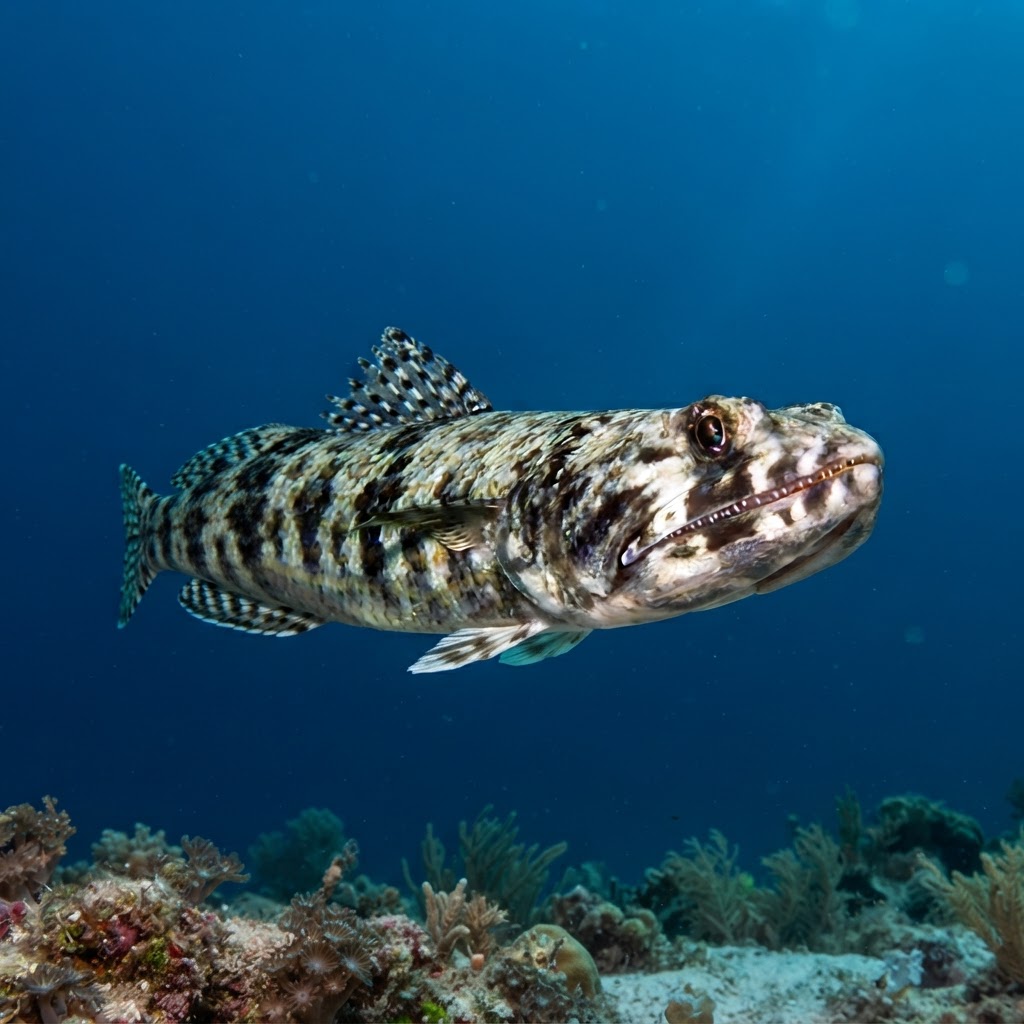
Synodus intermedius
Mottled and motionless on the sand in Bonaire's Leeward Coast or Honduras' Bay Islands, year-round in water from 17 to 27C.
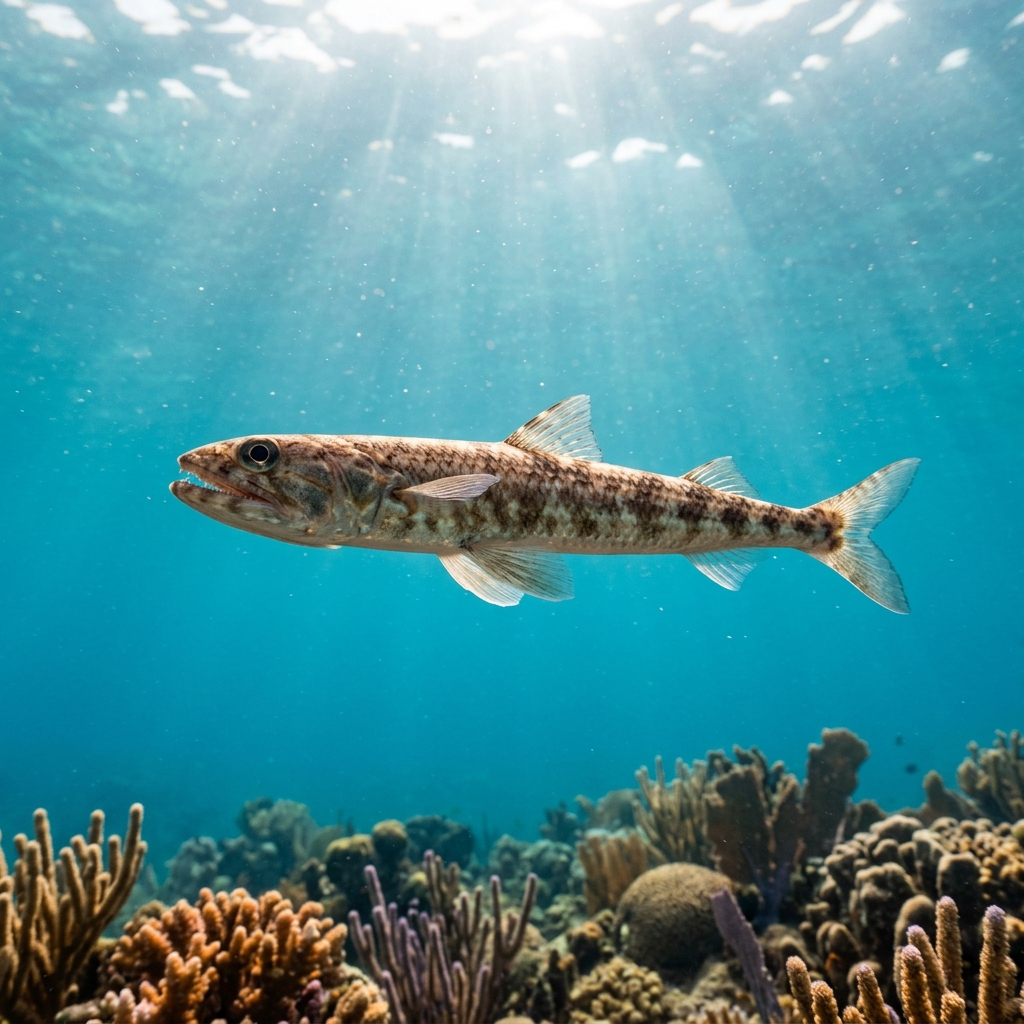
Cylindrical, torpedo-shaped body up to about 32cm, propped up on its lower fins as it rests on open sand or rubble patches near reef. Mottled tan, brown and cream blotchy pattern that breaks up its outline against the seabed, with a pointed, reptilian-looking snout and a mouth full of visible small teeth. Usually seen lying dead still rather than swimming, which is often the biggest tell versus other bottom-dwellers.
Spends most of its time propped motionless on sand or rubble, blending into the bottom while it waits for small fish to wander within range. Divers usually notice it only when it finally bolts a short distance and resettles, or when a torch beam catches its eyes on a night dive. It tends to hold its ground rather than flee far, so slow, careful approaches often get you a close look.
It hunts by ambush rather than active pursuit, relying on camouflage to stay invisible on open sand until prey drifts close enough for a short, explosive strike.
No clear seasonal pattern shows up in sightings, and it turns up across a wide temperature range from about 17 to 27C, so it's a year-round find on Caribbean reefs.
Most reliably logged in the Bay Islands of Honduras and along Bonaire's Leeward Coast, with strong numbers also in the US Virgin Islands, Grenada, Colombia's Caribbean coast, Mexico's Yucatán Peninsula, the British Virgin Islands and Curacao. Look on sand patches, rubble flats and the open ground between reef structures rather than on the coral itself.
Mapping where Sand Diver is logged…
It's most commonly reported in Honduras' Bay Islands and along Bonaire's Leeward Coast, with good numbers also in the US Virgin Islands, Grenada, Colombia, Mexico's Yucatán Peninsula and the British Virgin Islands. Check sandy patches and rubble zones near the reef rather than the coral structure itself.
There's no strong seasonal pattern in sightings, and it's found across a wide temperature range from roughly 17 to 27C, so it can be spotted on Caribbean reefs at any time of year.
Look for a slim, torpedo-shaped fish around 32cm long, lying propped on sand or rubble with a mottled tan and brown pattern and a pointed snout. Its stillness is often the giveaway, most fish this shape are swimming, not lying on the bottom.
They typically reach around 32cm in length, a slender build that keeps them low-profile and easy to miss against sand.
No, they pose no threat to divers and simply rely on camouflage and stillness to avoid attention.
Rather than chasing prey, it lies motionless on the seabed using its mottled pattern as camouflage, then makes a short, fast strike when a small fish comes within range.
Site and sighting data is aggregated from diver logs, iNaturalist and GBIF. For taxonomy and conservation status:
Soldierfish
3,612 sites