Holacanthus tricolor
Spot the rock beauty's bold black-and-yellow pattern on Caribbean reefs from the Yucatán to Bonaire. Sightings peak Jul, Mar in 25-28 °C water.
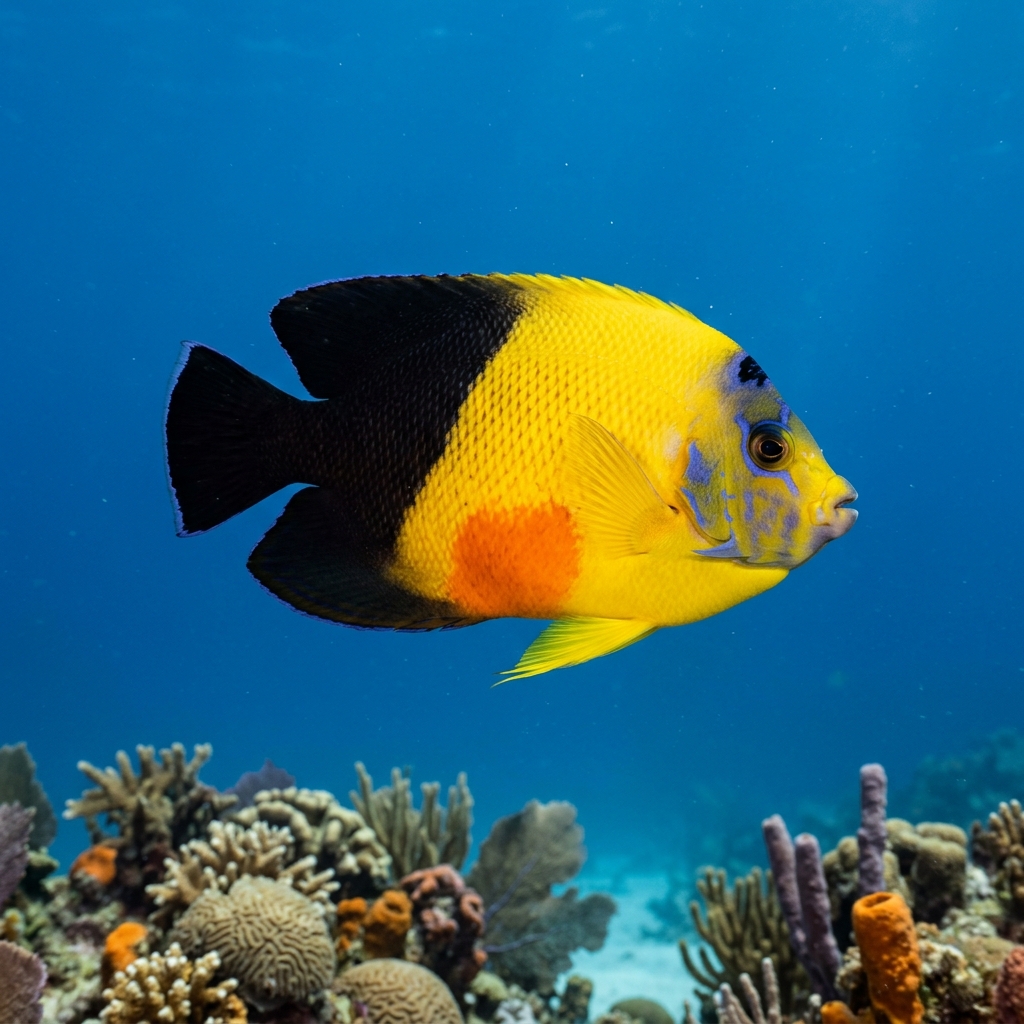
A medium-sized angelfish, around 24 cm, with a colour scheme that does all the work: the front third of the body and the tail are bright yellow, while the rear two-thirds are deep black, creating one of the most graphic contrasts on the Caribbean reef. The face is yellow-orange with blue trim around the eyes and along the fins. That bold yellow-black split is unique among Caribbean angelfishes, making confident ID quick even at a distance.
Rock beauties are active during the day, foraging along the reef and defending a patch of territory with enough confidence that you may catch them nipping at fish that stray too close. They are shy around divers, and a direct or fast approach will send them straight into the coral, so slow down, hover calmly, and let the fish settle. With patience they resume feeding and give excellent views.
Unusually for a carnivorous angelfish, sponges make up a significant part of the rock beauty's diet, an ability most reef fish lack because sponge tissue is chemically defended and low in nutrition.
Northern Hemisphere sightings concentrate from July through March, covering the warmer summer months and continuing through the winter dive season in the Caribbean. The species favours water between roughly 25 and 28 °C, which aligns with typical conditions at its top Caribbean sites across those months.
Most consistently logged across the Caribbean and western Atlantic, with the strongest coverage in the Yucatán Peninsula, the Florida coast, Roatán in Honduras, Grand Cayman, and Grenada Island. Bonaire is another reliable destination, with strong numbers around Klein Bonaire in particular. Sightings also extend into the northeast coast of Brazil and throughout the British Virgin Islands.
Mapping where Rock Beauty is logged…
Rock beauties are most reliably found on Caribbean reefs. Top destinations include the Yucatán Peninsula, Roatán in Honduras, Grand Cayman, Bonaire, Grenada, the Bahamas, and the Florida coast. Sightings are also recorded along the northeast coast of Brazil and throughout the British Virgin Islands.
Based on logged sightings in the Northern Hemisphere, July through March offers the most reliable encounters. This spans the Caribbean summer and the popular winter dive season, when water temperatures sit in the 25-28 °C range the species favours.
Look for the unmistakable split: the head, pectoral area, and tail are vivid yellow while the large mid-body section is solid black. No other Caribbean angelfish shares this pattern. The face shows blue accents around the eyes. At around 24 cm it is a medium-sized fish, easy to notice against the reef.
Adults typically reach around 24 cm in length, making them a mid-sized Caribbean angelfish. They have a deep, rounded body shape that makes them look bulkier than that length suggests when you spot them on the reef.
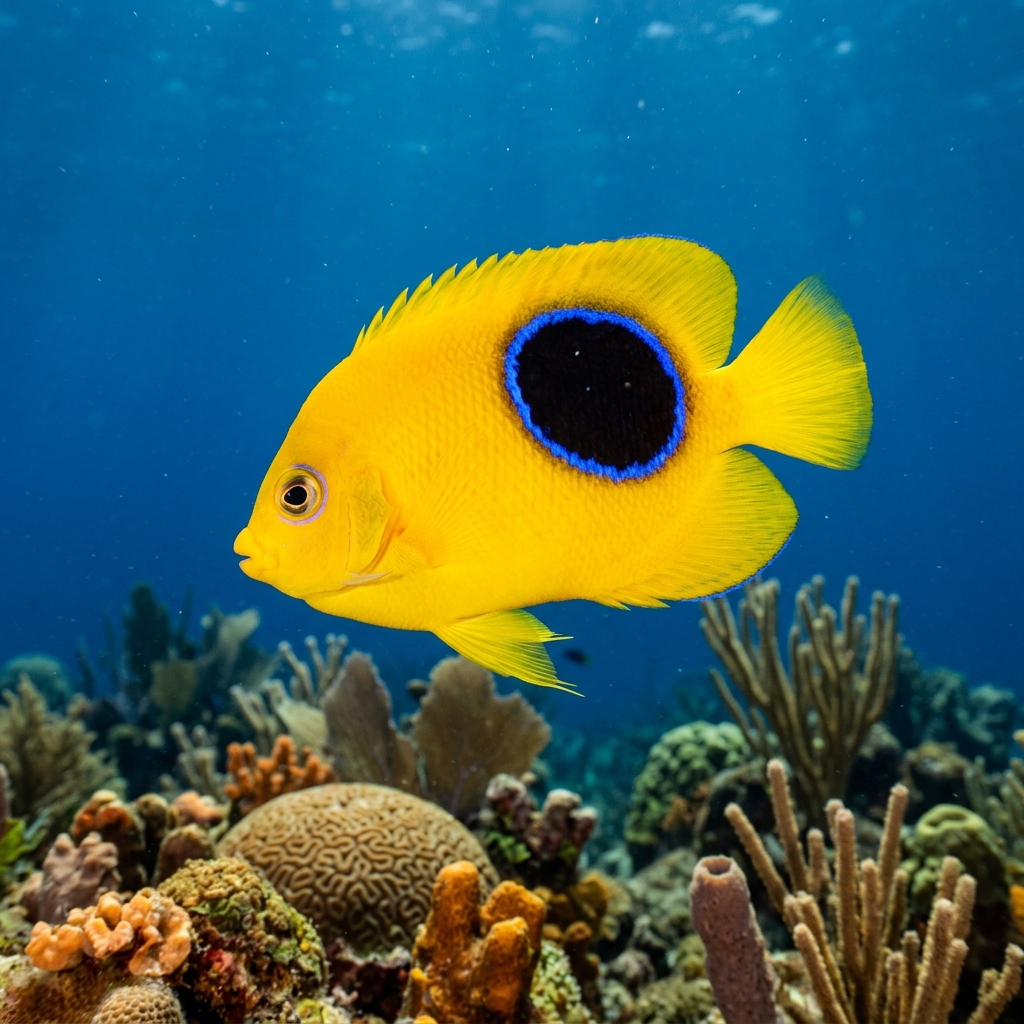
Juveniles look dramatically different from adults: they are mostly bright yellow with a single large black spot edged in iridescent blue on the upper rear body. As the fish grows, that spot expands to cover most of the body, eventually producing the classic adult pattern.
Site and sighting data is aggregated from diver logs, iNaturalist and GBIF. For taxonomy and conservation status:
Pearl-scaled Angelfish
1,326 sites