Pygoplites diacanthus
Spot the regal angelfish on Red Sea and Maldives reefs year-round. Bold orange, white, and blue banding makes it one of the most recognisable angelfish underwater.
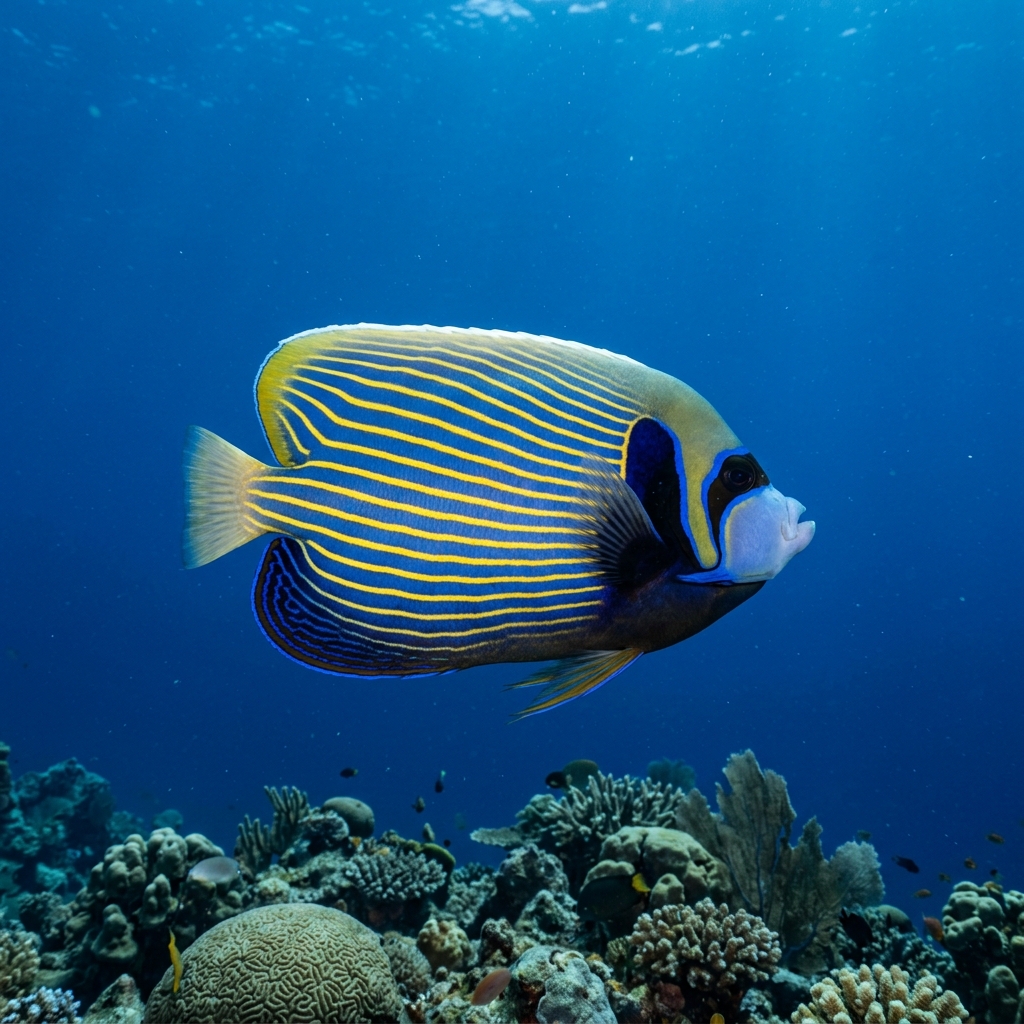
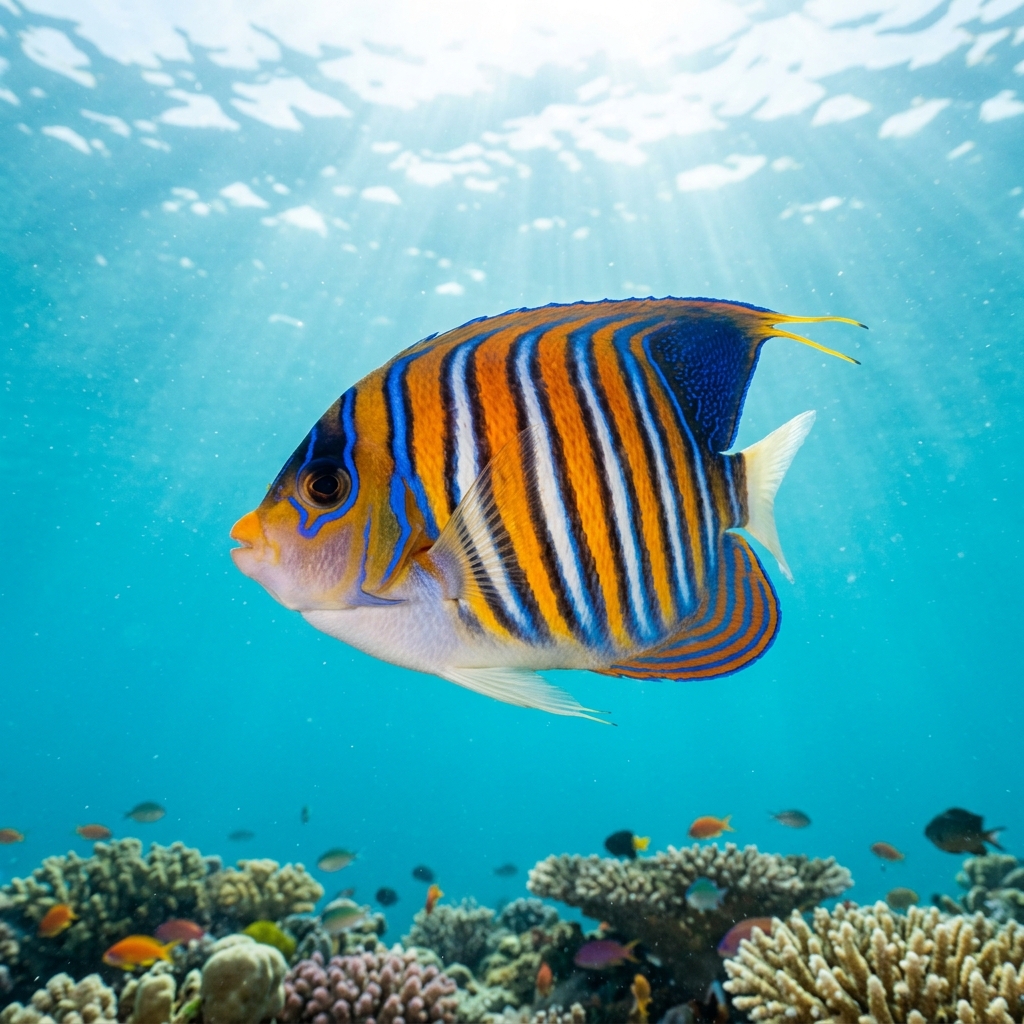
Bold vertical bands of bright orange and white, each white band edged in vivid blue, make this one of the easier angelfish to name on sight. The rear portion of the body transitions to yellow, and the dorsal fin carries a distinctive blue-and-yellow trailing edge. Body shape is the classic deep, compressed oval of the larger angelfishes. Juveniles share the same banding pattern as adults but sport a prominent false eye-spot (ocellus) near the base of the dorsal fin, which fades as the fish matures.
You'll typically find regal angelfish patrolling coral-rich sections of the reef at moderate depths, often picking at sponges and tunicates along overhangs and walls. They tend to be somewhat wary of divers, ducking into coral structure when approached directly, so hovering quietly at a slight distance usually rewards patience with a closer look. Solitary individuals are the norm, though pairs are occasionally seen.
Regal angelfish are obligate sponge-feeders in the wild, meaning they rely heavily on live sponges and tunicates rather than algae. This diet makes them famously difficult to sustain in home aquaria, and wild-caught individuals often decline without a carefully matched food source.
In the Northern Hemisphere it is present year-round with no concentrated season, which fits its preference for warm tropical water in the 23 to 29 °C range. Southern Hemisphere sightings concentrate across August through June, with a quieter period around July.
Most consistently logged across Egypt's Red Sea, particularly around Sharm el Sheikh and Marsa Alam, and throughout the Maldives' Male and Ari Atolls. Strong populations are also recorded in the Central Visayas of the Philippines and across Indonesia, with reliable sightings in Palau, French Polynesia, and Sipadan in East Sabah, Malaysia.
Mapping where Regal Angelfish is logged…
The Red Sea is the standout destination, with Sharm el Sheikh, Marsa Alam, and Safaga all producing regular sightings. The Maldives' Male and Ari Atolls are equally reliable, and the Central Visayas in the Philippines, Palau, and Sipadan in Malaysia all have solid records.
In the Red Sea, Maldives, and other Northern Hemisphere sites they can be encountered year-round, with no single peak season. For Southern Hemisphere locations, sightings are strongest from August through to June.
Look for the repeating pattern of bright orange and white vertical bands, each white band rimmed in electric blue. The rear body and caudal fin are yellow. No other angelfish in its range shares this exact combination, making it one of the more straightforward ID calls on a tropical reef.
Regal angelfish typically reach around 25 cm in length as adults, making them a medium-sized member of the angelfish family. Underwater they appear noticeably deep-bodied relative to their length.
They are specialised feeders on sponges and tunicates, grazing along reef walls and overhangs. This obligate sponge diet is a key part of their reef ecology and explains why they are most often seen working vertical reef structure rather than open sandy areas.
Site and sighting data is aggregated from diver logs, iNaturalist and GBIF. For taxonomy and conservation status:
Pearl-scaled Angelfish
1,326 sites