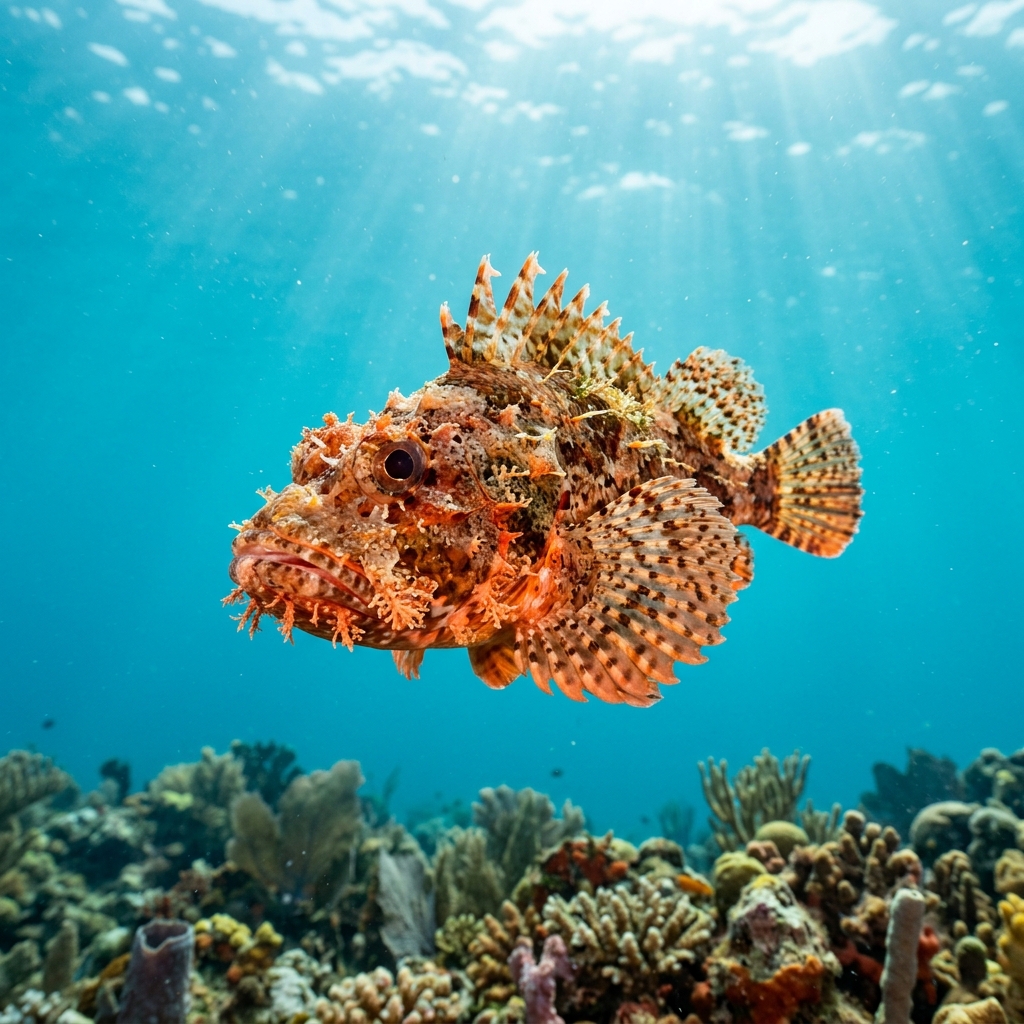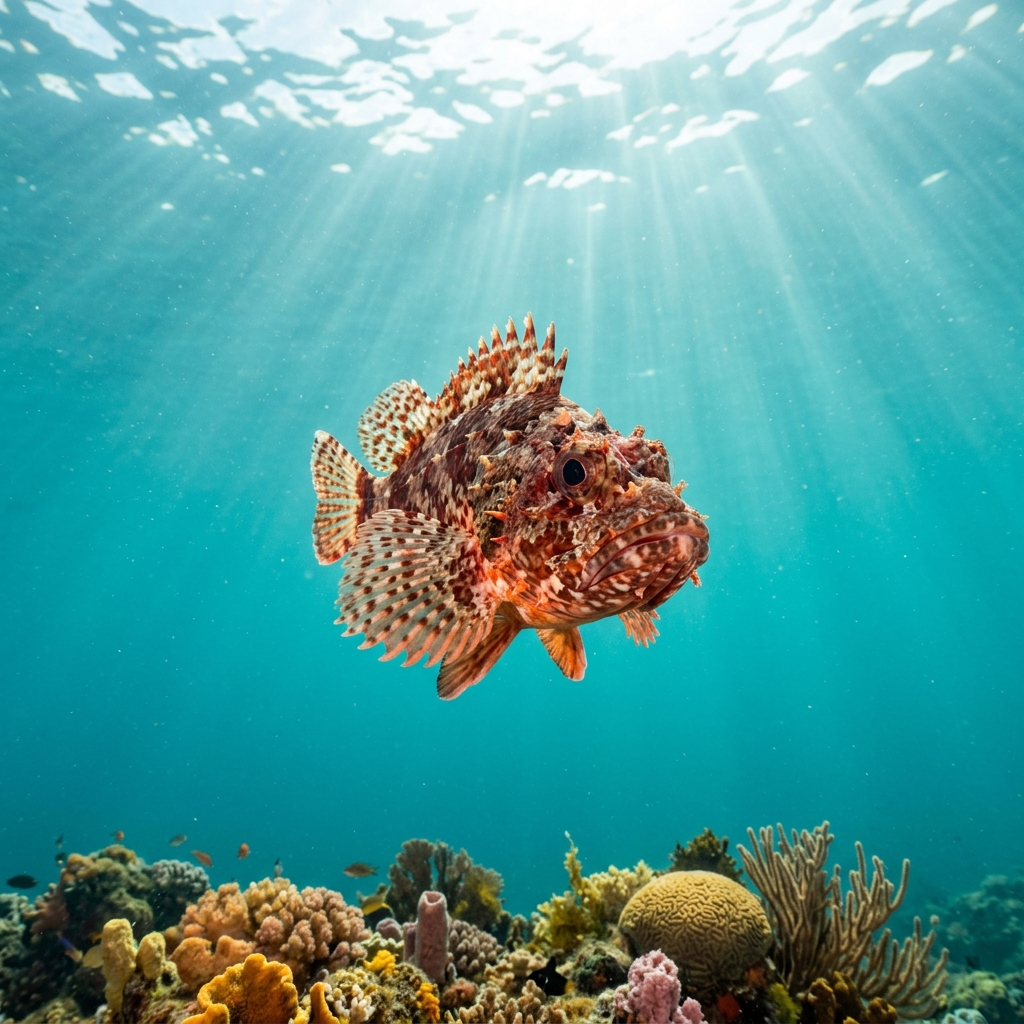
Synanceia verrucosa
Spot the world's most venomous fish across Indonesian, Maldivian and Philippine reefs. Northern Hemisphere sightings peak Mar, Jul in 24-29 °C water.
Safety warning
The spines carry venom and snap off easily in the skin. Do not touch it, and never rest a hand or knee on the reef near one; the spines drive in on the lightest contact.
If you're stung
Venomous spinesGeneral first-aid guidance, not a substitute for professional medical care. In an emergency, call your local emergency number.
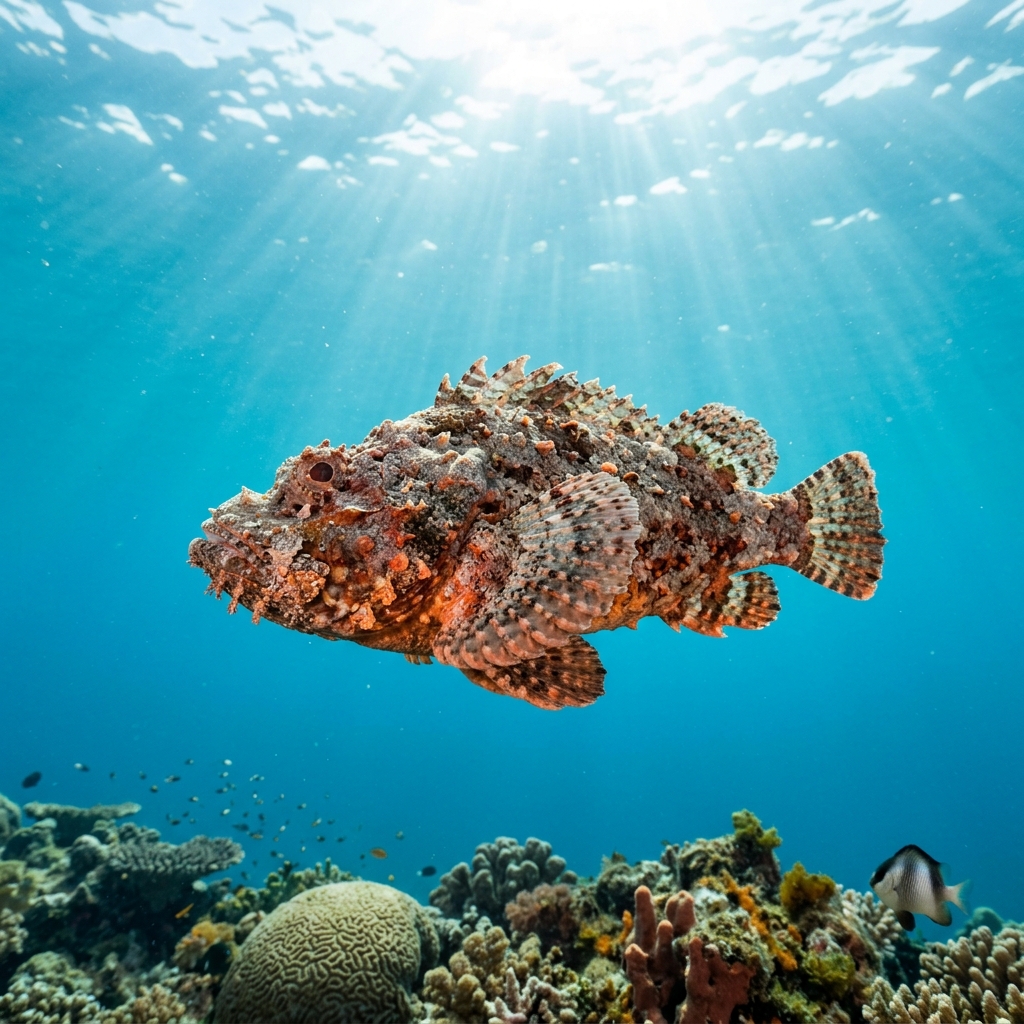
Camouflage is the whole game: a stocky, flattened body covered in warty lumps and irregular patches of brown, red, grey, and orange that mimic encrusted reef rubble so closely that even experienced divers look straight past it. The giveaway is the large, upward-facing mouth, set in a face that looks almost comically grumpy, and a row of thirteen sharp dorsal spines visible when the fish is at rest. It rarely moves when a diver approaches, relying entirely on its disguise rather than flight.
Reef stonefish spend most of their time completely stationary on the bottom, tucked against rubble, coral heads, or sandy patches where their texture and colour match the surroundings perfectly. When approached by a diver they almost never flee; instead they may press closer to the substrate or do nothing at all, which is exactly what makes them so easy to miss and so important to spot deliberately. They are ambush predators, lunging at small fish and crustaceans that wander within range, but that strike is rarely witnessed on a casual dive.
Those thirteen dorsal spines are each sheathed in a venom gland, and the venom is considered the most potent of any fish. The spines do not inject actively; pressure from a foot or a hand pushes the sheath down and forces venom up the spine, meaning the fish poses essentially zero risk to a diver who keeps their hands off the reef and watches where they put their fins.
Northern Hemisphere sites show sightings concentrated between March and July, so that window is the best bet for destinations like the Maldives, Philippines, and Thailand. The species' warm-water niche of roughly 25 to 29 °C means it is present on tropical reefs throughout the year at equatorial sites.
Most consistently logged across Indonesia, the Maldives, and the Philippines, with strong representation through Thailand, Australia, and Malaysia as well. Within those countries, the North and Central Atolls of the Maldives, Queensland in Australia, and the Visayas and Palawan regions of the Philippines stand out as particularly reliable areas. Mozambique and French Polynesia round out a range that spans the warm Indo-Pacific.
Mapping where Reef Stonefish is logged…
The reef stonefish is most commonly logged in Indonesia, the Maldives, and the Philippines, with solid records from Thailand, Australia, Malaysia, Mozambique, and French Polynesia. Top regional spots include the North and Central Atolls of the Maldives, Queensland in Australia, and Palawan and the Visayas in the Philippines.
At Northern Hemisphere sites such as the Maldives and Philippines, sightings cluster between March and July. At equatorial or Southern Hemisphere destinations, the species' preference for 25-29 °C water means it is present year-round, so any time suits.
They carry the most potent venom of any fish, delivered through dorsal spines when pressure is applied. For a diver who avoids touching the reef and watches fin placement, the practical risk is very low. The danger is almost always accidental contact in shallow water, not a fish that seeks out divers.
Look for a squat, motionless lump on rubble or sandy reef that, on closer inspection, has a large upturned mouth and a row of raised dorsal spines. The warty, mottled skin in browns, reds, and greys is the defining feature; it blends so well that the upward-facing eyes and frowning mouth are often the first details a diver picks out.
Reef stonefish typically reach around 30-40 cm in length, though the data for this entry does not specify a confirmed typical size. Underwater they look compact and thick-bodied, more like a knobbly rock than a fish until you notice the face.
Each of the thirteen dorsal spines is enclosed in a sheath connected to a pair of venom glands. When something presses down on a spine, the sheath slides back and forces venom up grooves in the spine and into whatever is pressing on it. The fish does not strike with its spines; every envenomation is the result of something pressing onto the fish, not the other way around.
Site and sighting data is aggregated from diver logs, iNaturalist and GBIF. For taxonomy and conservation status:
Madeira Rockfish
2,773 sites