Limacia lucida
A small white nudibranch with orange-tipped gills, most reliably logged on Western Cape reefs in cool 14-20C water.
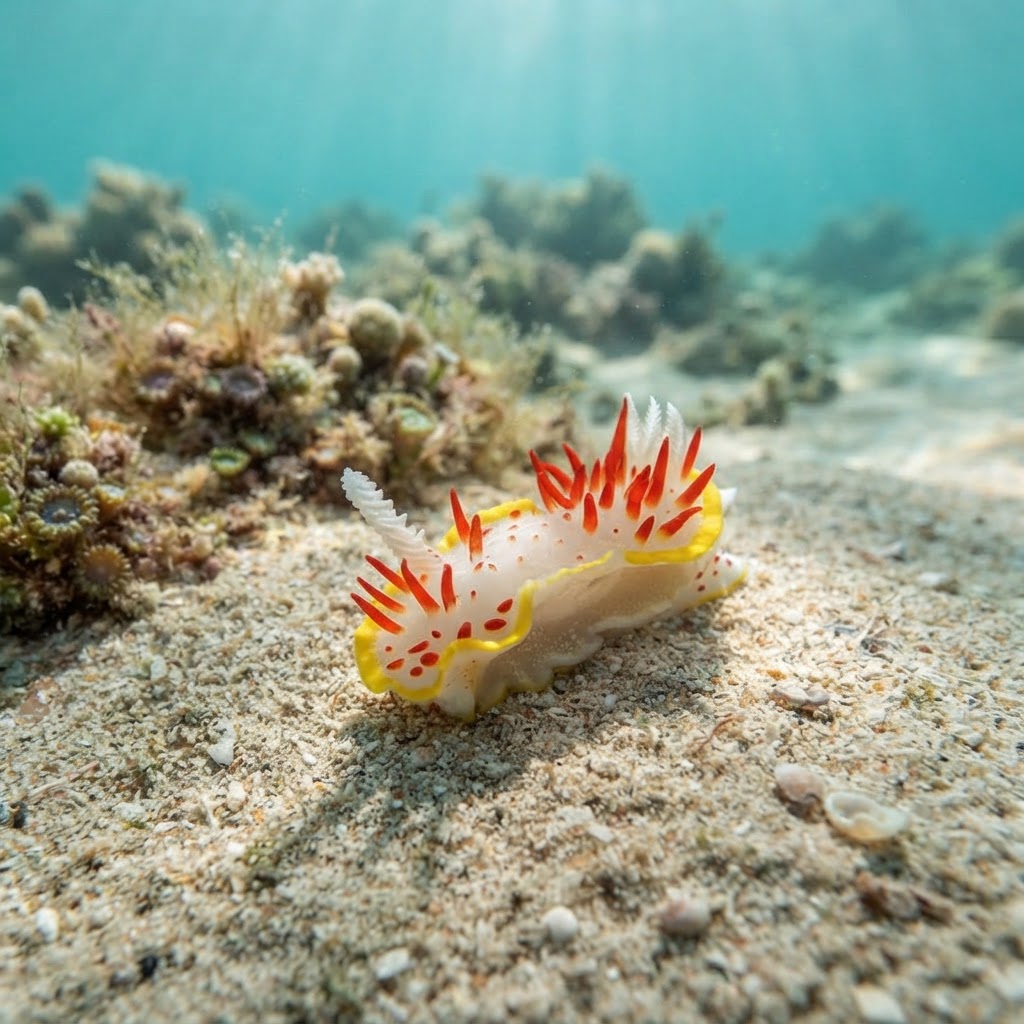
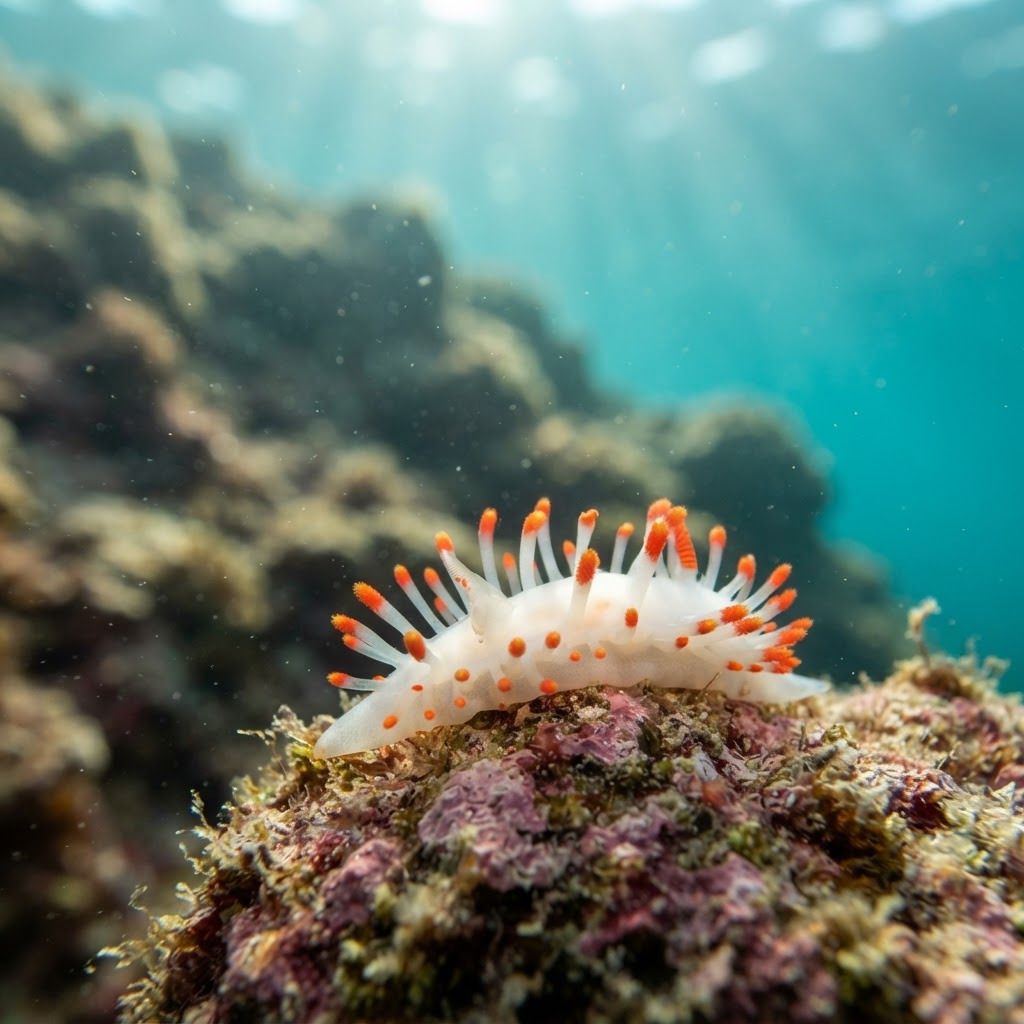
Look for a small, slender, translucent white body with rows of raised orange or yellow-tipped bumps (called tubercles, small skin projections) running along the back. The gills and the rhinophores (the paired sensory tentacles on the head) carry the same orange clubbed tips, which is the giveaway against the plainer white species it shares reefs with. It moves slowly across rock and rubble and rarely reaches more than a couple of centimetres, so a slow eye and a torch help.
Found grazing slowly over encrusting sponges and bryozoans on rock and rubble, usually tucked into cooler, current-washed reef rather than open sand. It shows no reaction to divers beyond continuing its crawl, so a patient close look with a torch is the best way to pick out the orange-tipped gills against the white body. Most reports come from divers working slowly along reef walls rather than mid-water.
Like other dorid nudibranchs, it feeds on sponges and related encrusting invertebrates, and the bright tubercle tips are thought to signal a chemical defence borrowed from that diet rather than being purely decorative.
Sightings don't show a clear season, so treat it as a year-round find on Western Cape reefs. The water there sits in the 13.7 to 19.7C range this species favours, which is consistent with the cool water diving on offer through most of the year.
Reef neighbours a diver could mistake it for. Use the identification notes above to tell them apart.
This one is very much a Western Cape speciality: every logged sighting comes from South Africa, concentrated in the Western Cape region. If you are searching temperate reefs and kelp-forest sites around that coastline, this is one of the small nudibranchs worth checking rock faces and rubble patches for.
Mapping where Reef Orange-clubbed Dorid is logged…
Almost all logged sightings are from South Africa's Western Cape, making it a reef find specific to that region's cool-water dive sites rather than something you'll see on tropical reefs.
There's no strong seasonal pattern in the sightings, so it's considered a year-round find in the Western Cape, where water temperatures sit in the 14 to 20C range it's usually recorded in.
Look for a small translucent white nudibranch with orange or yellow-tipped tubercles along its back and matching orange-tipped gills and rhinophores. It moves slowly over rock and rubble, so a close, patient look is needed to spot the coloured tips.
Exact size data isn't available, but like most dorid nudibranchs in its family it stays small, typically a couple of centimetres or so, and is easy to miss without a torch and a close look at the reef surface.
No, it poses no risk to divers. It's a small, slow-moving grazer that can be observed safely at close range without disturbing it.
Site and sighting data is aggregated from diver logs, iNaturalist and GBIF. For taxonomy and conservation status:
Blue Dragon
3,163 sites