Procambarus clarkii
Reddish freshwater crayfish turning up in Zeeland canals and Carinthia lakes, active in cool water from 10.5 to 18.8 C.
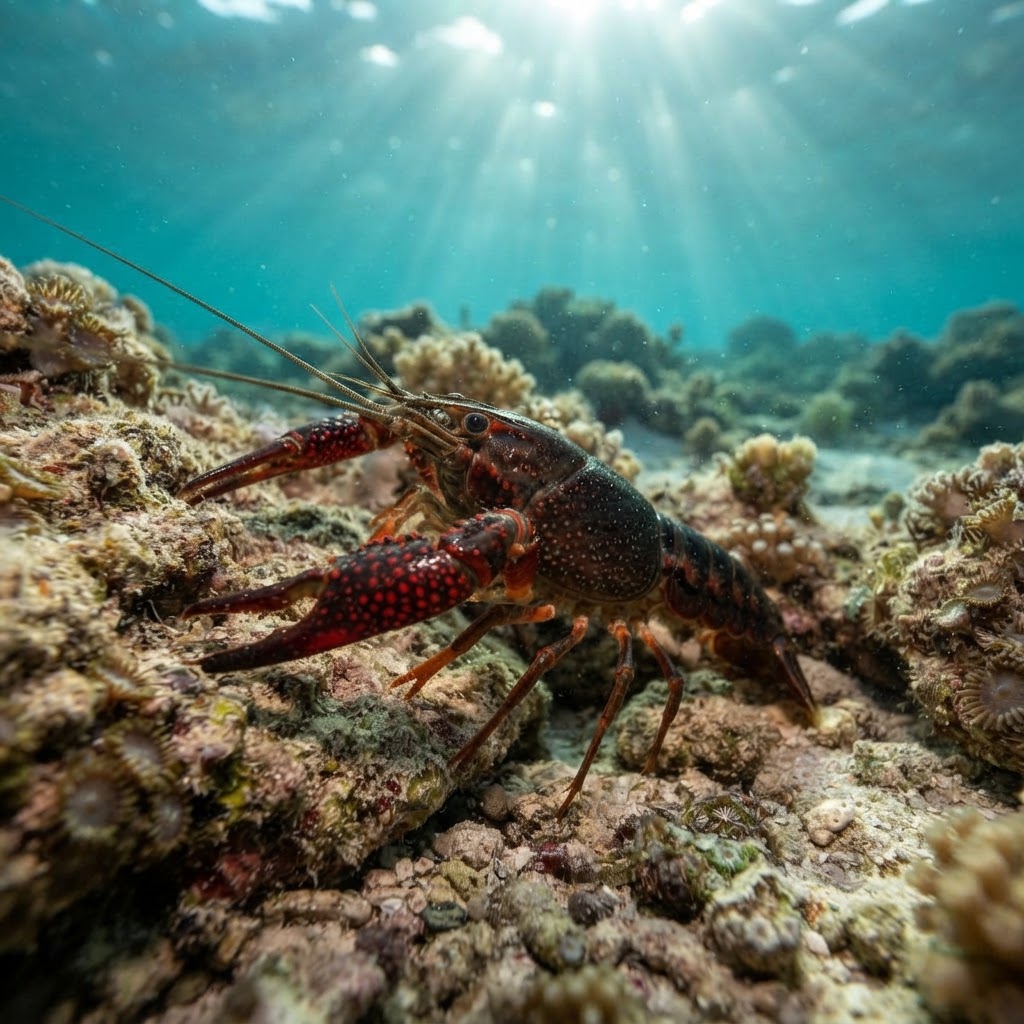
A reddish-brown to brick-red crayfish with long, narrow claws edged in a darker red, usually spotted crawling along silt or gravel bottoms rather than swimming. Body length is modest, well under a diver's hand span, with a hard segmented tail and prominent antennae longer than the body itself. Look for the raised, warty texture on the claws, which is a decent giveaway even in low visibility.
Divers typically find it walking slowly across the bottom of lakes, canals and slow rivers, often near submerged vegetation or debris where it can retreat if disturbed. It is not a fast mover and tends to hold its ground or back away rather than flee, which makes for easy, if brief, close-up viewing. Most sightings are single individuals rather than groups, and it is logged as uncommon at the majority of sites rather than something you can count on every dive.
Native to the Mississippi River basin, this crayfish has established wild populations across Europe and beyond, largely through the aquarium and stocking trade, making it one of the most widely introduced freshwater crustaceans divers encounter outside its home range.
No clear seasonal pattern shows up in the sighting data, so treat it as a year-round find wherever it is established. It has been logged in water from about 10.5 to 18.8 C, a range that covers much of the temperate diving season in these regions.
Most reliably logged in freshwater sites across the Netherlands, especially Zeeland and Gelderland, and in the lakes of Carinthia, Austria. It also turns up in Texas in the United States, the Algarve in Portugal, and around Sao Miguel and Santa Maria in the Azores.
Mapping where Red Swamp Crayfish is logged…
Zeeland and Gelderland in the Netherlands and Carinthia in Austria are the strongest areas, with further sightings in Texas, the Algarve, and the Azores.
There is no strong season in the sighting data, so it is worth looking for year-round in the temperate lakes and canals where it lives, generally in water between 10.5 and 18.8 C.
Look for a reddish-brown body with darker red, warty-textured claws, moving slowly across silt or gravel rather than swimming. Its long antennae and hard, segmented tail help distinguish it from other freshwater invertebrates.
No, they pose no danger to divers. They are slow-moving bottom dwellers that will retreat or hold still rather than approach, so there is nothing to worry about if you come across one.
No, it originates from the Mississippi River basin in the United States and has spread widely across Europe, including the Netherlands, Austria and Portugal, through introductions linked to the aquarium and stocking trade.
Site and sighting data is aggregated from diver logs, iNaturalist and GBIF. For taxonomy and conservation status:
Caribbean Spiny Lobster
2,209 sites