Procambarus virginalis
Spot marbled crayfish in Central Germany and Berlin & Brandenburg. Rare freshwater sightings with a remarkable biology story every diver should know.
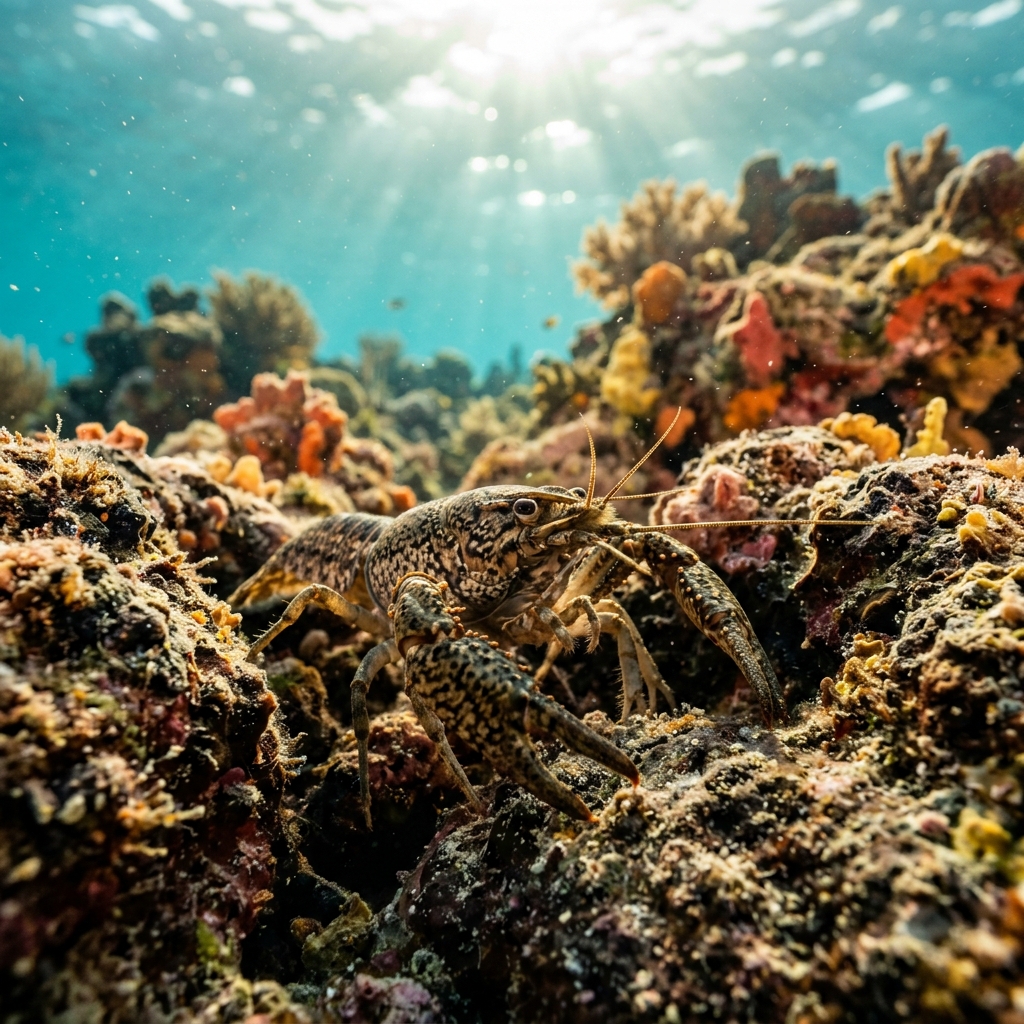
A small freshwater crayfish with a distinctly mottled, marbled pattern of olive, brown, and grey across the carapace (the hard upper shell) and claws, which gives the animal its name. Body form is typical of crayfish: a broad, segmented abdomen, two prominent claws held forward, and long antennae. Underwater the marbled patterning is the key ID feature, setting it apart from plain-coloured freshwater crayfish species found in the same waters.
Marbled crayfish are typically found crawling along the bottom substrate in freshwater environments, foraging among leaf litter, rocks, and aquatic vegetation. They tend to be most active after dark and will often retreat under cover when approached. Divers who move slowly and scan the substrate carefully, particularly around sheltered hiding spots, stand the best chance of a sighting.
Marbled crayfish reproduce entirely by parthenogenesis, meaning every individual is female and each one can produce clones of itself without mating. This makes it one of the only known decapod crustaceans to reproduce this way, and it is the reason populations can establish rapidly from a single animal.
There is not enough monthly sighting data to point to a peak season, so it can be treated as a year-round possibility wherever suitable freshwater sites are accessible.
All logged sightings come from Germany, making it effectively a German speciality for divers. The overwhelming majority of records come from Central Germany, with a smaller cluster of observations around Berlin and Brandenburg. Encounters are rare at every site where it has been recorded, so treat any sighting as a notable find.
Mapping where Marbled Crayfish is logged…
Logged dive sightings are confined to Germany, with most records from Central Germany and a smaller number from the Berlin and Brandenburg region. These are freshwater dives, so look for them in lakes, ponds, and slow-moving waterways rather than marine sites.
There is not yet enough seasonal sighting data to identify a best month or season. They can potentially be encountered year-round in suitable freshwater sites across Germany.
Look for the distinctive mottled olive, brown, and grey patterning across the carapace and claws that gives the species its name. Combined with the classic crayfish body plan, with two forward-held claws and long antennae, the marbled colouration is the clearest underwater ID marker.
They reproduce entirely by parthenogenesis: every individual is female and produces genetically identical offspring without any male involvement. This makes them one of the only known decapod crustaceans to do so, and means a single animal is enough to start a new population.
Typical size data for this species is not recorded in current dive logs. In general, marbled crayfish are a small to medium freshwater crayfish, broadly comparable in size to other freshwater crayfish found in European waterways.
Site and sighting data is aggregated from diver logs, iNaturalist and GBIF. For taxonomy and conservation status:
Caribbean Spiny Lobster
2,209 sites