Plotosus lineatus
Spot striped eel catfish across the Philippines, Indonesia and Oman. Year-round in tropical waters between 21-29°C. ID tips and top dive regions inside.
Safety warning
The spines carry venom and snap off easily in the skin. Do not touch it, and never rest a hand or knee on the reef near one; the spines drive in on the lightest contact.
If you're stung
Venomous spinesGeneral first-aid guidance, not a substitute for professional medical care. In an emergency, call your local emergency number.
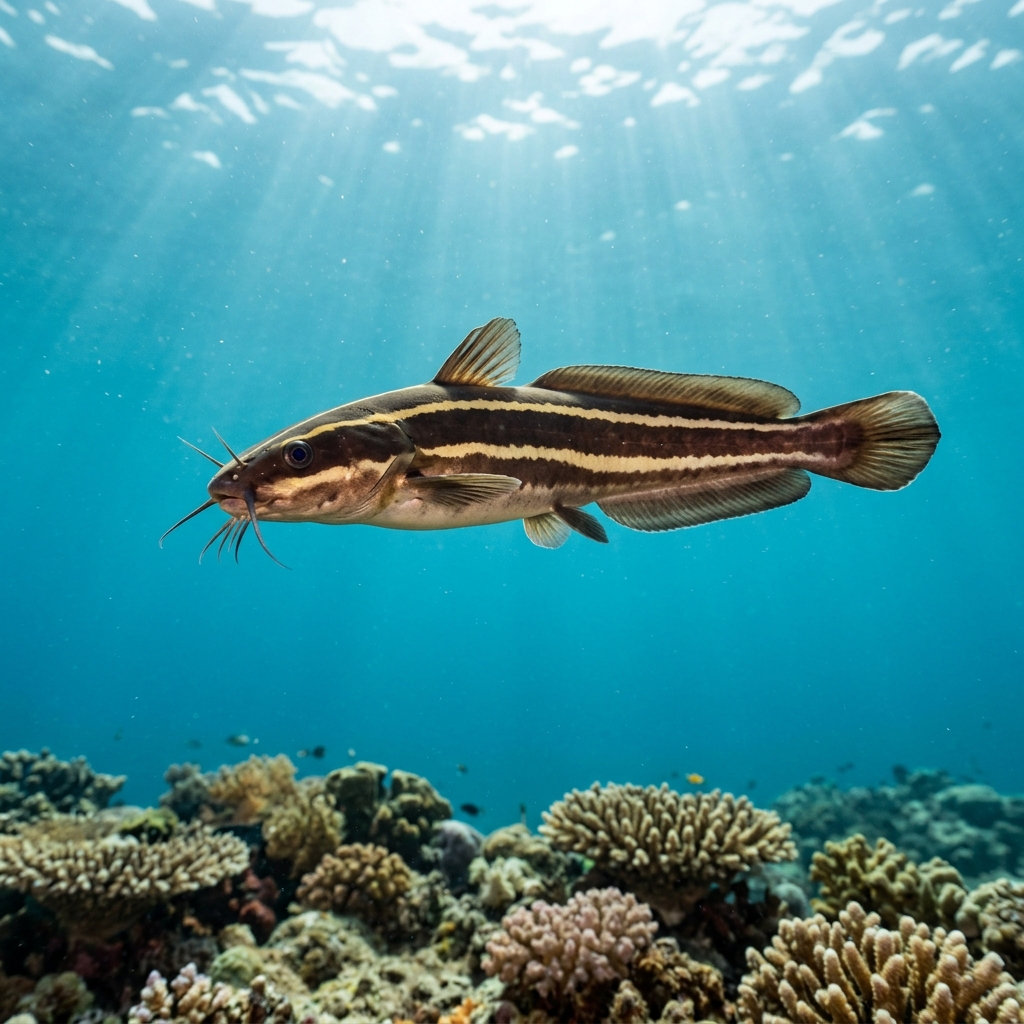
Bold, contrasting white and black horizontal stripes running the full length of a slender, eel-like body make this fish unmistakable underwater. The head is broad and rounded with long sensory barbels around the mouth, giving it a distinctly catfish look despite the elongated form. Juveniles are often seen in tight, swirling ball formations, one of the most striking schooling behaviours on Indo-Pacific reefs.
Juveniles are the real spectacle, they school in dense, writhing balls of hundreds of individuals that roll along the seabed and over rubble, a predator-confusion tactic that looks almost hypnotic. Adults tend to be more solitary or found in small groups sheltering under ledges or in crevices during the day. The species is not bothered by diver presence and will generally continue feeding or sheltering without retreating.
The spines on the dorsal and pectoral fins carry venom, not a risk during a normal dive but a good reason never to handle or corner one. The venom can cause intense pain and swelling if a spine punctures skin.
In the northern hemisphere, sightings are recorded year-round with no concentrated season, which makes sense given the species' comfortable temperature niche of 21 to 29°C across warm tropical and subtropical reefs. Southern hemisphere divers see the most activity between July and May.
Most commonly logged across the Philippines and Indonesia, with the Visayas and Bali standing out as the strongest hotspots in the data. Australia's New South Wales coast and the Muscat area of Oman also produce reliable sightings, as do Malaysia, Thailand, Mauritius, and the Egyptian Red Sea, together covering a broad Indo-Pacific and Red Sea range.
Mapping where Striped Eel Catfish is logged…
They are most commonly logged in the Philippines, particularly the Visayas, and across Indonesia, especially Bali. Strong populations also turn up in Australia's New South Wales, Oman's Muscat region, Thailand, Malaysia, Mauritius, and Egypt's Red Sea. It is a wide Indo-Pacific and Red Sea species with real diver records across all those areas.
In the northern hemisphere, they are present year-round with no concentrated season, so any time of year works if you are diving in the Philippines, Indonesia, or the Red Sea. In the southern hemisphere, sightings concentrate between July and May.
They are not aggressive and pose no threat during a normal dive. However, the dorsal and pectoral fin spines are venomous, a puncture wound can cause serious pain and swelling. Simply avoid touching or handling them and you will have no issues.
Look for strong, continuous white and black horizontal stripes along a slim, eel-like body with a blunt catfish head and visible barbels around the mouth. Juveniles schooling in dense, rolling balls are almost impossible to mistake for anything else on an Indo-Pacific reef.
The tight, swirling ball formation is a collective anti-predator behaviour. Hundreds of juveniles move together so closely that the group looks like a single large organism, making it harder for a predator to single out one fish. It is one of the more dramatic schooling displays you will see on a shallow reef.
Site and sighting data is aggregated from diver logs, iNaturalist and GBIF. For taxonomy and conservation status:
Soldierfish
3,612 sites