Oncorhynchus gorbuscha
Spot spawning pink salmon in Alaska and British Columbia rivers, in cold 0.5-9.3 C water, sightings logged year-round but mostly a rare treat.
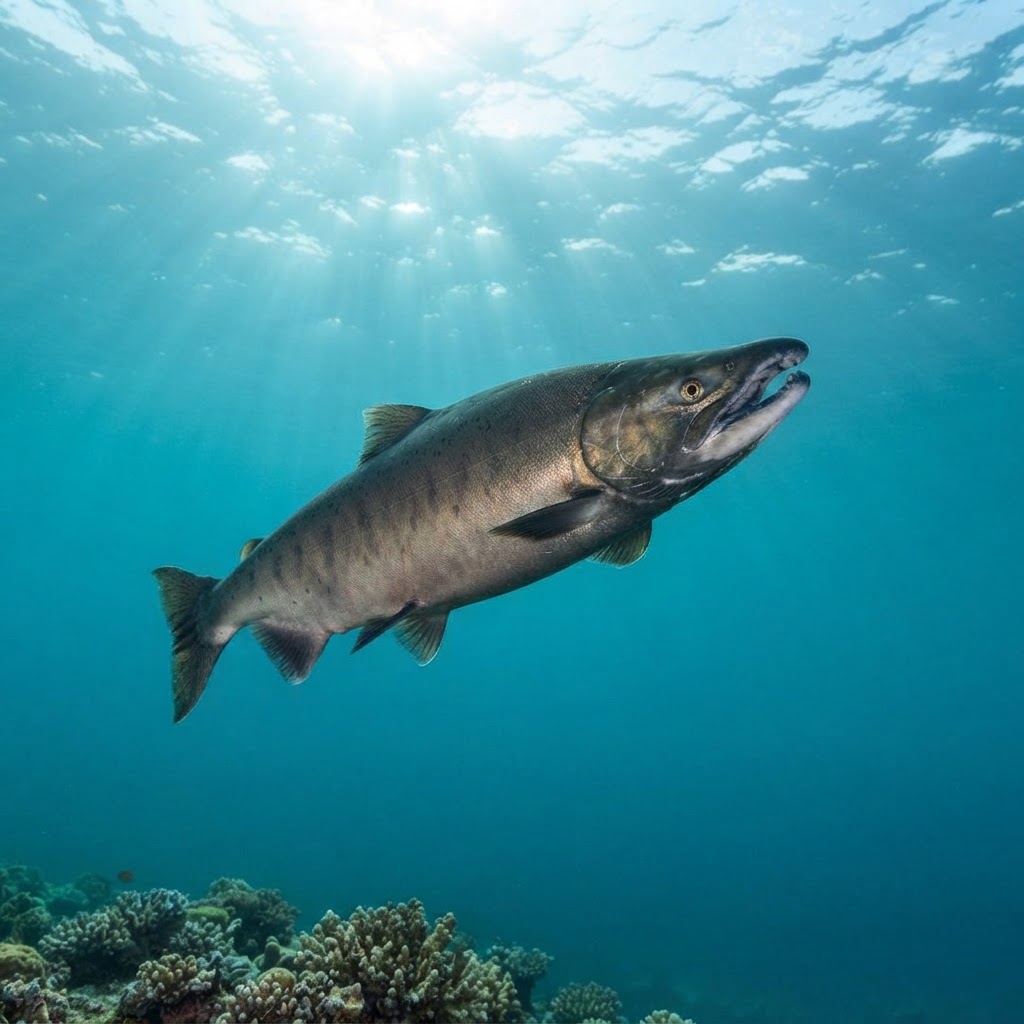
Look for a torpedo-shaped fish around 53 cm long with a silvery body and small black spots scattered across its back and tail. Spawning adults develop a pronounced hump behind the head and a hooked jaw, which is where the nickname humpback salmon comes from. In clear cold water they often show a faint olive-green to blue sheen along the back that fades to white on the belly.
Where divers do encounter them, pink salmon are usually seen holding in current or moving upstream in loose groups, focused on migration rather than on the diver nearby. They tend to ignore bubbles and torches, making them easy to approach slowly, though most sites report them as rare so patience pays off. Expect sightings in shallow, cold river channels rather than deeper open water.
Pink salmon have one of the shortest and most rigid life cycles of any Pacific salmon, returning to spawn on an almost exact two-year cycle so that odd and even year runs stay genetically separate.
Sighting data does not show a strong seasonal pattern, but pink salmon are a cold-water species observed in the 0.5 to 9.3 C range, which lines up with the cooler months and glacial-fed rivers of Alaska and British Columbia. Check locally for spawning runs, since that is when fish concentrate and become easier to find even though the overall data reads as year-round.
Most divers log this species in North America, with a reliable spread across sites in Alaska in the United States and British Columbia in Canada. These sightings tend to come from cold rivers and estuaries rather than reef dives, so plan for the freshwater or brackish stretches where salmon stage before spawning.
Mapping where Pink Salmon is logged…
Sightings are concentrated in North America, most reliably in Alaska in the United States and in British Columbia, Canada, usually in cold rivers and estuaries rather than open reef.
There is no strong recorded season, so treat sightings as possible year-round, but the cold 0.5 to 9.3 C temperature niche suggests spawning-run months in Alaska and British Columbia are your best bet.
Look for a silvery, spotted body around 53 cm long, with spawning adults showing a distinctive humped back and hooked jaw that gives them the humpback salmon nickname.
They typically reach around 53 cm in length, making them one of the smaller Pacific salmon species divers might encounter.
They run on an almost exact two-year life cycle, so populations spawning in odd years and even years stay largely separate from each other over time.
No, they pose no danger to divers and typically continue their migration behaviour undisturbed by a calm, slow approach.
Site and sighting data is aggregated from diver logs, iNaturalist and GBIF. For taxonomy and conservation status:
Sun Perch
2,182 sites