Cleidopus gloriamaris
Spot the pineapplefish on Australian reefs from Western Australia to Queensland. A chunky, armour-plated fish with bioluminescent cheeks, hard to miss once you know where to look.
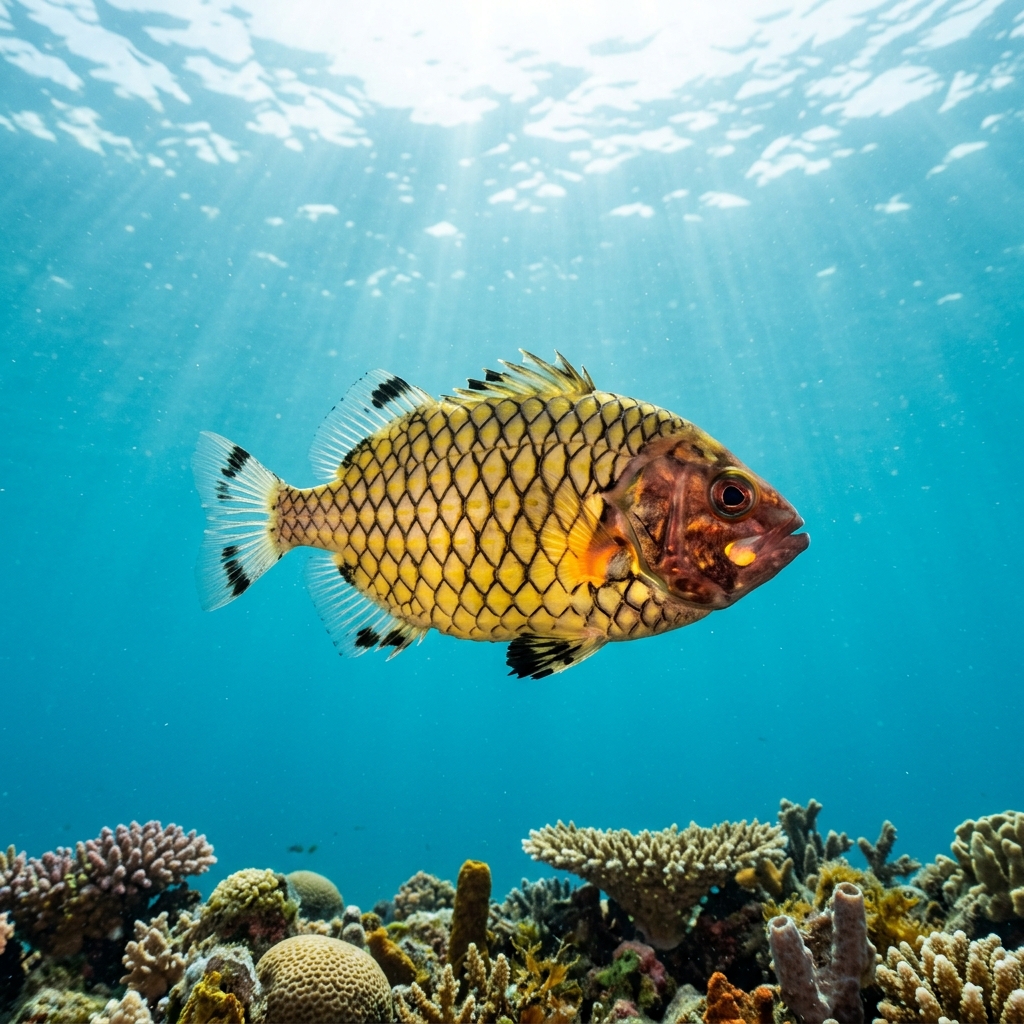
About 15 cm long, this fish looks like a floating pineapple: each large yellow-orange scale is rimmed in black, creating a bold geometric pattern across a deep, rounded body. Two rigid dorsal spines and a plate-armoured exterior make the silhouette unmistakable. Look for the two small blue-green bioluminescent (light-producing) patches on the lower jaw, these glow faintly in the dark and are unique among Australian reef fish. Juveniles show the same body plan but are typically paler with less contrast in the scale patterning.
During the day, pineapplefish typically shelter in caves, under ledges, or in crevices, often sitting very still, which is why divers who look carefully into dark recesses tend to find them. At night they become more active, moving onto the open reef to feed on small crustaceans, and the bioluminescent jaw patches are thought to help lure or illuminate prey. They are generally calm around divers and rarely bolt, making close-up observation straightforward if you approach slowly with a torch.
Those glowing jaw spots are not just decorative: they harbour colonies of bioluminescent bacteria that produce a steady blue-green light, one of very few examples of bacterial bioluminescence used in a marine vertebrate.
No clear seasonal peak emerges from the sighting data, so pineapplefish can be treated as a year-round target. Their observed temperature range of 16 to 26 °C covers most of Australia's temperate and subtropical reef zones throughout the year.
Pineapplefish are almost entirely an Australian species, with the strongest sighting record spread across Western Australia, Queensland, and New South Wales. South Australia and Victoria also contribute meaningful records, so the animal is accessible to divers along most of Australia's temperate and subtropical coastlines. A single modelled site appears off Canada, but all verified observations come from Australian waters.
Mapping where Pineapplefish is logged…
Pineapplefish are found almost exclusively in Australian waters. Western Australia and Queensland have the most logged sites, followed by New South Wales and South Australia. Dive sites along rocky reef and cave systems in these regions give you the best chance of an encounter.
There is no single peak season in the data, so pineapplefish can be targeted year-round across Australian reefs. They tolerate a water temperature range of roughly 16 to 26 °C, which suits most of the continent's temperate and subtropical coast throughout the year.
Look for a small, very deep-bodied fish about 15 cm long with large, bold yellow-orange scales each edged in black, giving a strong geometric pattern that really does resemble a pineapple skin. The rigid armoured body, prominent dorsal spines, and glowing blue-green jaw patches are unlike any other reef fish in Australian waters.
Most adults reach around 15 cm in length. Their deep, compressed body makes them appear chunkier than that length suggests, and the large scales add to the impression of a robust, solid fish.
Pineapplefish carry colonies of bioluminescent bacteria in two small organs on the lower jaw, which emit a faint blue-green glow. This is one of the very few known cases of bacterial bioluminescence in a fish, and is thought to assist with attracting or spotting small prey at night.
Site and sighting data is aggregated from diver logs, iNaturalist and GBIF. For taxonomy and conservation status:
Meagre
1,159 sites