Pictichromis paccagnellae
Spot the vivid half-purple, half-yellow Royal Dottyback on reefs across Indonesia and Timor-Leste in warm 27-29 °C waters. Here's where divers actually see it.
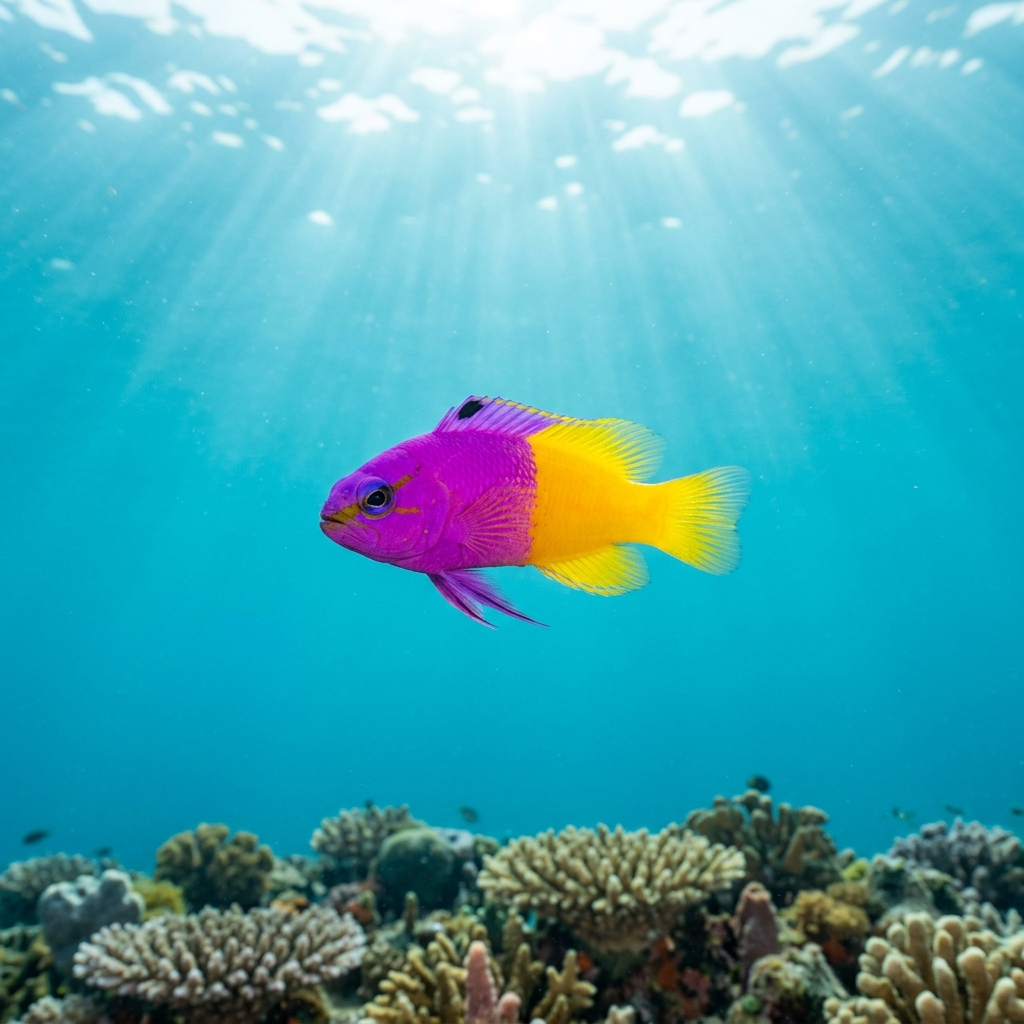
Few reef fish are as instantly recognisable as this one: the front half of the body is deep violet-purple and the rear half is vivid yellow-orange, with a sharp, almost perfectly straight dividing line across the middle. It is a small fish, typically darting in and out of crevices rather than swimming openly in the water column. That two-tone colouring is essentially unique in its range, making it one of the easier reef species to name on a dive even for beginners.
Royal dottybacks are bold for their size but highly reef-dependent, spending most of their time hovering just outside a crevice or coral head and retreating inside at the first sign of a threat. Divers who move slowly and keep their distance often get a prolonged view; approach too quickly and the fish disappears entirely. They tend to occupy the same small territory on a reef, so if you spot one and back off, it will often reappear within a minute or two.
Like many pseudochromids (dottybacks), royal dottybacks are protogynous hermaphrodites, meaning females can transform into fully functional males when conditions on the reef require it, such as when a dominant male disappears from a territory.
There is not enough monthly data to identify a peak season, so treat it as a year-round resident. It lives comfortably in the warm tropical waters of 27-29 °C that characterise its Indonesian and Timorese range throughout the year.
The overwhelming majority of logged sightings come from Indonesia, with the Nusa Tenggara and Banda Sea region leading by a wide margin, followed by Sulawesi and then Bali, Lombok, and Java. Timor-Leste, particularly the Dili and North Coast area, rounds out the confirmed range. If a sighting is your goal, Indonesian reefs are clearly the strongest bet.
Mapping where Royal Dottyback is logged…
Royal dottybacks are most commonly logged in Indonesia, with the Nusa Tenggara and Banda Sea region seeing the most sightings, followed by Sulawesi and the Bali, Lombok, and Java area. Timor-Leste, especially along the Dili and North Coast, also has confirmed sightings. All recorded sites are within the Coral Triangle.
Sighting data does not point to any single peak month, so they appear to be present year-round across their range. The warm, stable water temperatures of 27-29 °C found on Indonesian and Timorese reefs persist throughout the year, which likely keeps the species active regardless of season.
The colour pattern does all the work: a sharp split between deep purple on the front half and bright yellow-orange on the rear half. No other small reef fish in its range shares this exact two-tone pattern. Look for it hovering close to crevices and coral rubble in shallow to mid-depth reef zones.
Royal dottybacks are small fish, typically reaching around 6-7 cm in length. Their compact, elongated body shape is typical of the dottyback family, and their small size is part of why they are so closely tied to crevices and coral structure for shelter.
Diver sighting data rates it as rare at most sites where it has been observed, with uncommon being the next most common rating. Even in its strongholds in Nusa Tenggara and Sulawesi, a sighting is never guaranteed. Slow, patient diving near coral rubble and drop-off walls gives the best chance.
Site and sighting data is aggregated from diver logs, iNaturalist and GBIF. For taxonomy and conservation status:
Soldierfish
3,612 sites