Phyllidia flava
Spot the White-spotted Yellow Nudibranch across the French Riviera, Croatian Kvarner Gulf, and Northwest Italy in cool Mediterranean waters.
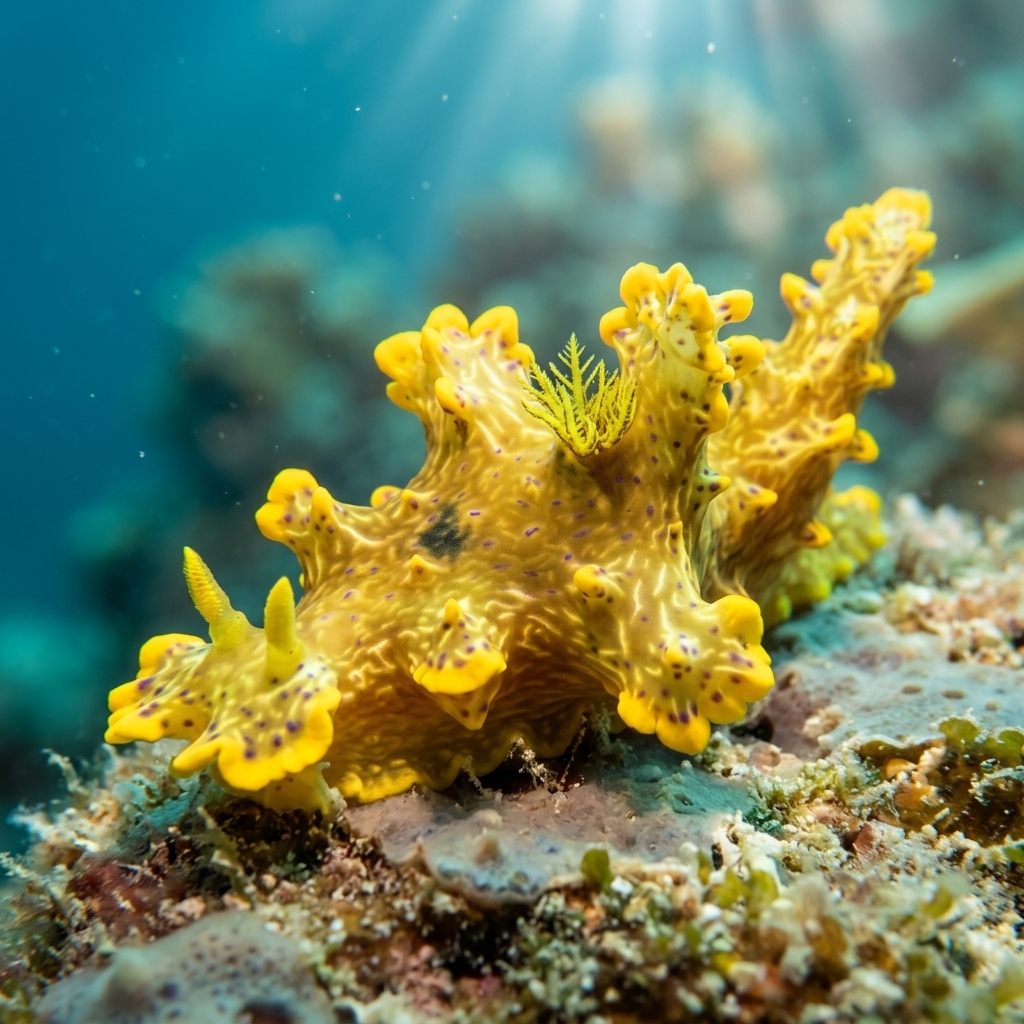
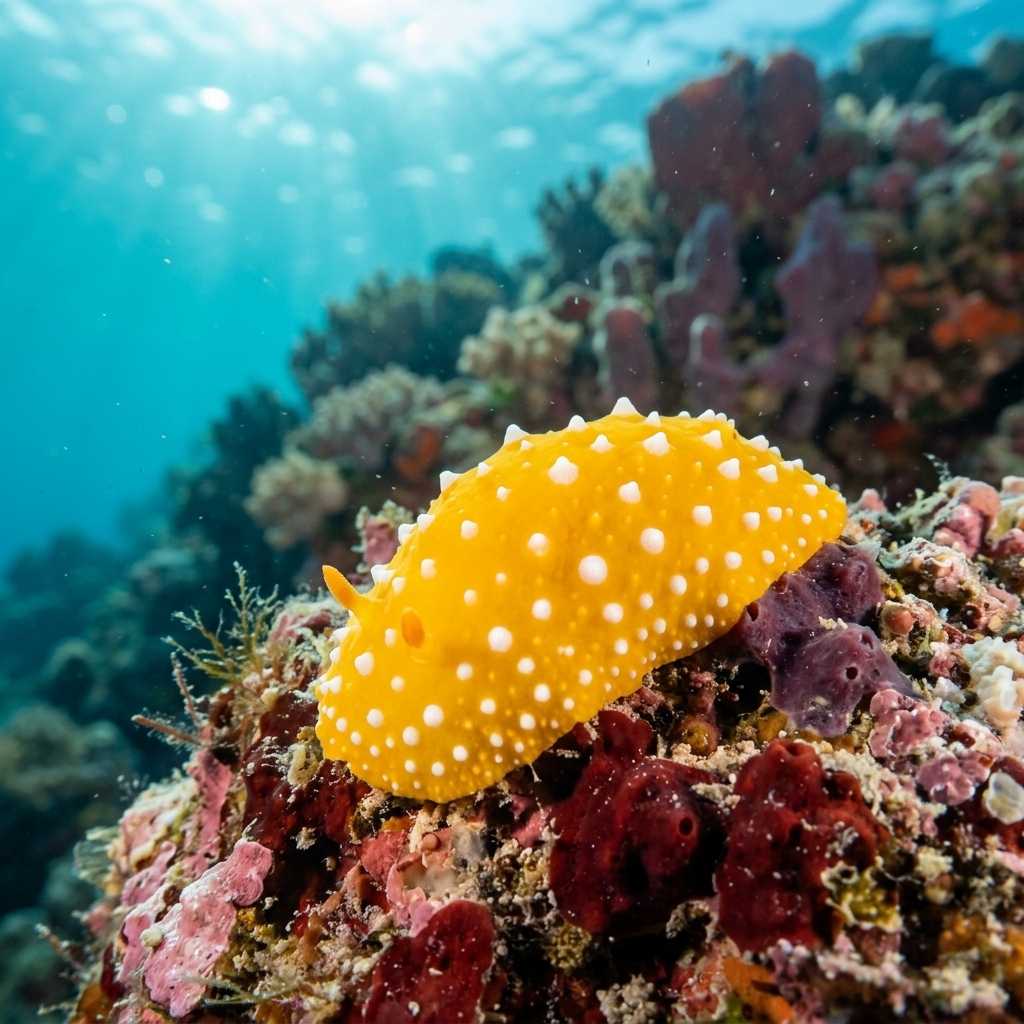
A compact, flattened nudibranch with a vivid yellow body covered in small white spots or tubercles (raised bumpy projections), making it stand out sharply against rocky or algae-covered Mediterranean reef. The underside is typically paler, and the lack of prominent gill plumes distinguishes it from many other nudibranch families. Key in on the bold yellow-and-white contrast and the warty, ridge-free body surface.
Like most phyllidiid nudibranchs, it moves slowly across hard substrates, grazing on sponges, and is typically found on rocky reef faces or under ledge overhangs rather than in open water. It shows little reaction to divers, making close observation straightforward, but its small size means it is easy to swim straight past. Searching slowly along rocky walls in the 5 to 25 metre range gives the best chance of an encounter.
Phyllidiid nudibranchs cannot store the defensive toxins they absorb from sponges indefinitely; when threatened, they release a mucus laced with those chemicals, which is toxic to fish kept in the same enclosed water, a fact well known to marine aquarists.
There is not yet enough monthly data to pin down a peak season, so it can be treated as potentially present year-round where conditions suit. Its observed water-temperature range of 13 to 22.5 °C aligns well with Mediterranean conditions in spring through autumn, though winter dives in the region do fall within that band.
Reef neighbours a diver could mistake it for. Use the identification notes above to tell them apart.
Sightings are concentrated firmly in the Mediterranean, with the greatest spread of logged sites in Northwest Italy and the Kvarner Gulf of Croatia. The French Riviera and Provence coast also produce strong records, while Sardinia, Tuscany, Sicily, and the Halkidiki peninsula of Greece round out the reliable areas.
Mapping where White-spotted Yellow Nudibranch is logged…
It is most reliably logged across the Mediterranean, particularly along the Northwest Italian Riviera, the Kvarner Gulf in Croatia, and the French Riviera. Greece's Halkidiki coast and Spain's Costa Brava also have confirmed sightings, making the northern and central Mediterranean the clear focus for finding this species.
There is not enough seasonal data to identify a single best window. Its presence across Mediterranean sites whose water temperatures run from 13 to 22.5 °C suggests it tolerates the full range of regional conditions from winter through summer, so any dive in the key regions is a reasonable opportunity.
Look for a small, flattened nudibranch with a bright yellow body covered in white bumpy tubercles. The absence of external gill plumes on the back is a useful pointer to the Phyllidiidae family. The vivid yellow-and-white pattern is the single strongest field mark against the darker rocky reef it favours.
Reliable size data for this species is limited in current diver observation records. Phyllidiid nudibranchs of this type are generally small, often in the range of 2 to 5 cm in length, but until more measured sightings are logged the exact typical adult size remains uncertain.
No. This nudibranch poses no threat to divers. Like other phyllidiids it can release defensive chemicals from its skin, but this only matters in enclosed water and has no effect on a diver in open water. Simply observe without handling it.
Site and sighting data is aggregated from diver logs, iNaturalist and GBIF. For taxonomy and conservation status:
Blue Dragon
3,163 sites