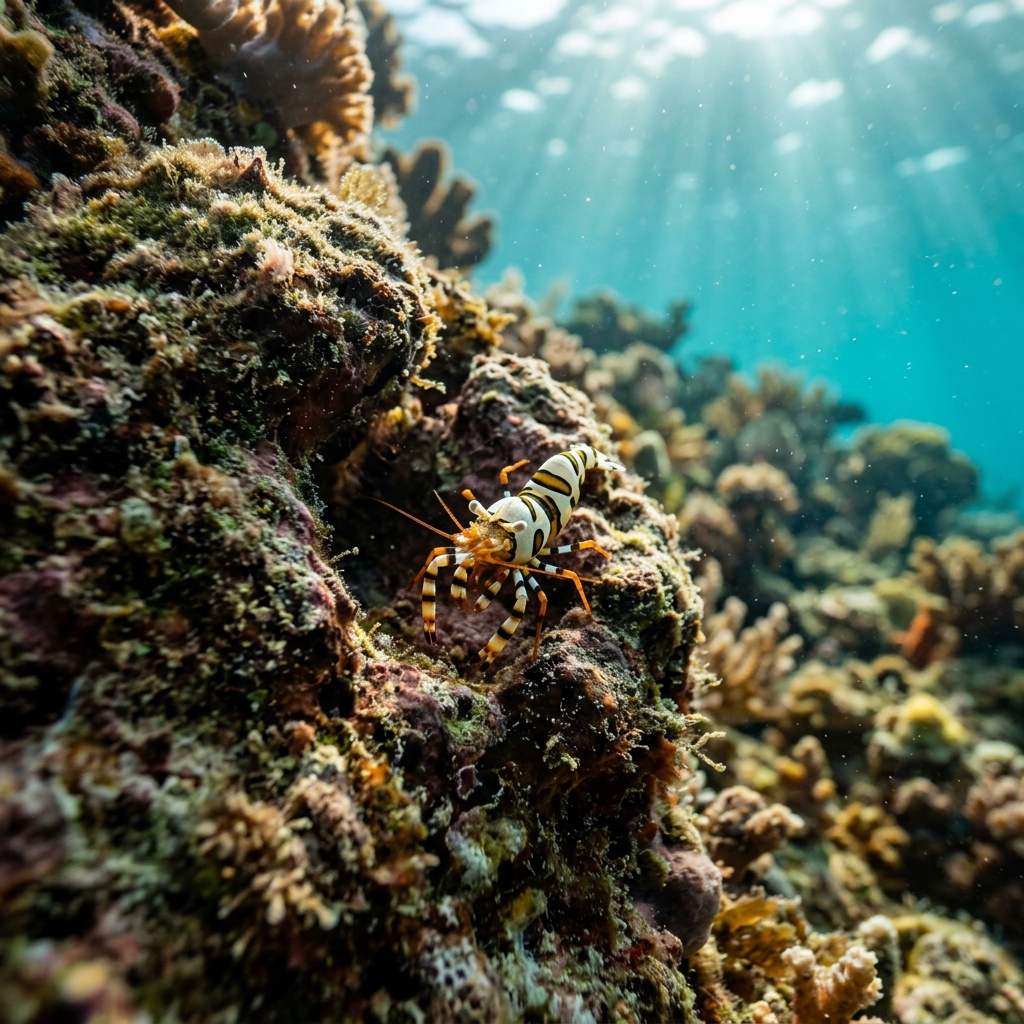
Periclimenes colemani
Coleman Shrimp live on fire urchins in warm Philippine and Indonesian waters. Here's where to find them, how to spot them, and what makes them so hard to see.
Look for a small, almost translucent white shrimp decorated with vivid red-orange and purple-edged spots and markings, sitting directly on the spines or among the tube feet of a fire urchin. The bold colouration is striking up close, but the shrimp tends to tuck tight against its host, so the pattern breaks up against the urchin's own colours. Pairs are almost always found together on the same urchin, with the female noticeably larger than the male. Finding the host first is the real skill; once you have the urchin in your torch beam, scan slowly from the base of the spines upward.
Coleman Shrimp live in obligate symbiosis (a relationship in which one species absolutely depends on another) with fire urchins, spending their entire adult lives on the same host. A bonded male-female pair typically clears a small patch of spines on the urchin's upper surface, cropping tube feet and creating a flattened territory they defend against other shrimp. When approached by a diver, they tend to shift to the far side of the urchin rather than flee, so slow and patient observation from the shrimp's level usually yields a better view than coming in from above.
The shrimp are thought to neutralise the fire urchin's venom in the cleared territory through chemical secretions, allowing them to move freely on a host that would otherwise sting them. They also manipulate the urchin's tube feet and pedicellaria (tiny pincer-like organs on the urchin's skin), effectively disarming their immediate patch.
No seasonal peak has emerged from the data, so this appears to be a year-round resident on reefs within its range. The observed water temperature sits between about 27 and 29 °C, typical of the warm tropical Indo-Pacific, so any time conditions hold in that range the shrimp should be present.
The overwhelming majority of logged sightings come from the Philippines, particularly sites across Luzon and the North, making that region by far the strongest bet for an encounter. A small number of sightings extend south into Sulawesi and Maluku in Indonesia, and a couple of sites around Nha Trang in Vietnam round out the known range. If you want the best odds, the Philippine sites are where to focus your search.
Mapping where Coleman Shrimp is logged…
The Philippines is the standout destination, with sites concentrated around Luzon and the North. Sightings also come from Nha Trang in Vietnam and from sites in Sulawesi and Maluku in Indonesia. Your best odds by far are in the Philippines.
No clear seasonal pattern has been recorded, so they appear to be present year-round wherever conditions suit them. The shrimp favour warm water around 27 to 29 °C, which is stable across their tropical range throughout the year.
Look for the host first: Coleman Shrimp live exclusively on fire urchins, usually in a cleared patch near the top. The shrimp themselves are white with bold red-orange and purple-edged markings. They are almost always found in a male-female pair, with the female the larger of the two.
Females typically reach around 2 cm in body length; males are noticeably smaller. Both are small enough that you can easily swim over a fire urchin without noticing them, which is why a slow, torch-assisted search of the urchin surface is essential.
Fire urchins provide a well-defended home that most predators avoid. The shrimp clear a small territory on the urchin's surface, apparently neutralising the local venom and spines to create a safe living space. In return, the relationship gives the urchin some degree of grooming, though the shrimp are thought to take food from the urchin's tube feet as well.
Site and sighting data is aggregated from diver logs, iNaturalist and GBIF. For taxonomy and conservation status:
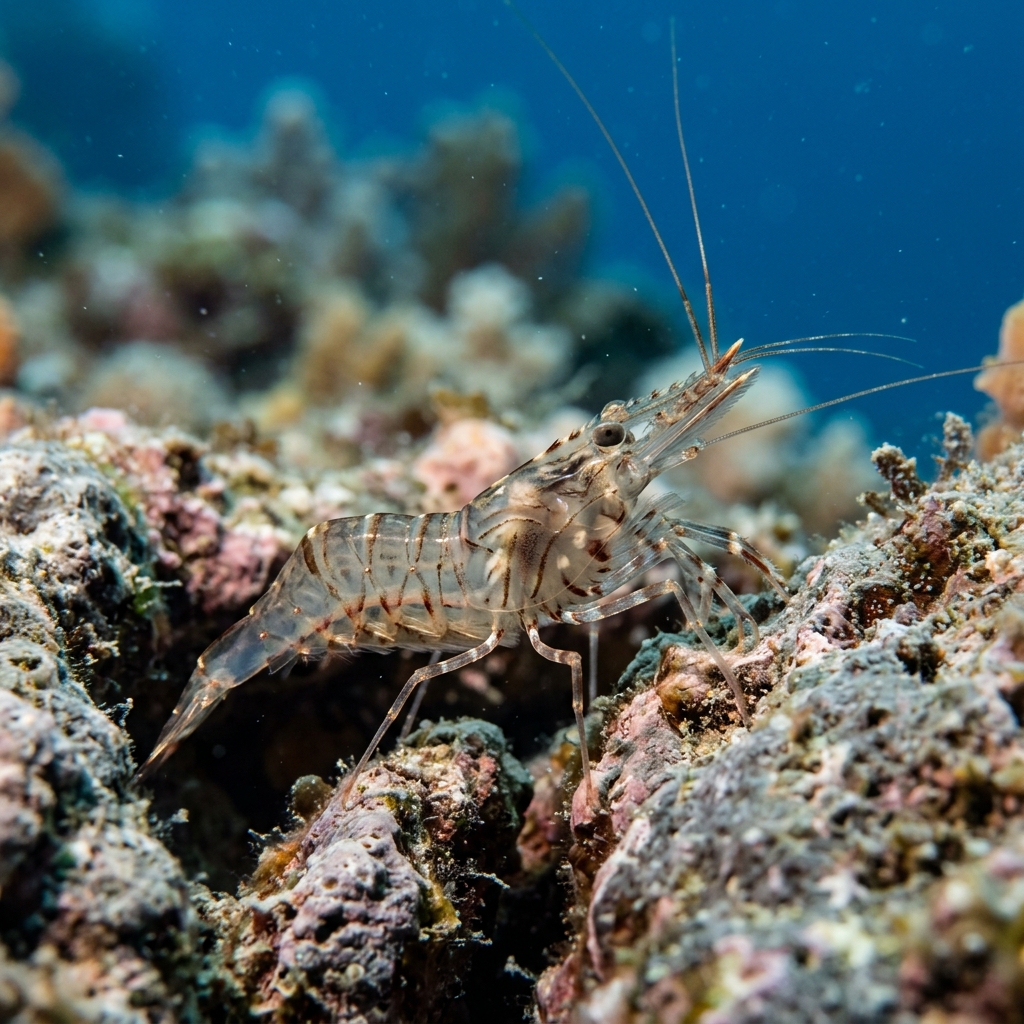
Rockpool Prawn
2,179 sites