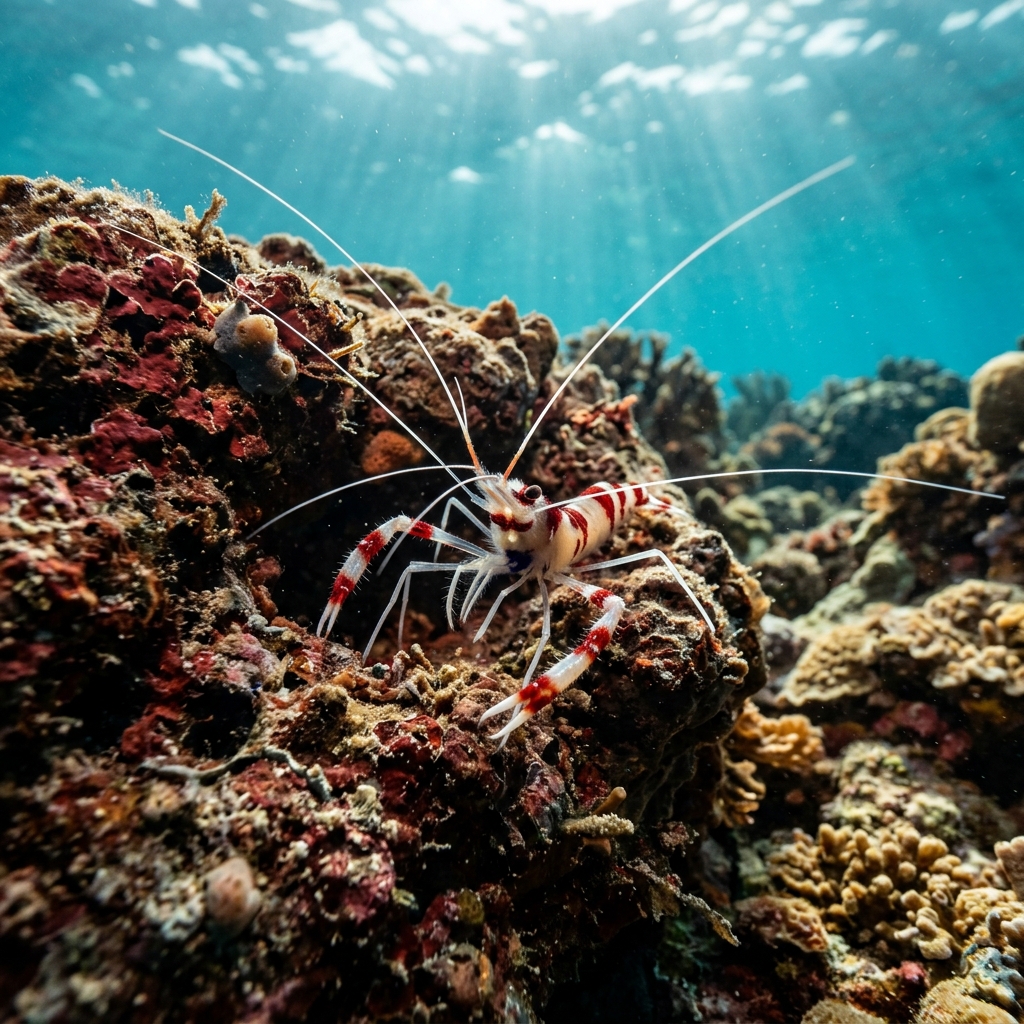
Stenopus hispidus
Spot the red-and-white banded Banded Coral Shrimp year-round across Florida, the Philippines, and the Maldives. Know where to look and what to look for.
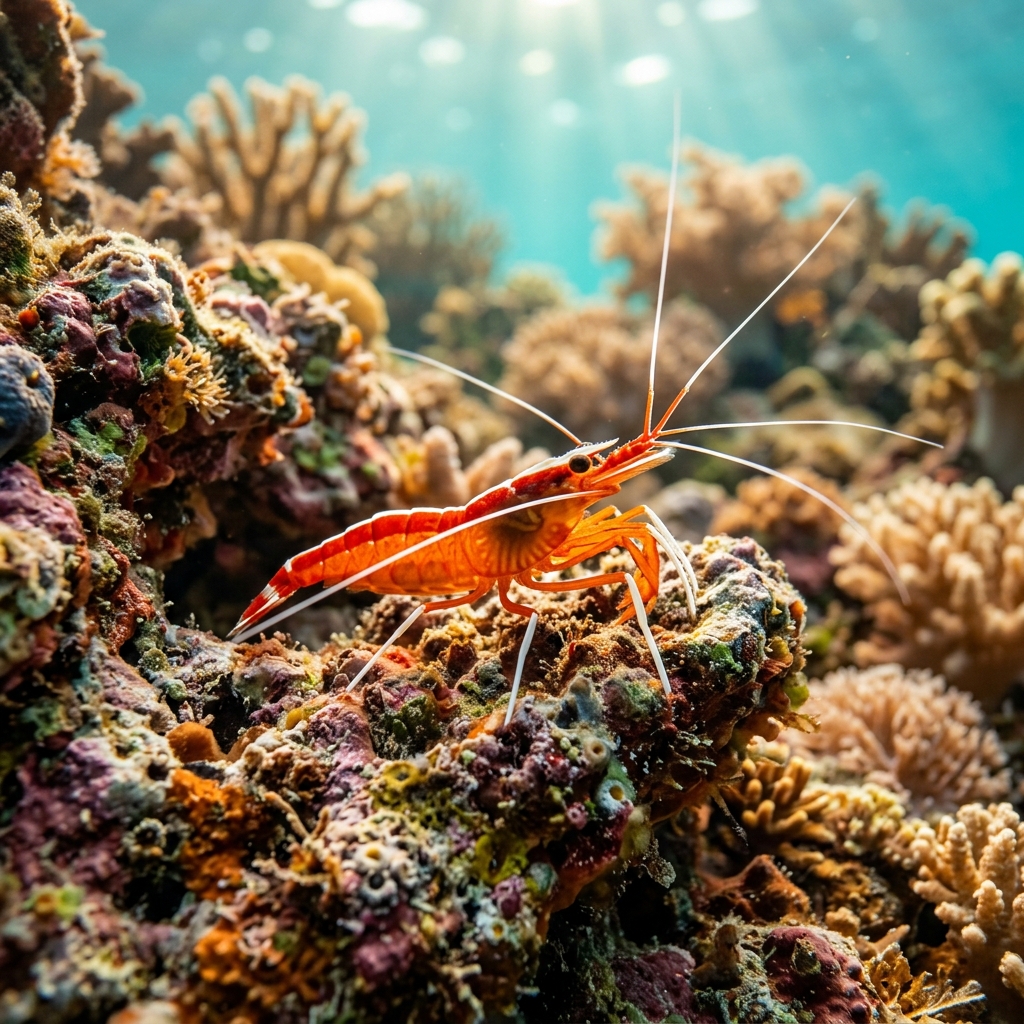
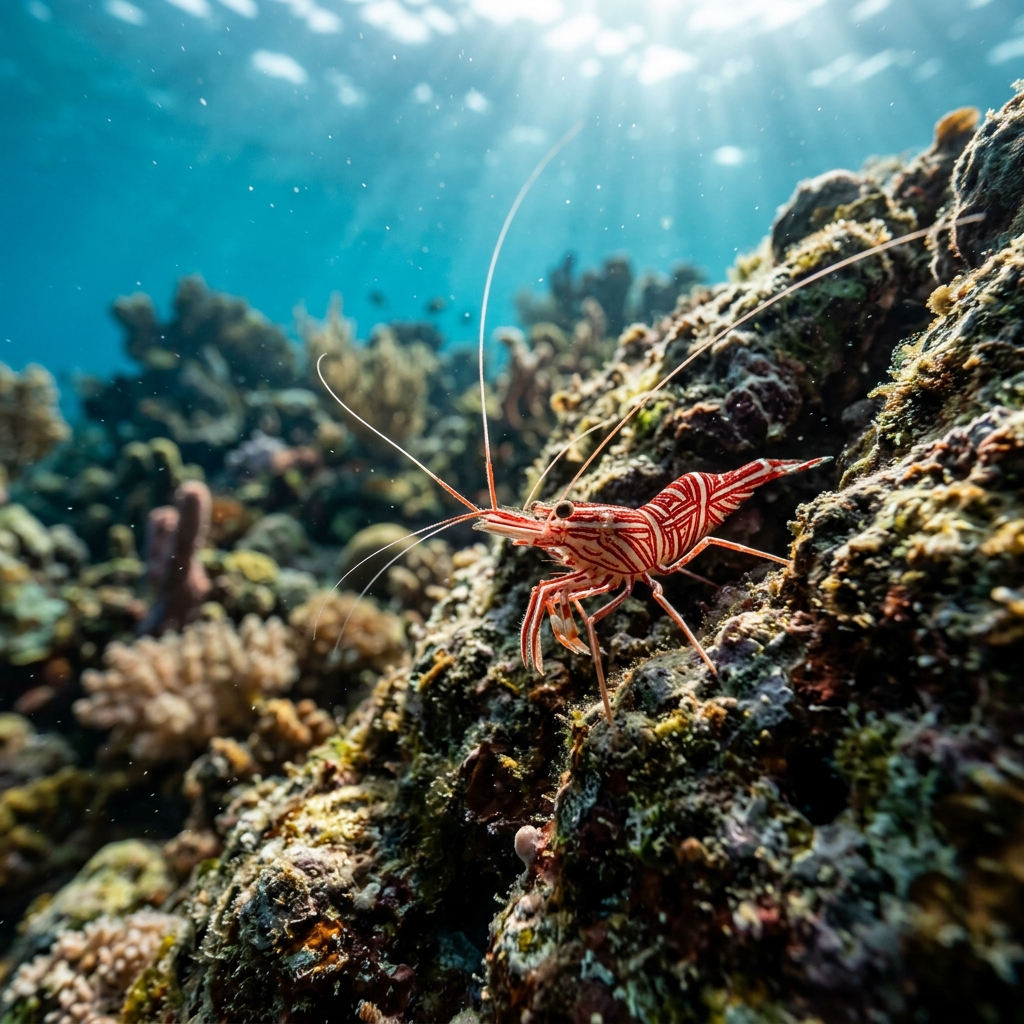
Bold alternating red (or orange-red) and white bands run across the body, claws, and legs, making this shrimp one of the most visually striking crustaceans on the reef. The oversized, spiny white claws are the key field mark underwater, held out in front or to the sides as the shrimp perches at the entrance to a crevice. Long white antennae, often the first thing you spot, extend well beyond the body length. Females can be picked out by a noticeably broader abdomen carrying a visible cluster of pale green or blue-green eggs.
You'll almost always find banded coral shrimp stationary inside or just outside a small cave, overhang, or coral crevice, where it sets up a cleaning station and waits for fish to arrive. It waves its long white antennae to advertise its services, and fish queue up to be groomed of parasites and dead tissue. Divers who stay still and approach slowly can watch the shrimp work at close range; it rarely retreats unless disturbed by sudden movement.
Pairs are monogamous and strongly territorial, defending a single cleaning station together. If you find one, look for a second tucked just behind it or nearby on the same coral head.
In the Northern Hemisphere, sightings are logged year-round with no concentrated season, which makes sense given the species' comfort in water from around 20 to 29°C across tropical and subtropical reefs. In the Southern Hemisphere, sightings tend to cluster between November and May.
Most consistently logged across the United States (especially Florida and Hawaii), the Philippines, Indonesia, and the Maldives, where sightings are spread across a large number of reef sites. Strong populations are also well-documented in Australia's Queensland, Roatán in Honduras, Bali, and the Egyptian Red Sea. It turns up in the Caribbean too, with the Cayman Islands representing a solid concentration of sightings.
Mapping where Banded Coral Shrimp is logged…
They are logged across tropical and subtropical reefs worldwide. The strongest concentrations of sightings come from Florida, the Philippines (especially the Visayas), Indonesia, the Maldives, Australia's Queensland coast, and Roatán in Honduras. Egypt's Red Sea and the Cayman Islands are also reliable spots.
In the Northern Hemisphere they are present year-round with no peak season, so you can look for them on any reef dive in tropical or warm subtropical waters. In the Southern Hemisphere, sightings are most frequently logged between November and May.
Look for bold alternating red-and-white bands across the body, legs, and large spiny claws, paired with long white antennae that extend well past the body. It almost always sits at the entrance to a crevice or small cave rather than out in the open. Nothing else on the reef looks quite like it.
Adults typically reach around 5 to 6 cm in body length, though the long antennae and outstretched claws make them appear considerably larger in the water. They are small but their colouration makes them easy to spot once you know where to look.
They run cleaning stations, removing parasites and dead tissue from fish that visit. The shrimp wave their antennae to signal availability, and reef fish actively seek them out. Pairs are monogamous and hold the same station for long periods, so returning to a known spot across multiple dives often produces a repeat sighting.
Site and sighting data is aggregated from diver logs, iNaturalist and GBIF. For taxonomy and conservation status:
Freshwater Shrimp
2,168 sites