Squatina californica
Flat, sand-coloured and easy to miss: find Pacific Angelshark buried in the seabed off Baja California and California year-round.
Safety warning
Not aggressive, but bites can happen if a diver corners it, tries to move it, or puts a hand down near its head while it is buried. Give it space, avoid touching or trying to flip it for photos, and approach slowly from the front so it can see you rather than feel cornered.
If you're bitten
BiteGeneral first-aid guidance, not a substitute for professional medical care. In an emergency, call your local emergency number.
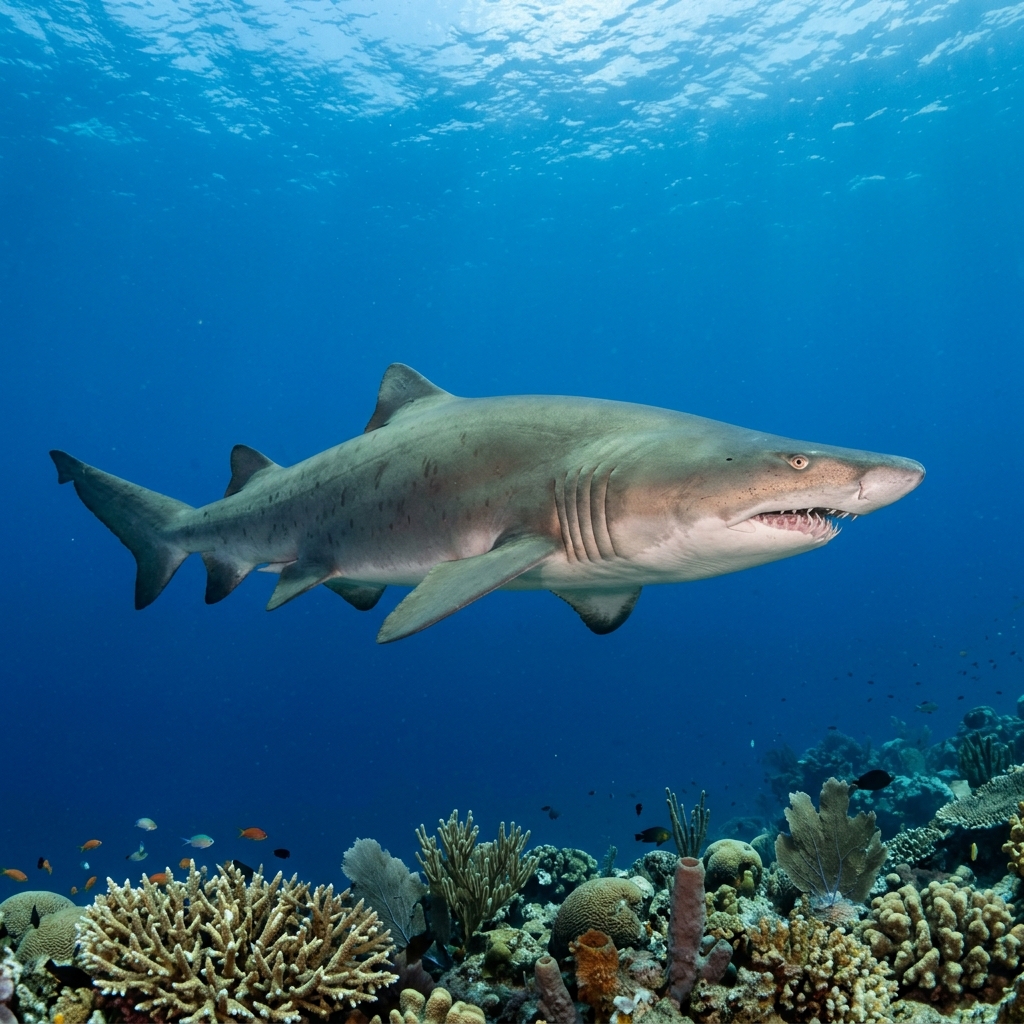
Flattened, ray-like body up to around 106 cm long, with wide pectoral fins that fan out low against the sand rather than lying flat like a true ray. Mottled brown, grey and sandy blotches break up its outline, and two small spiracles (breathing holes) sit just behind the eyes on top of the head. Look for the shape first: a broad, disc-like front half tapering into a short, muscular shark tail with two dorsal fins set far back, unlike any ray.
Spends most of daylight hours buried or half-buried in sand with just its eyes and outline showing, ambushing small fish that swim within striking range. Divers who spot one usually do so by scanning flat sandy patches near reef edges or kelp margins rather than mid-water, and a resting angelshark will often hold still even as divers approach closely. Given room, it tends to stay put; if crowded or touched it can strike upward fast to escape or feed.
Its ambush strike is explosive for a bottom-dwelling shark: it can snap its jaws and body upward in a fraction of a second to grab prey that has drifted too close, a speed most divers never expect from something that looks like part of the seafloor.
Sightings run year-round with no strong seasonal pattern in the data, which fits its wide comfort range of roughly 13 to 25.5°C across shallow and deeper water. Plan around good visibility and calm sand-diving conditions at your chosen site rather than a specific month.
Most consistently logged around Baja California in Mexico and along the California coast in the United States, with Revillagigedo also producing sightings. Smaller numbers turn up further south along Peru's Máncora coast and Ecuador's Pacific coast, so the species spans a long stretch of the eastern Pacific.
Mapping where Pacific Angelshark is logged…
Baja California and California are the strongholds, with Revillagigedo also a reliable spot in Mexican waters. Further south, divers occasionally find them along Peru's Máncora coast and Ecuador's Pacific coast.
There's no strong seasonal pattern, so they're seen year-round across their range. Water temperature tolerance from around 13 to 25.5°C means they're present in both cooler California waters and warmer Baja sites throughout the year.
They're not aggressive and won't chase divers, but a startled or cornered angelshark can strike fast if touched or trapped. Keep your distance, don't try to move or flip it, and it will almost always stay calm and still.
Look for a flattened, mottled brown body buried in sand with wide pectoral fins and a distinct shark-like tail with two dorsal fins set far back. That tail shape, plus visible spiracles behind the eyes, separates it from any true ray.
They typically reach around 106 cm in length, making them a modest-sized bottom shark rather than anything imposing.
It lies motionless, half-buried in sand, then launches an explosive upward strike to snatch prey that swims too close. The speed of that strike is surprising given how still and camouflaged it looks the rest of the time.
Site and sighting data is aggregated from diver logs, iNaturalist and GBIF. For taxonomy and conservation status:
Tiger Shark
1,616 sites