Oreochromis aureus
Blue Tilapia are most reliably spotted in the Central & Mountain West US from April to September. Here's where divers find them and how to ID them.
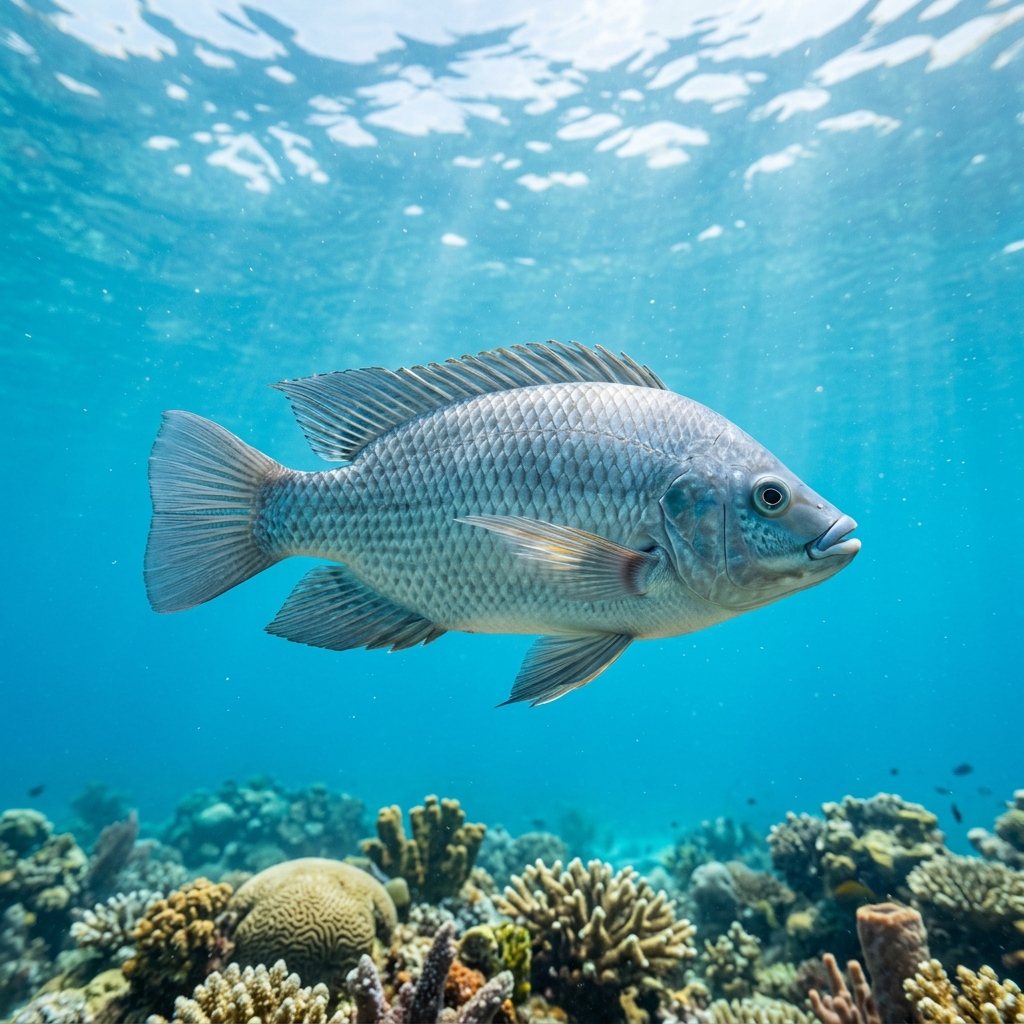
A robust, laterally flattened cichlid with silvery-blue to greenish flanks, a faint series of darker vertical bars along the body, and a distinctly rounded snout. Look for a reddish-pink flush on the edges of the dorsal and tail fins, which is one of the most reliable underwater markers. Males in breeding condition develop a noticeably deeper blue-grey colouring on the head and throat compared to the plainer females.
Blue tilapia are often seen patrolling shallow, open-water areas or moving along rocky or vegetated substrate, where they forage on algae and plant matter. They tend to hold their ground rather than bolt when a diver approaches, making for reasonably relaxed encounters. During breeding season you may spot pairs or small groups near cleared patches of substrate where they guard nests.
Blue tilapia are mouthbrooders: after spawning, the female (and sometimes the male) holds the fertilised eggs and later the free-swimming fry inside her mouth to protect them from predators, a behaviour you might actually witness on a dive if you spot a fish with a noticeably puffed-out throat.
Sightings in the Northern Hemisphere concentrate between April and September, aligning with warmer water temperatures within their observed range of roughly 19 to 28 °C.
Almost all logged sightings come from the United States, with the large majority concentrated in the Central & Mountain West region. A smaller number of records come from Florida and the Southeast. These are typically freshwater sites such as warm springs, reservoirs, and spring-fed rivers.
Mapping where Blue Tilapia is logged…
Blue tilapia are logged almost exclusively in the United States, with the strongest concentration of sites in the Central & Mountain West. A smaller number of records come from Florida and the Southeast. They favour warm freshwater environments such as spring-fed rivers, thermal springs, and reservoirs.
Based on diver sightings in the Northern Hemisphere, the most reliable window runs from April through September. This matches the warmer months when water temperatures sit comfortably within their preferred range of around 19 to 28 °C.
Look for a stocky, disc-shaped cichlid with silvery-blue flanks and faint vertical bars running down the body. The clearest ID mark is a reddish-pink trim on the dorsal and caudal (tail) fins. Males in breeding condition also show a noticeably blue-grey head and throat.
In the wild, blue tilapia typically reach around 30 to 50 cm in length, though individuals in warm, food-rich environments can grow larger. They are solidly built fish that appear quite chunky in the water.
Blue tilapia are mouthbrooders. After eggs are fertilised, the female carries them inside her mouth until they hatch, and continues to shelter the fry this way for a period after. On a dive, a female doing this will have a visibly swollen throat and will move cautiously to protect her young.
Site and sighting data is aggregated from diver logs, iNaturalist and GBIF. For taxonomy and conservation status:
Sun Perch
2,182 sites