Balistapus undulatus
Spot orangestripe triggerfish across Maldives, Indonesia and the Philippines. Know the bold orange lines, the territorial streak, and when to dive.
Safety warning
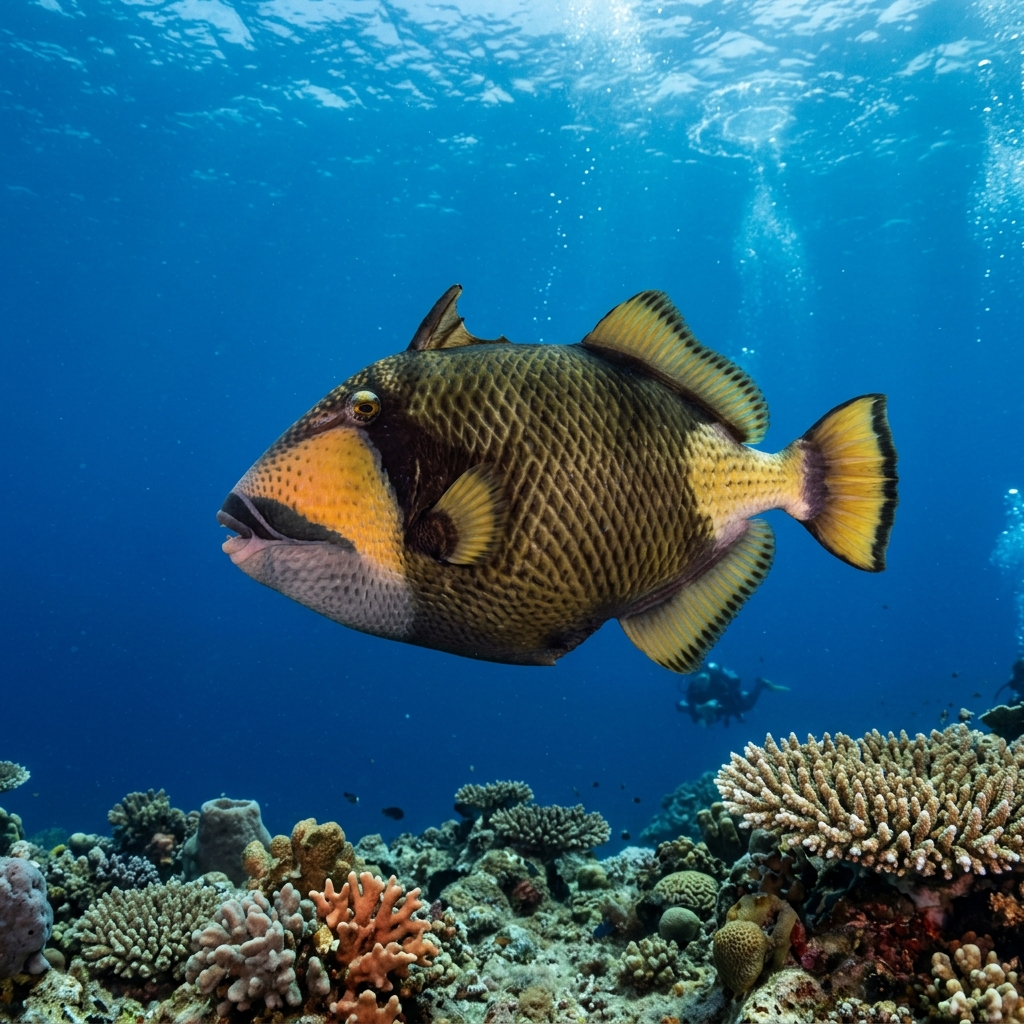
Nesting females are actively aggressive and will charge at divers who stray into their territory, which is typically a cleared patch of rubble or sand near the reef base. Unlike the titan triggerfish, whose bite risk is well-publicised, this species is smaller but still capable of a serious nip. If one starts swimming directly toward you, move horizontally away from the nest rather than ascending, as the defended zone extends upward in a cone above the nest.
If you're bitten
Territorial biteGeneral first-aid guidance, not a substitute for professional medical care. In an emergency, call your local emergency number.
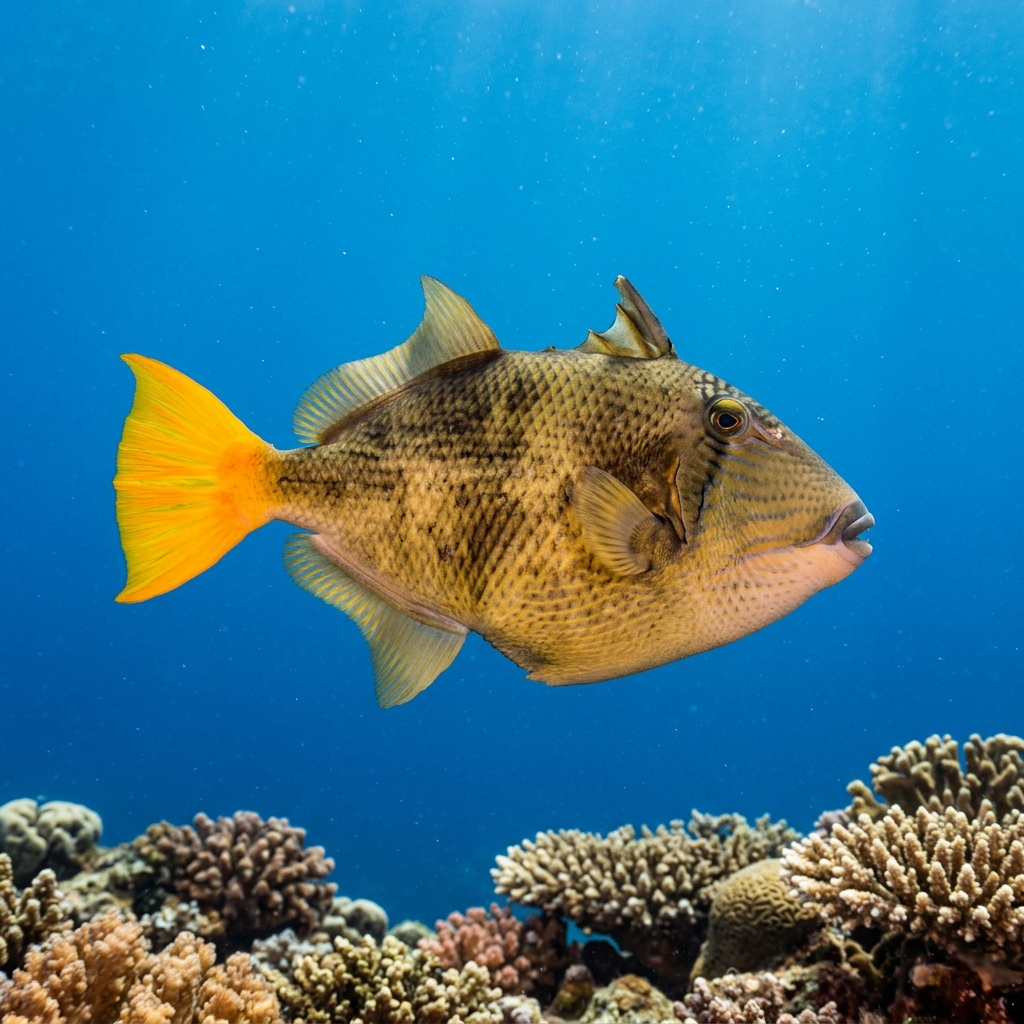
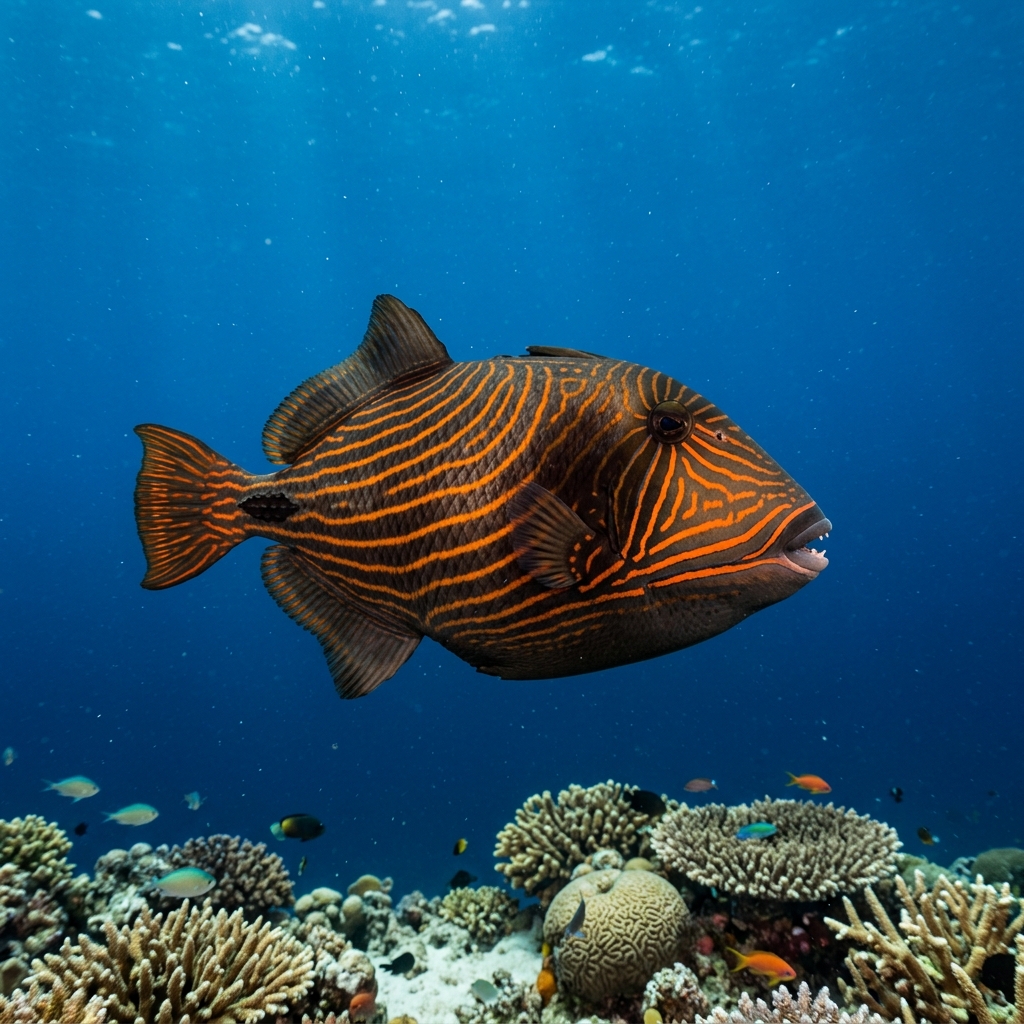
Bold orange or golden diagonal stripes ripple across a dark olive-green to brownish body, making this one of the easier triggerfish to nail at a glance. At roughly 20 cm, it sits on the smaller end of the triggerfish family, with an oval, laterally compressed body and that characteristic trigger spine (the locking dorsal spine triggerfish use to wedge into crevices). An orange stripe also runs from the corner of the mouth toward the pectoral fin base, giving the face a striped look that no other common reef triggerfish shares.
Expect to find one foraging alone across hard coral and rubble, picking at invertebrates, sea urchins, and encrusting organisms during daylight hours. Reactions to divers vary sharply between individuals: many will retreat briskly into a reef crevice, while others hold their ground and track your movements with one eye, especially if you wander close to a nest site. During breeding season, a nesting adult will make its displeasure clear with an escalating approach; back off early and it usually settles.
Like other triggerfish, it fans and moves sand to expose buried prey, and has strong enough teeth to crack sea urchin spines. This feeding behaviour can actually benefit local reef structure by controlling urchin populations.
In the Northern Hemisphere, sightings concentrate between May and March, which effectively covers most of the year with a quieter window in April. In the Southern Hemisphere, the productive window runs May through January, aligning with the warmer months when water temperatures sit in their preferred 25 to 29 °C range.
Most commonly logged across the Indo-Pacific, with the strongest presence in the Maldives, Indonesia, and the Philippines. The Male and Ari Atolls in the Maldives lead all regions in sighting records, followed closely by the Visayas in the Philippines and the Bali, Lombok and Java region of Indonesia. Egypt's Red Sea sites and Thailand also turn up consistent sightings, and it appears regularly along the Queensland coast of Australia.
Mapping where Orangestripe Triggerfish is logged…
They are found across a wide stretch of the Indo-Pacific. The Maldives, Indonesia, and the Philippines account for the largest share of logged sightings, with the Male and Ari Atolls, Bali, and the Visayas being particularly productive regions. Egypt's Red Sea and Thailand also offer reliable encounters.
In Northern Hemisphere destinations like the Maldives, Philippines, and Red Sea, sightings are reported across most of the year from May through March. In Southern Hemisphere locations such as Queensland, the most active window runs May to January. Their warm-water temperature preference of 25 to 29 °C means tropical reefs host them year-round in many spots.
They can be. Nesting individuals will actively charge divers who come too close to their territory. The defended zone extends upward above the nest, so swimming horizontally away rather than ascending is the safest exit. Outside nesting periods most individuals are wary and retreat, but some bold ones will approach to investigate.
Look for the bold, diagonal orange or golden stripes running across a dark olive-green body. A distinctive stripe also runs from the mouth toward the pectoral fin, giving the face a streaked appearance. No other commonly encountered reef triggerfish combines this stripe pattern with this colour scheme, making it one of the more straightforward triggerfish IDs.
They typically reach around 21 cm, making them one of the smaller triggerfish species on the reef. Their compact, oval body can make them look larger when they square up to a diver, but they are noticeably smaller than the titan triggerfish they sometimes share habitat with.
Across sites where they are recorded, the most typical sighting frequency is uncommon. You may well complete a dive without seeing one even at known sites. Encounters are more reliable in high-density regions like the Maldives atolls and the central Philippines, though sightings are never guaranteed.
Site and sighting data is aggregated from diver logs, iNaturalist and GBIF. For taxonomy and conservation status:
Flagtail Triggerfish
2,287 sites