Balistoides conspicillum
Spot the bold white spots and yellow lips of the Clown Triggerfish across the Maldives, Indonesia and Philippines. Best seen Nov, Mar in the north.
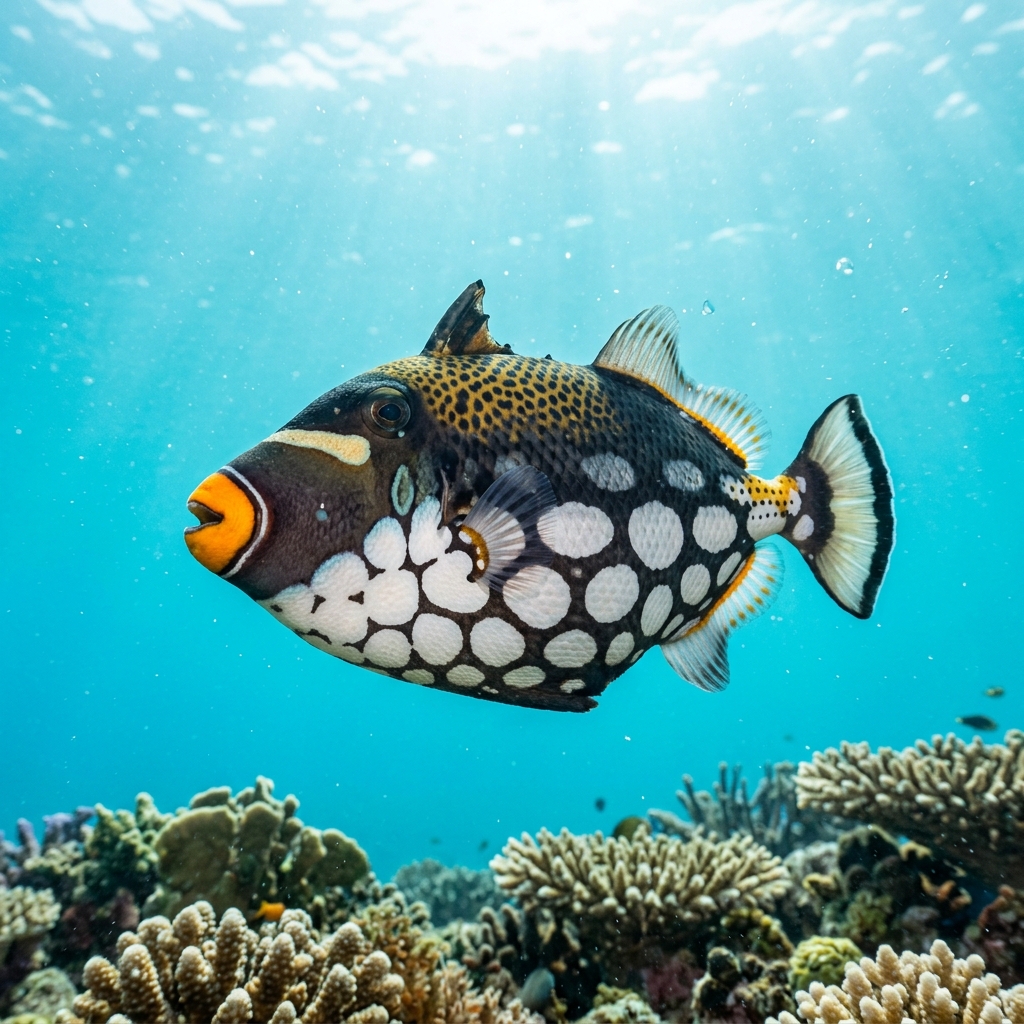
Few reef fish are as instantly recognisable: a dark upper body covered in yellow-edged white spots on the lower half, a vivid yellow or orange ring around the mouth, and a smaller scattering of pale dots across the upper flanks. The stocky, oval body and thick leathery skin are typical of triggerfish, but no other species combines this polka-dot belly with the bright mouth ring. Juveniles are darker overall with larger, more contrasting white spots, making them look even bolder than the adults.
Clown triggerfish tend to cruise mid-water or along outer reef slopes and drop-offs rather than hovering over flat sandy patches. They are typically solitary and can be wary of divers, often drifting away before you can close in, so a slow, non-direct approach works best. Sightings are usually brief, the fish moving purposefully between coral heads as it searches for hard-shelled invertebrates to crunch.
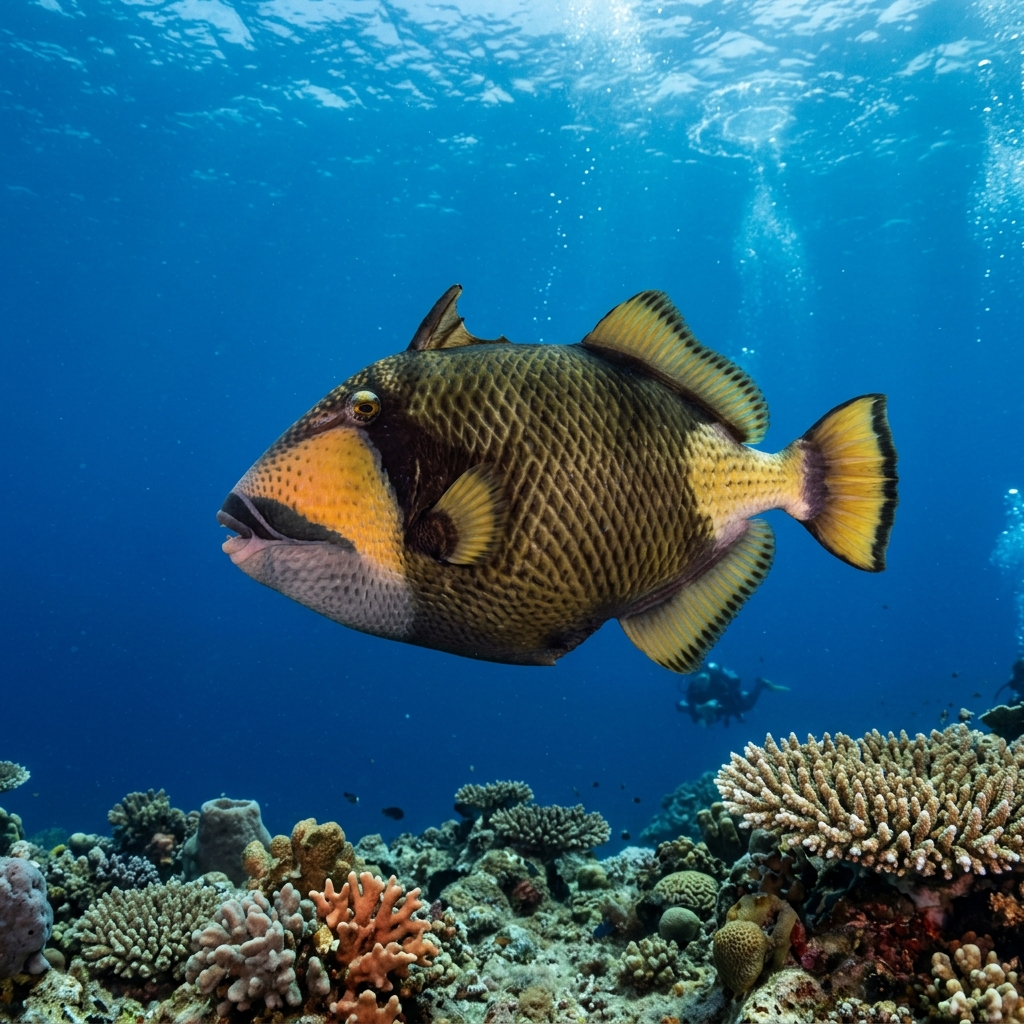
The trigger mechanism that gives the family its name is on full display here: the first dorsal spine locks upright and can only be released by depressing the smaller 'trigger' spine behind it, letting the fish wedge itself immovably into a coral crevice when threatened.
In Northern Hemisphere destinations such as the Maldives, Japan, and the Philippines, sightings concentrate from November to March. In Southern Hemisphere locations like Queensland and Indonesia's southern regions, the peak runs from October to April, broadly matching the warmer months within its preferred water temperature of 23 to 29 °C.
Most sightings come from the Maldives, particularly Male and Ari Atolls and the North and Central Atolls, which collectively make it the single strongest destination for this species. Indonesia follows closely, with solid records from Maluku and Papua, Nusa Tenggara and the Banda Sea, and Bali. The Philippines, especially Palawan, Apo Reef, and the Visayas, round out the top three countries, with further sightings reaching Australia's Queensland coast, Japan, Malaysia, and Palau.
Mapping where Clown Triggerfish is logged…
The Maldives is by far the most reliably logged destination, particularly Male and Ari Atolls and the North and Central Atolls. Indonesia (Maluku, Papua, Bali, and the Banda Sea), the Philippines (Palawan, Apo Reef, Visayas), and Australia's Queensland coast are also strong options. The species is widespread across the Indo-Pacific, reaching Japan, Malaysia, Palau, and South Africa.
In the Maldives, Philippines, and Japan, sightings peak from November to March. In Queensland and southern Indonesia, October to April is the strongest window. The species lives in warm tropical water around 23 to 29 °C, so it can be encountered year-round in its core range, but those seasonal peaks reflect when divers log it most often.
Look for the bold pattern of large white spots covering a dark lower body, combined with a vivid yellow or orange ring around the mouth. No other triggerfish shares this exact combination. The stocky oval shape and thick skin are classic triggerfish features, but the polka-dot belly makes this species unmistakable at a glance.
Adults typically reach around 50 cm in length, making them a medium-to-large triggerfish. In the water they look robust and substantial, with a thick, deep body that reinforces the impression of size even at the lower end of that range.
At most sites where it is recorded it is logged as uncommon, and at a significant number of sites it is considered rare. Common sightings are logged at only a small proportion of known sites. Patience and choosing well-rated destinations like the Maldivian atolls or Palawan improve your odds considerably.
No, clown triggerfish are not considered dangerous to divers. Unlike some of their relatives, such as the titan triggerfish, they do not guard nests aggressively. They are generally shy and will move away from approaching divers rather than standing their ground.
Site and sighting data is aggregated from diver logs, iNaturalist and GBIF. For taxonomy and conservation status:
Lagoon Triggerfish
2,435 sites