Ptilosarcus gurneyi
Orange sea pens sway in cold Pacific waters from British Columbia to Alaska. Find out where divers spot them, what they look like, and when to go.
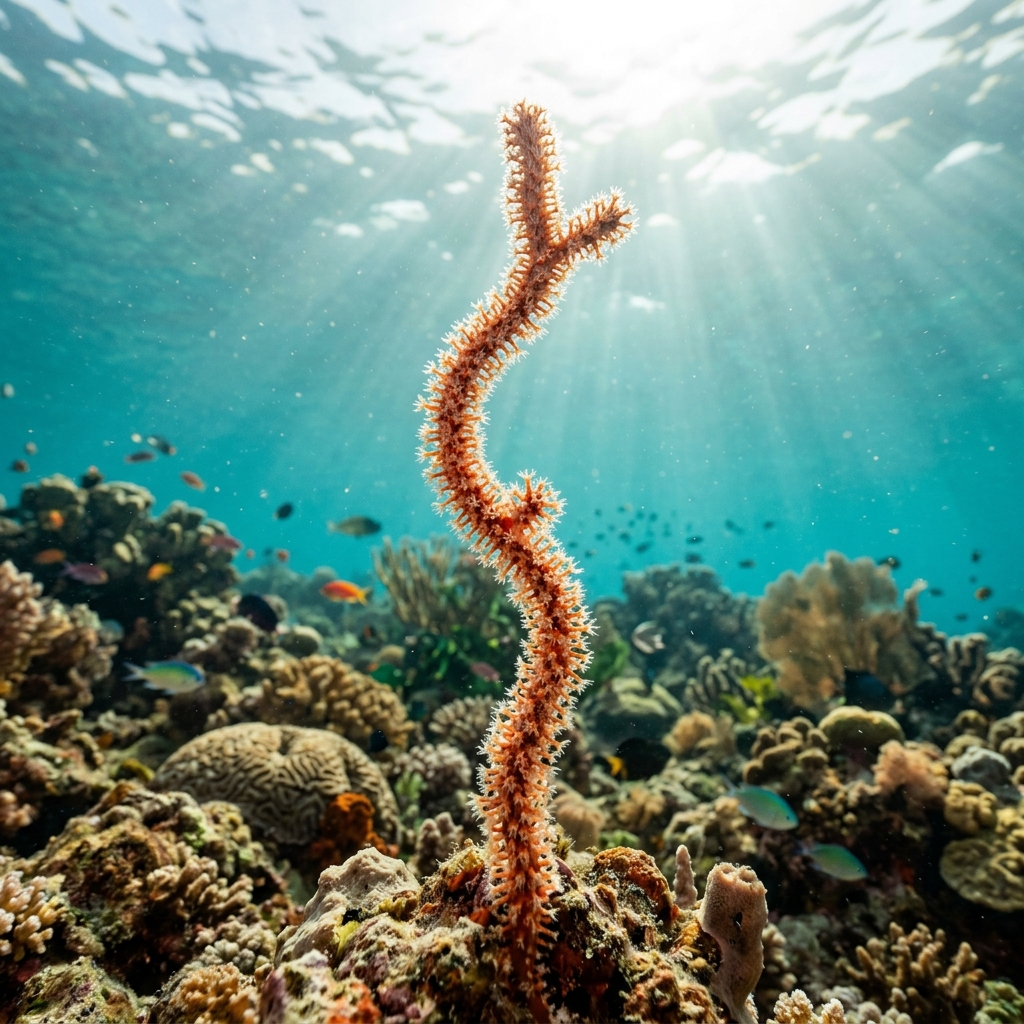
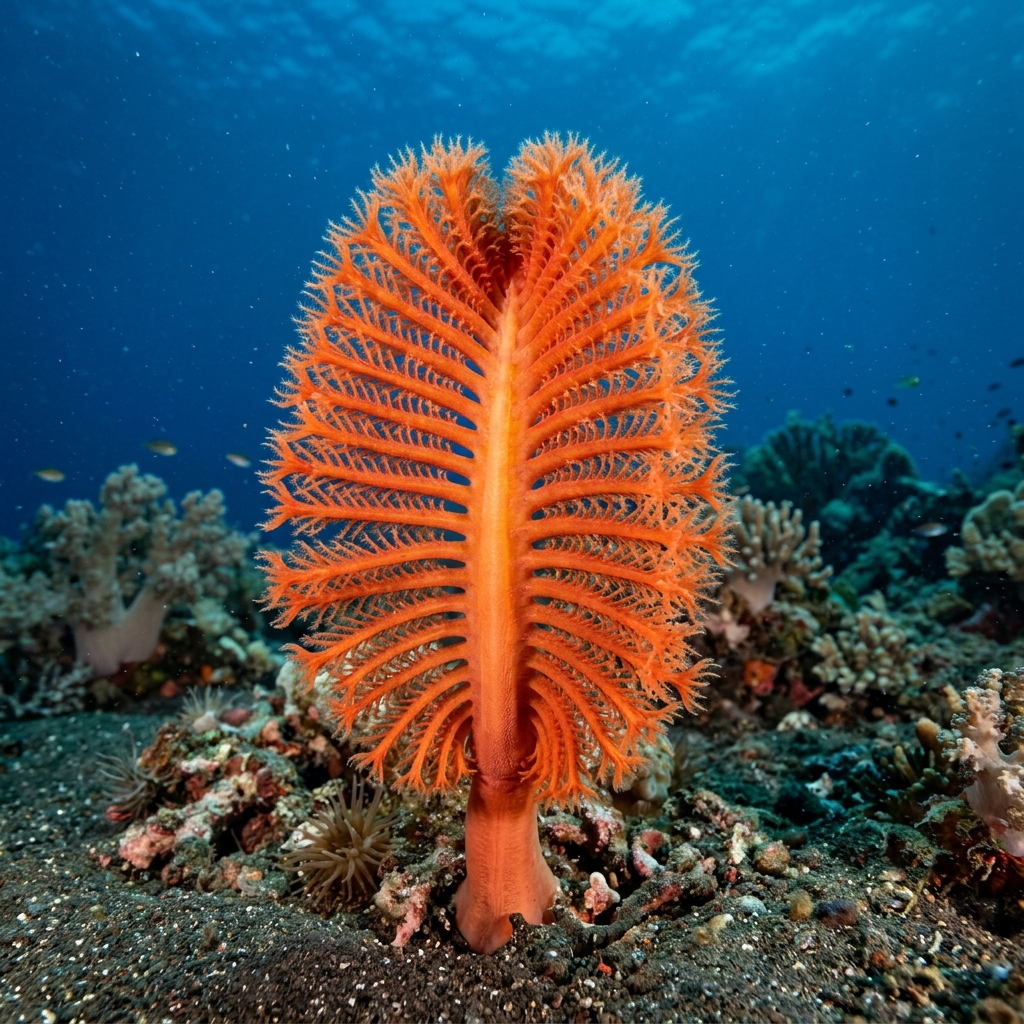
Rising up to around 30 cm from soft sediment, this animal looks unmistakably like an old-fashioned quill pen: a stiff central stalk (the rachis) lined symmetrically with feathery side branches covered in tiny feeding polyps. Underwater, the dominant colour is a warm orange to orange-yellow, which catches a torch beam well in low-visibility cold water. The whole colony sways slowly with current when actively feeding, giving it a soft, animated quality that helps separate it from debris or sponge.
Fixed in place on soft sandy or muddy bottoms, an orange sea pen spends its time extending its polyps into the current to filter feed, and that is largely what you will see when you find one. It does not react to divers and is not shy, so you can approach slowly for a close look without disturbing its feeding behaviour. Polyps are typically extended during daylight hours, making daytime dives the best opportunity for the full visual effect.
Like many sea pens, this species can luminesce, producing a faint blue-green glow when physically disturbed. If you encounter one in the dark during a night dive and a current brushes it, you may catch a brief bioluminescent flash ripple along the colony.
There is not enough seasonal data to point to a peak month, so encounters appear possible year-round. Given its cold-water niche (observed between roughly 5 and 16 °C), the species is well suited to conditions in the Pacific Northwest in any season.
Reef neighbours a diver could mistake it for. Use the identification notes above to tell them apart.
Most sightings come from the British Columbia coast and the Pacific coast of the United States, making the cold-water reefs of the northeastern Pacific the go-to region. Alaska also produces a solid number of logged encounters. A handful of records extend further afield, including sites in Mexico and the British Virgin Islands, but these are outliers compared with the main Pacific Northwest stronghold.
Mapping where Orange Sea Pen is logged…
The Pacific Northwest is your best bet, with strong sightings across the British Columbia coast and the Pacific coast of the United States, including Alaskan waters. These cold, current-swept sites with sandy or silty bottoms are exactly the habitat this species favours.
There is no clear seasonal peak in the dive data, so they can be encountered year-round. Their cold-water preference means the Pacific Northwest is productive in any season, just be prepared for water temperatures that often sit below 12 °C.
Look for a quill-shaped colony rising from soft sediment, with feathery side branches symmetrically arranged along a central stalk. The warm orange colour and slow swaying in current make it distinctive. No local species shares quite the same shape and colour combination.
They typically reach around 30 to 32 cm in height, roughly the length of a forearm. That makes them noticeable on an open sandy bottom, though easy to miss if you are not scanning carefully near the substrate.
Yes, they are bioluminescent. When disturbed, they can produce a brief blue-green light that travels along the colony. This is a defence response, not a feeding behaviour, and is best observed on a night dive when ambient light is low.
Not at all. They are completely passive filter feeders anchored to the seafloor. The only thing to be careful about is not kneeling on or finning into them, as the colony is fragile and slow to recover from physical damage.
Site and sighting data is aggregated from diver logs, iNaturalist and GBIF. For taxonomy and conservation status:
Red Coral
3,301 sites