Trapania vitta
A rare find in Luzon, Philippines: this tiny nudibranch turns up on warm reefs at 25-31C, but only if you slow down and look close.
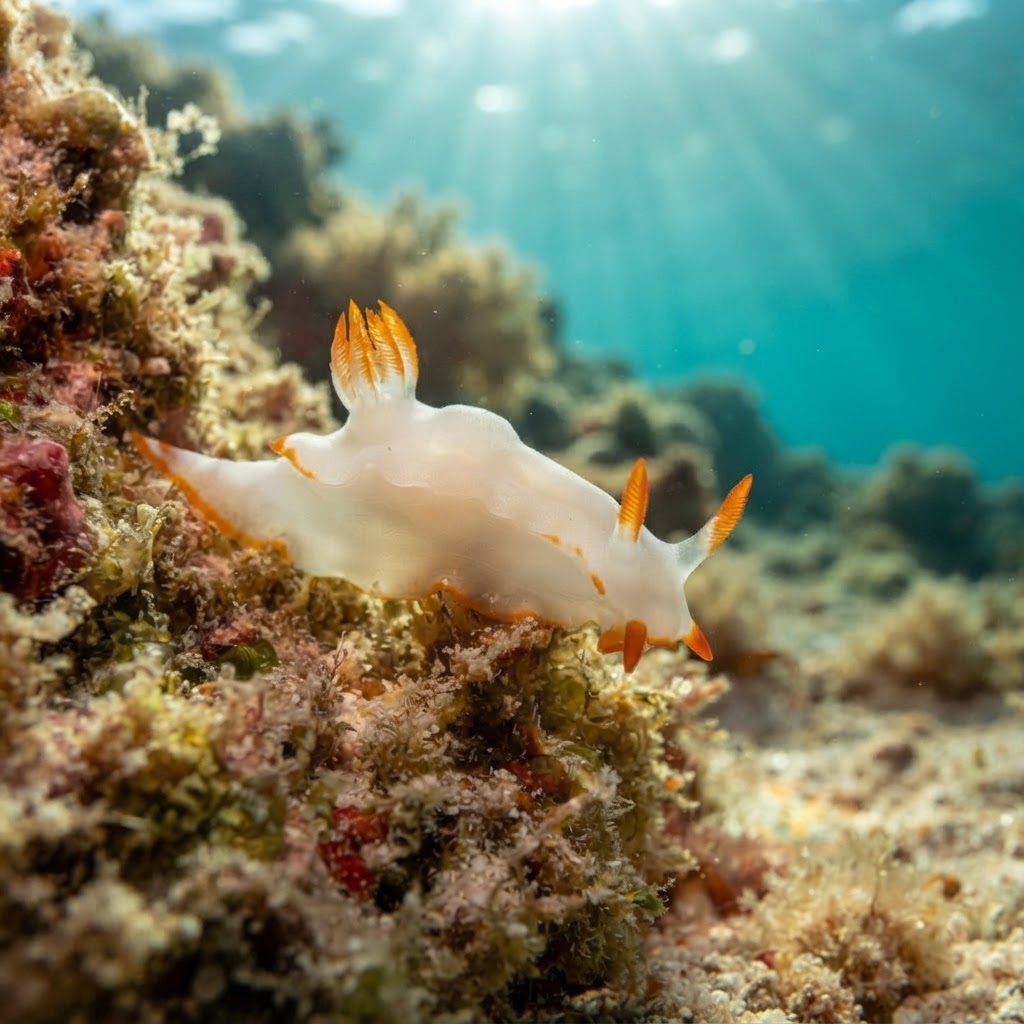
A small, slender nudibranch with a translucent white to pale body and fine orange or yellow trim along the mantle edge and extended tentacle-like appendages (oral tentacles and gill projections) near the head and rear. The long, whip-like processes trailing off the body are the giveaway, most Chromodoris-type nudibranchs are smooth and oval by comparison. It moves slowly across hard substrate and rubble, rarely more than a couple of centimetres long.
Divers find it moving slowly over rubble and hard substrate, usually spotted by dive guides or macro-focused divers scanning the bottom rather than the water column. It shows no reaction to divers beyond continuing its slow grazing pace, and there's no reported day/night pattern that sets it apart from other small dorids on the reef.
Like other Trapania species, it likely feeds on bryozoans and small encrusting invertebrates, using its exposed extra sensory tentacles to track prey across the reef surface rather than relying on eyesight.
Sightings sit within a warm 25.3 to 31.3C band with no detected seasonal pattern, so it's logged year-round on tropical reefs rather than tied to a particular month.
Reef neighbours a diver could mistake it for. Use the identification notes above to tell them apart.
Most records come from Luzon in the Philippines, which accounts for the bulk of logged sightings, with a further site recorded in Queensland, Australia. Treat it as a Philippines-first search if you're specifically hunting this one down.
Mapping where Orange-edged Pump Dorid is logged…
It's most reliably logged in Luzon, Philippines, with an additional sighting recorded in Queensland, Australia. Sightings overall are uncommon, so it's a species for divers actively searching rubble and hard substrate rather than a guaranteed spot.
There's no clear season in the data, sightings occur year-round on warm reefs between roughly 25 and 31C. Any time you're diving Luzon's reefs in that temperature range is fair game.
Look for a small, pale translucent body with orange or yellow edging along the mantle and long, thread-like tentacles trailing near the head and tail. It's easy to miss against rubble, so slow, close-up scanning is key.
Exact size data isn't available, but like other Trapania species it's small, typically only a centimetre or two long, making it a macro-photography target rather than something spotted from a distance.
It carries extended sensory tentacles near its head and tail that likely help it track small prey like bryozoans across the reef surface, a feature shared across the Trapania genus.
Site and sighting data is aggregated from diver logs, iNaturalist and GBIF. For taxonomy and conservation status:
Light-spotted Aegires
3,168 sites