Oncorhynchus nerka
Kokanee thrive in cold, clear lakes at 4.9-12.6 °C. Learn how to spot this landlocked sockeye salmon and what to expect underwater.
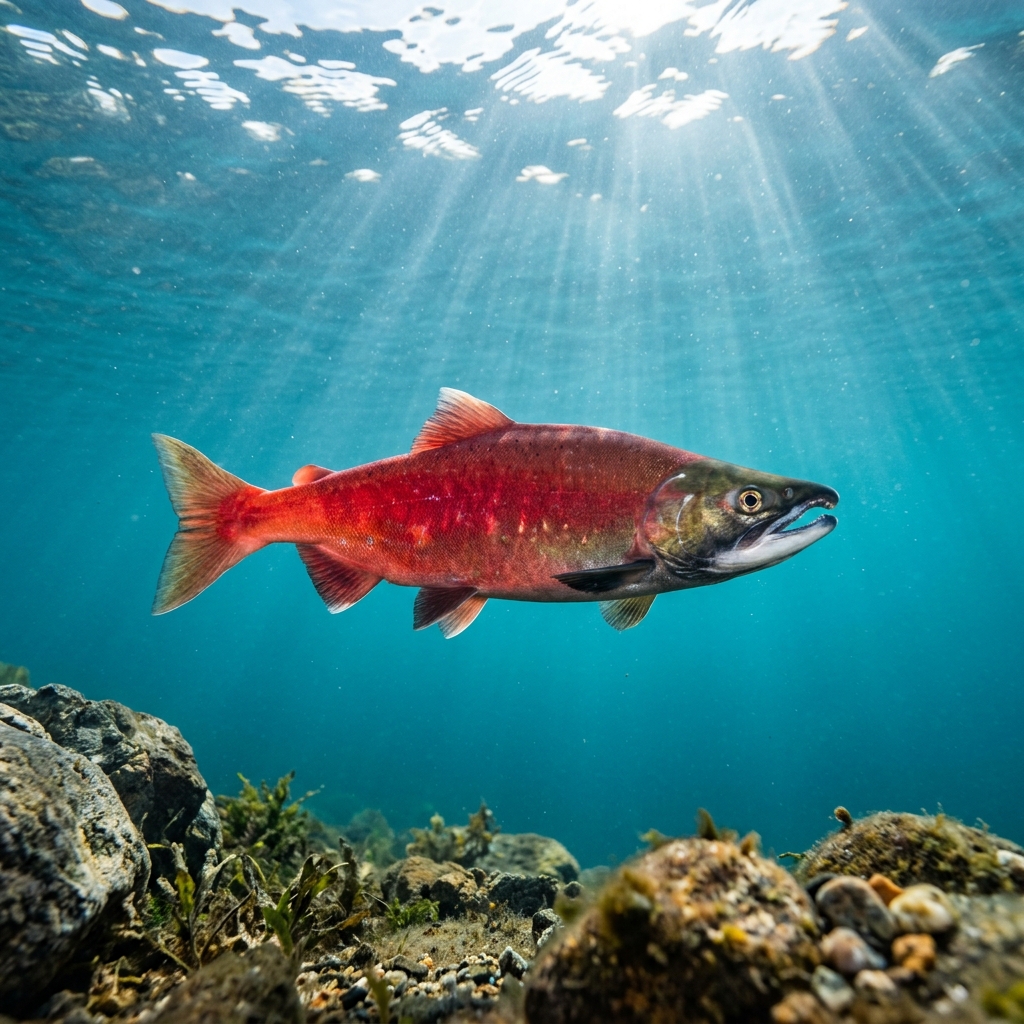
Kokanee are the landlocked form of sockeye salmon, typically slender and silvery-blue in their non-spawning phase, with a metallic sheen along the flanks and fine black speckles but no large spots like those on a rainbow trout. During spawning, males develop a striking red-to-crimson body with a green head and a pronounced hooked jaw (kype). Females also turn reddish at spawning time but are less vivid and lack the strongly hooked jaw. Their small size relative to sea-run sockeye is the most reliable underwater cue.
Kokanee school in open water, tracking cold-water layers rather than hugging the bottom, so encounters typically happen in the mid-water column of deep, cold lakes rather than on any reef structure. During non-spawning months they tend to hold at depth and may disperse quickly when approached. Spawning fish move into shallower inlet streams and lake margins, making them far more visible to snorkellers and divers in those brief weeks.
At spawning time kokanee stop feeding entirely, live off stored energy, and die shortly after reproducing. Their decomposing bodies fertilise the lake and surrounding forest, making a single spawning run a significant nutrient event for the whole ecosystem.
There is not yet enough sighting data to identify a peak season. Their observed water-temperature range of 4.9 to 12.6 °C suggests that late spring through early autumn, when thermoclines in cold lakes place suitable temperatures at diveable depths, is the most logical window to target.
No dive sites with confirmed kokanee sightings have been logged on Fin yet, so there are no verified locations to point you to at this stage. Kokanee are found in cold, deep lakes across western North America and some introduced populations elsewhere, so freshwater lake dives in those regions offer the most plausible encounters. Until diver observations are logged here, local knowledge from lake-dive communities will be your best guide.
Mapping where Kokanee is logged…
No kokanee dive sites have been logged on Fin yet. Kokanee are landlocked salmon living in cold, deep lakes primarily across western North America. Your best bet is to connect with freshwater diving communities in those regions for site-specific tips.
There is no confirmed seasonal peak in Fin's data yet. Their preferred water temperature of roughly 5 to 13 °C suggests late spring through early autumn is when suitable conditions occur at diveable depths. Spawning season brings fish into shallower water and makes sightings easier.
Outside spawning season, look for a streamlined silvery fish with a metallic blue-green back and fine black speckling but no large spots. During spawning, males are unmistakable with a vivid red body and green head. Their smaller size compared to sea-run salmon is a consistent clue.
Kokanee are notably smaller than their sea-run sockeye relatives. Most adults reach around 25 to 45 cm in length, though size varies considerably between lake populations depending on food availability.
No. Kokanee pose no risk to divers whatsoever. They are small, non-aggressive fish that will typically move away from a diver rather than towards one.
Kokanee are a landlocked form of sockeye salmon that complete their entire life cycle in freshwater, never migrating to the ocean. Like all Pacific salmon, they are semelparous, meaning they reproduce once and die, with their bodies becoming nutrients for the lake ecosystem.
Site and sighting data is aggregated from diver logs, iNaturalist and GBIF. For taxonomy and conservation status:
Sun Perch
2,182 sites