Oncorhynchus mykiss
Spot rainbow trout diving in Canada's Great Lakes region and Slovenia's Alpine Lakes. Watch for that pink lateral stripe in cool water from 3 to 23 °C.
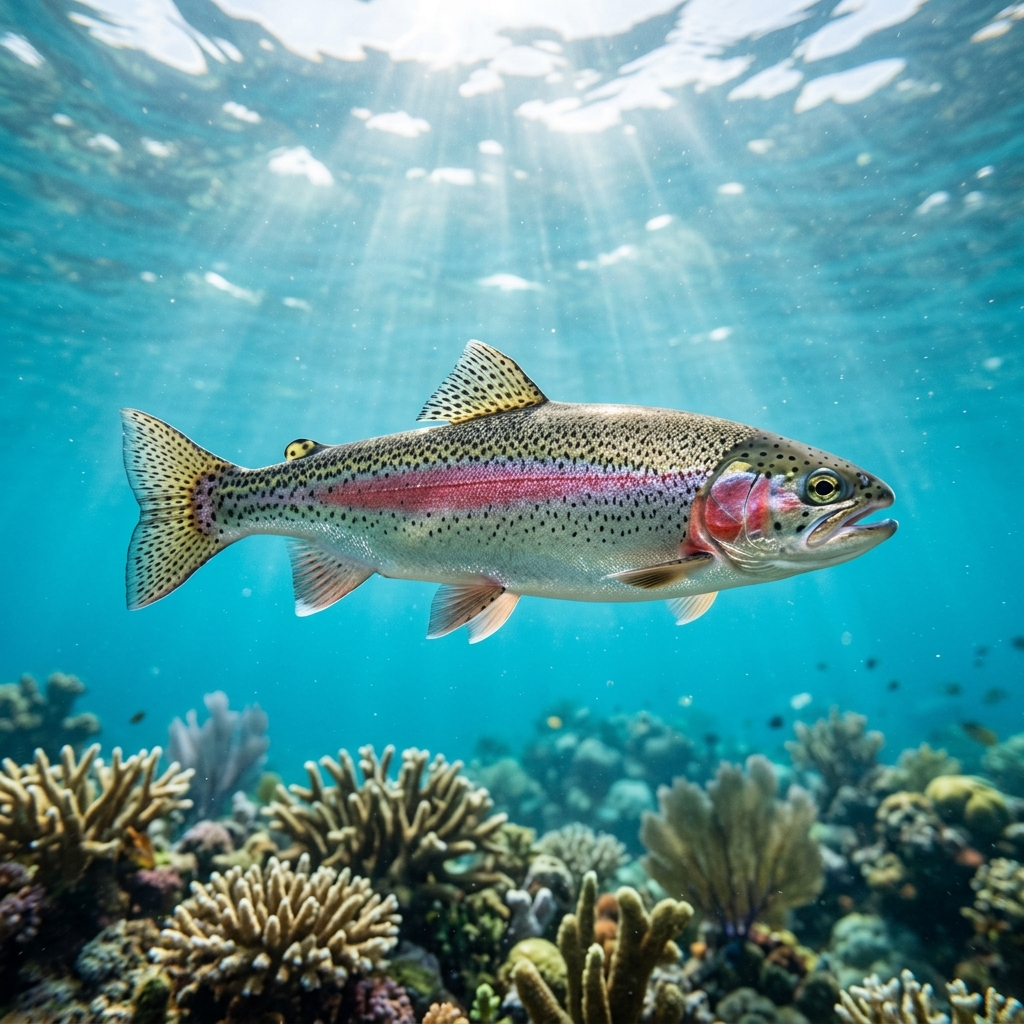
A sleek, torpedo-shaped salmonid most easily identified by the vivid pink-to-red horizontal stripe running along the lateral line from gill to tail. The flanks are silver to olive-green, heavily speckled with small black spots across the body, dorsal fin, and tail. In the water they look larger and more solid than most freshwater fish you'll encounter, with a distinctly forked tail and a slightly underslung jaw. Breeding males develop a more pronounced pink flush and a slightly hooked lower jaw (kype).
Rainbow trout are active, fast-moving fish that tend to hold in mid-water or near the bottom in areas with current or structure such as submerged boulders and weed edges. They are wary and will typically move away from a diver at pace rather than allowing a close approach, so slow, calm movement improves your chances. Most encounters are brief, with the fish doing a single pass before retreating to deeper or more sheltered water.
Rainbow trout are native to Pacific drainages of North America and East Asia, but introductions for recreational angling have spread them to cold lakes and rivers across Europe and beyond, which is why divers encounter them in Swiss and Austrian alpine lakes far outside their original range.
Northern Hemisphere sighting data concentrates in April through June, likely corresponding to increased trout activity in shallower water as temperatures rise from winter lows. Their tolerance for water between 3 and 23 °C means encounters are possible outside this window too, but spring is the most reliable period.
The overwhelming majority of logged sightings come from the Great Lakes and Ontario region of Canada, making it far and away the best-documented freshwater diving destination for this species. European alpine freshwater sites are also productive, with sightings spread across Slovenian Alpine Lakes, the Bernese Oberland in Switzerland, and the Salzkammergut in Austria. A smaller number of sites in the Great Lakes and Northeast United States round out the picture.
Mapping where Rainbow Trout is logged…
Most logged dive encounters come from the Great Lakes and Ontario region of Canada. Strong European options include Slovenian Alpine Lakes, the Bernese Oberland in Switzerland, and the Salzkammergut in Austria. A handful of sites in the northeastern United States also produce sightings.
Spring is the peak window. Northern Hemisphere sighting data points firmly to April through June, when trout move into shallower water as temperatures climb. Their broad temperature tolerance means encounters outside this window are possible, but spring gives you the best odds.
Look for the distinctive pink or red stripe running along the lateral line from behind the gill plate to the tail, combined with heavy black spotting on a silver-green body. The forked tail and streamlined shape distinguish them from most other freshwater fish you are likely to see at the same sites.
In wild lake environments rainbow trout commonly reach 50 to 80 cm in length and can exceed 5 kg, though fish over 90 cm do exist in large, food-rich lakes. Underwater they tend to look bigger than you expect, especially in the clear, low-distortion water of alpine lakes.
Rainbow trout are native to Pacific North America and northeastern Asia. They were widely introduced to European rivers and lakes during the 19th and 20th centuries for sport fishing. Many populations are now self-sustaining, which is why divers encounter them in Switzerland, Slovenia, and Austria.
Site and sighting data is aggregated from diver logs, iNaturalist and GBIF. For taxonomy and conservation status:
Sun Perch
2,182 sites