Notropis atherinoides
Spot the emerald shiner in the Great Lakes region of Canada and the US. A small, silvery freshwater fish observed in cold water down to 1°C.
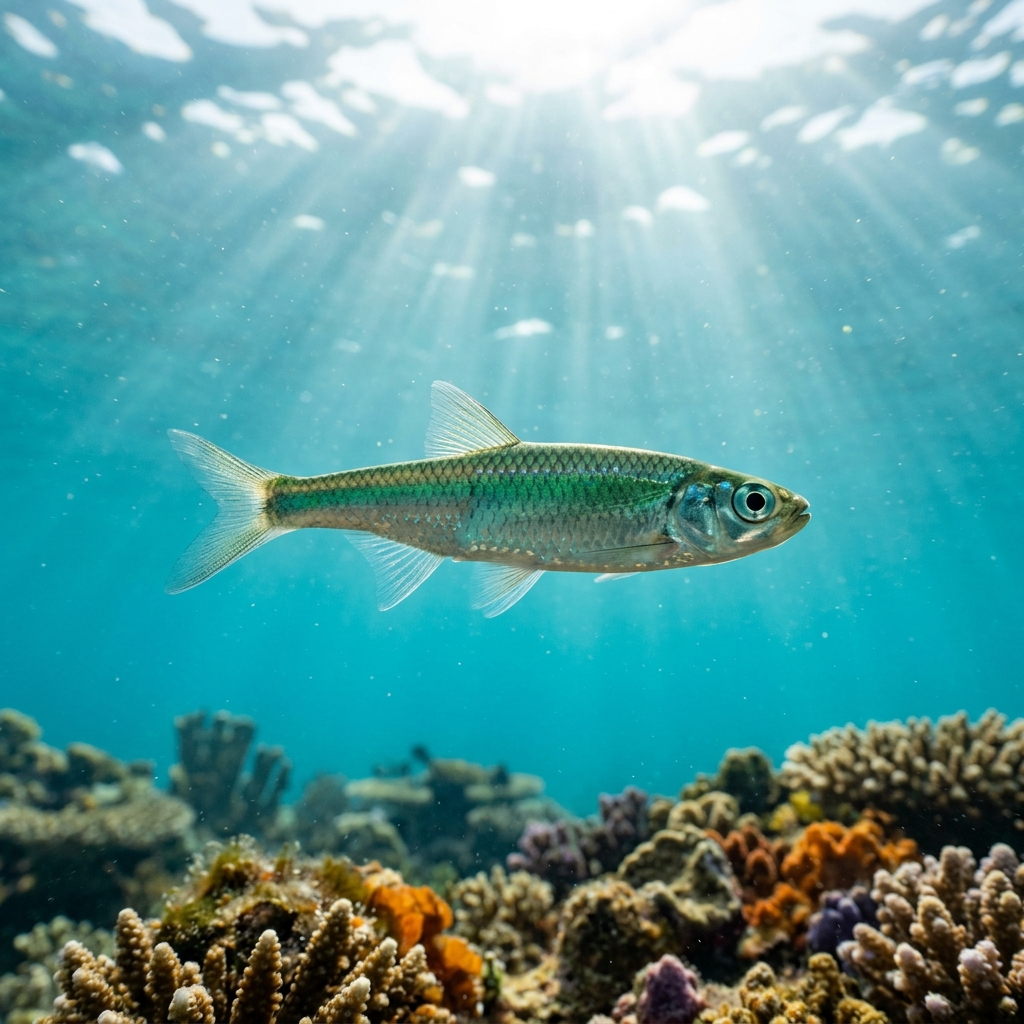
A small, slender fish with a strongly compressed (flattened side-to-side) body and a distinctly silvery sheen overlaid with a faint emerald-green iridescence along the back and upper sides. The belly is bright white and the scales are large enough to catch and scatter light, making schools flash noticeably in the water column. Look for the large eyes relative to the small, pointed head and the deeply forked tail as quick field marks.
Emerald shiners are open-water schooling fish, so when you do encounter them they are usually moving as a loose group in midwater rather than hugging the bottom or structure. Individual fish are quick and skittish around divers, but a large school may hold position briefly before breaking apart. Sightings are most likely in calmer, clearer stretches of river or lake rather than fast turbulent sections.
Schools of emerald shiners can be extraordinarily large in productive Great Lakes habitats, sometimes forming dense silvery clouds visible from the surface, making them one of the most visually striking freshwater schooling spectacles in North America.
There is not enough monthly sighting data to point to a peak season, so it should be treated as potentially present year-round. It tolerates very cold water down to around 1°C, so cold-water freshwater diving in the Great Lakes region can produce encounters even in the shoulder seasons.
Diver sightings cluster around the Great Lakes corridor, with the majority of logged encounters coming from Canadian sites in the Great Lakes and Ontario region. A smaller number of sightings extend into the Great Lakes and Northeast United States. Outside this freshwater belt there are no verified diver records in the data.
Mapping where Emerald Shiner is logged…
Verified diver sightings come from the Great Lakes and Ontario region in Canada and the Great Lakes and Northeast region in the United States. The Canadian sites account for the majority of logged encounters, making the Canadian Great Lakes corridor the most reliable area to look.
There is no clear seasonal peak in the available data, so they should be treated as potentially present year-round. They are known to tolerate very cold water, so encounters are possible even during cold-water freshwater dives in late autumn and winter.
Look for a small, slender, strongly compressed fish with an intensely silvery body and a subtle green iridescence along its back. Large eyes, a pointed snout, and a deeply forked tail help confirm the ID. They are almost always seen in schools rather than alone, which itself is a useful clue in Great Lakes freshwater environments.
Emerald shiners are a small fish, typically reaching around 5 to 9 centimetres in length as adults. Their slim, compressed body makes them look even smaller in the water, and they are easy to overlook unless you spot a school.
At most sites where they have been recorded, emerald shiners are logged as uncommon, with one site where they appear common and one where they are rare. Sightings are not guaranteed even in their core Great Lakes range, so treat an encounter as a welcome bonus rather than a certainty.
Site and sighting data is aggregated from diver logs, iNaturalist and GBIF. For taxonomy and conservation status:
Sun Perch
2,182 sites