Nematistius pectoralis
Spot roosterfish by their towering dorsal spines and bold stripe pattern. Active in warm coastal waters between 22-30 °C, here's what divers need to know.
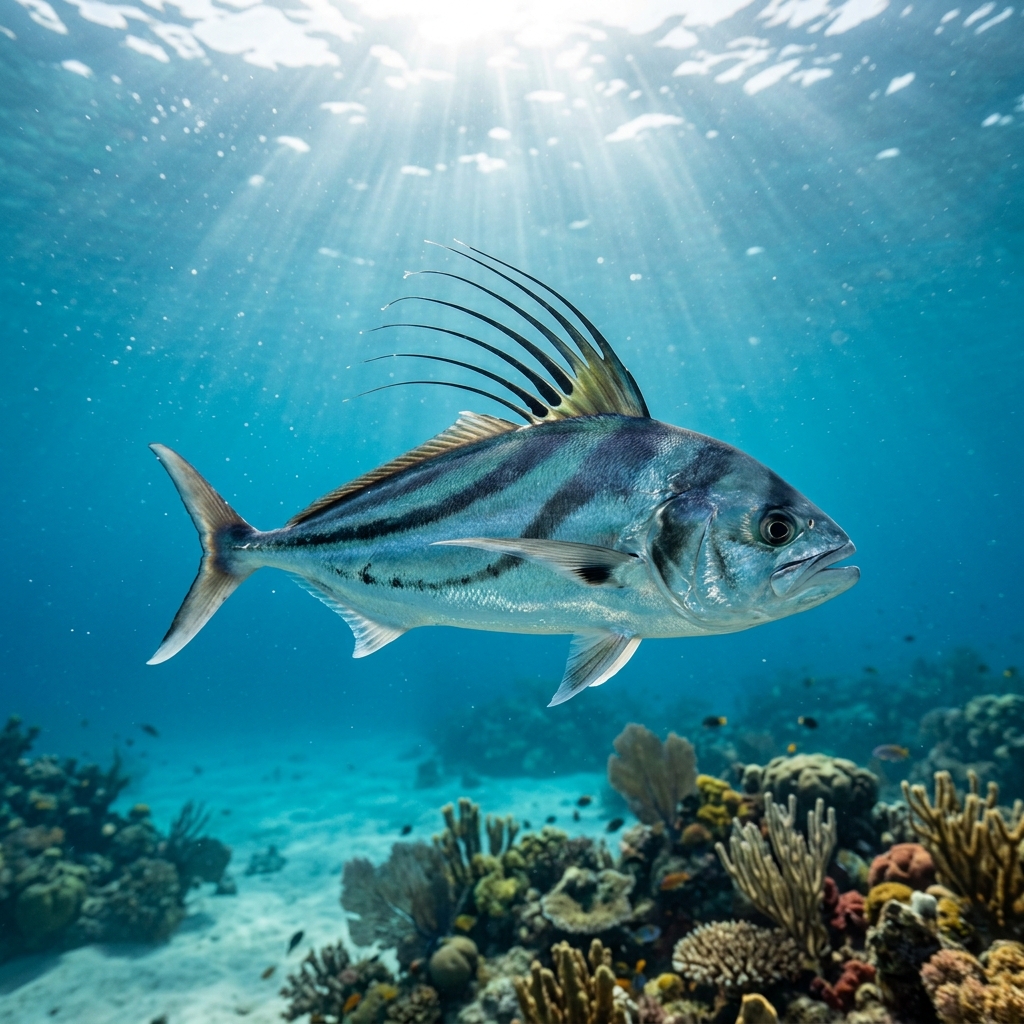
The roosterfish is unmistakable once you know what to look for: seven extraordinarily long, separate dorsal spines fan upright like a cockerel's comb, giving the fish its name. The body is silvery with two bold, dark curved stripes arching across the flanks. It reaches over a metre in length and has a deep, laterally compressed body that looks powerful and purposeful in the water. No other coastal fish in its range carries that combination of elongated free spines and strongly arched markings.
Roosterfish are active, fast-moving predators of the surf zone and sandy shallows, often hunting in small groups close to shore rather than over reef structure. They chase baitfish aggressively and can move at speed, so encounters tend to be brief unless the fish are preoccupied with feeding. They are not known to show particular curiosity towards divers, but a calm approach in low-surge conditions gives the best chance of time with them.
The seven free dorsal spines are not connected by a membrane, each spine stands independently. This unique arrangement is so distinct that the roosterfish is the sole member of its entire family, Nematistiidae.
There is not yet enough monthly sighting data to identify a peak season. The species is observed in water temperatures of roughly 22 to 30 °C, which corresponds to the warm coastal conditions found year-round in the tropical and subtropical eastern Pacific.
Roosterfish sightings have not yet been formally logged across Fin's dive-site network, so there is no data-backed ranking of top sites at this time. Based on known biology, the species is associated with sandy beaches, estuaries, and inshore coastal shallows along the eastern Pacific, from Baja California down through Central America to Peru. Divers exploring nearshore sandy environments in those regions stand the best chance of an encounter.
Mapping where Roosterfish is logged…
Look for the seven tall, separate dorsal spines that fan upright like a comb, no other fish in the eastern Pacific has this feature. Pair that with two bold dark curved stripes on a silvery body and you have an unmistakable ID. The fish is also large, often over a metre long, with a deep, powerful build.
Roosterfish regularly exceed one metre in length and can weigh over 50 kg in large individuals. Even average-sized fish encountered inshore are substantial, they are noticeably large compared to most species found in the same nearshore sandy habitats.
Roosterfish live along the eastern Pacific coast from Baja California south through Mexico, Central America, and down to Peru. They favour sandy beaches, surf zones, and estuarine shallows rather than coral reefs, so dives or snorkel sessions in those inshore environments offer the best chance of a sighting.
There is not yet enough logged sighting data to pinpoint a peak month or season. The species tolerates water temperatures from around 22 to 30 °C, so it is present in warm coastal waters across much of the year throughout its eastern Pacific range.
Those seven free dorsal spines, unconnected by any membrane, are unique in the fish world and have given the species its own family, Nematistiidae, with no close relatives. The exact function is not fully understood, but the spines can be raised and lowered rapidly, likely playing a role in threat displays or communication between individuals.
No. Roosterfish are not considered dangerous to divers or snorkellers. They are fast, predatory fish but their prey is small baitfish, and they show no aggressive behaviour towards humans. A calm, unhurried approach is all that is needed around them.
Site and sighting data is aggregated from diver logs, iNaturalist and GBIF. For taxonomy and conservation status:
Bigeye Trevally
2,591 sites