Plesionika narval
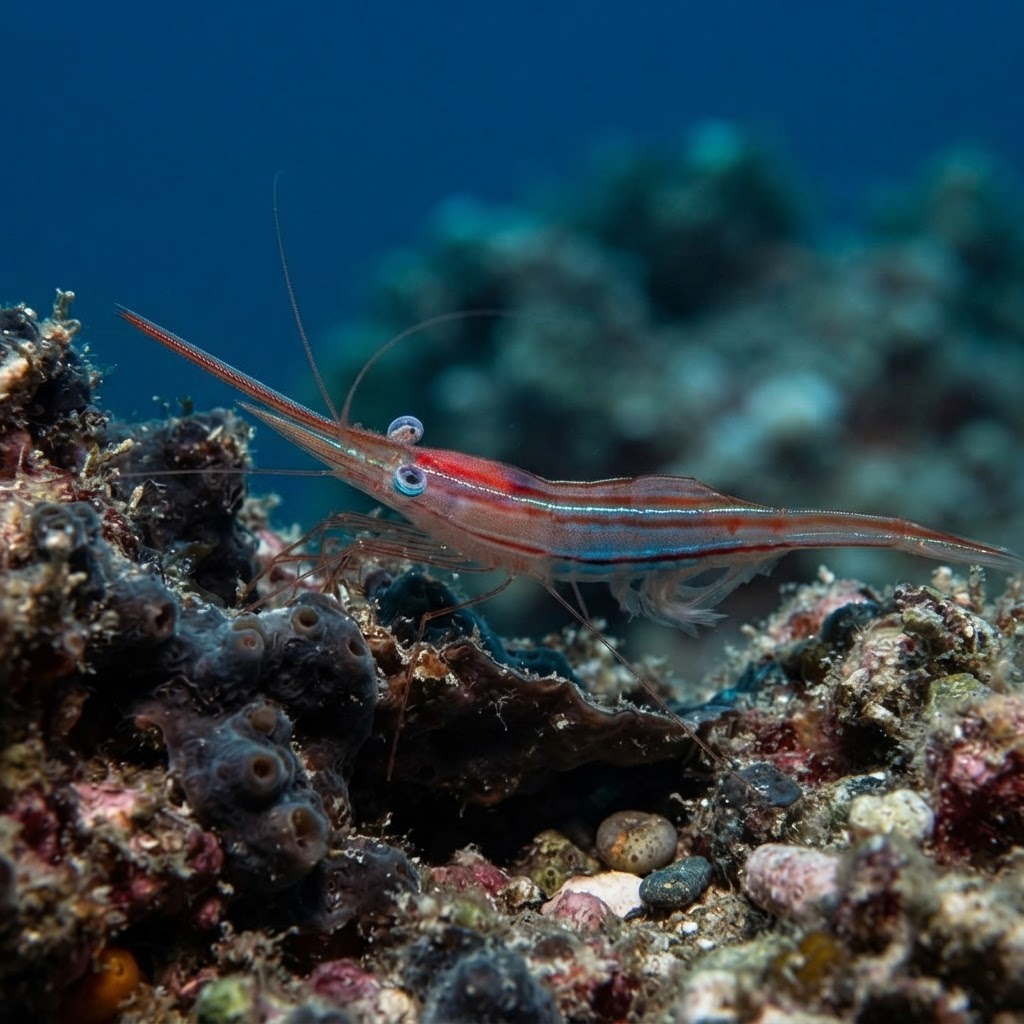
A near-transparent red-banded shrimp turning up on rocky ledges from Lanzarote to the French Riviera, mostly at night.
A small, slender shrimp reaching around 9 cm, with a mostly translucent body crossed by reddish bands that make it easy to pick out against dark rock or crevices. Its antennae are noticeably long, often trailing well past its body length, and it tends to sit still on ledges or in cave-like overhangs rather than swim in open water. Look for the reddish barring along the abdomen under torch light, which is usually the giveaway when spotting one at depth or at night.
Divers typically find this shrimp tucked into rocky crevices, overhangs, or the dark recesses of caves, often more active and visible on night dives when torch light picks up its reddish banding. It stays close to the substrate rather than venturing into open water, and it tends to hold its position rather than dart off when approached, though it will retreat deeper into a crevice if disturbed. Given its wide depth range, from shallow reef edges down past 900 metres, what divers see on a recreational dive is really just the shallow end of its distribution.
Its depth range stretches from around 10 metres down to over 900 metres, meaning most divers only ever encounter the shallow fringe of a species that spends much of its life far beyond recreational reach.
Sightings show no clear seasonal pattern, so it's treated as a year-round species at logged sites. Its comfort range of roughly 16.6 to 22.6 C spans much of the diving season in the Canary Islands and Mediterranean, which likely explains the lack of a tight window.
Most consistently reported in the Canary Islands, especially around Lanzarote and Tenerife, and along France's French Riviera and Provence coastline. Sicily in Italy also turns up regular sightings, with a smaller presence noted around Faial and Sao Jorge in the Azores.
Mapping where Narval is logged…
Best known from the Canary Islands, particularly Lanzarote and Tenerife, and also logged regularly along the French Riviera and Provence coast and around Sicily in Italy. Smaller numbers are recorded in the Azores.
There's no strong seasonal pattern in the sightings, so they're considered a year-round find at their known sites. Their preferred temperature range of roughly 16.6 to 22.6 C covers most of the diving calendar in the Canaries and Mediterranean.
Look for a small, mostly see-through shrimp with reddish banding across its body and long antennae, usually sitting still on rocky ledges or tucked into crevices. It's easiest to spot at night when torch light catches the red markings.
They're a small species, typically reaching about 9 cm in length, making the reddish banding the more reliable feature to spot rather than size alone.
No, they pose no danger to divers. They're a small, harmless crustacean that stays put on rock or in crevices when approached.
They occupy an enormous depth range, from around 10 metres to over 910 metres, so the animals divers see on a typical dive represent only the shallowest fraction of where the species actually lives.
Site and sighting data is aggregated from diver logs, iNaturalist and GBIF. For taxonomy and conservation status:
Sally Lightfoot Crab
2,422 sites