Morone chrysops
White Bass are most commonly logged by divers in the Great Lakes region of Canada. Here's how to spot them and what to expect underwater.
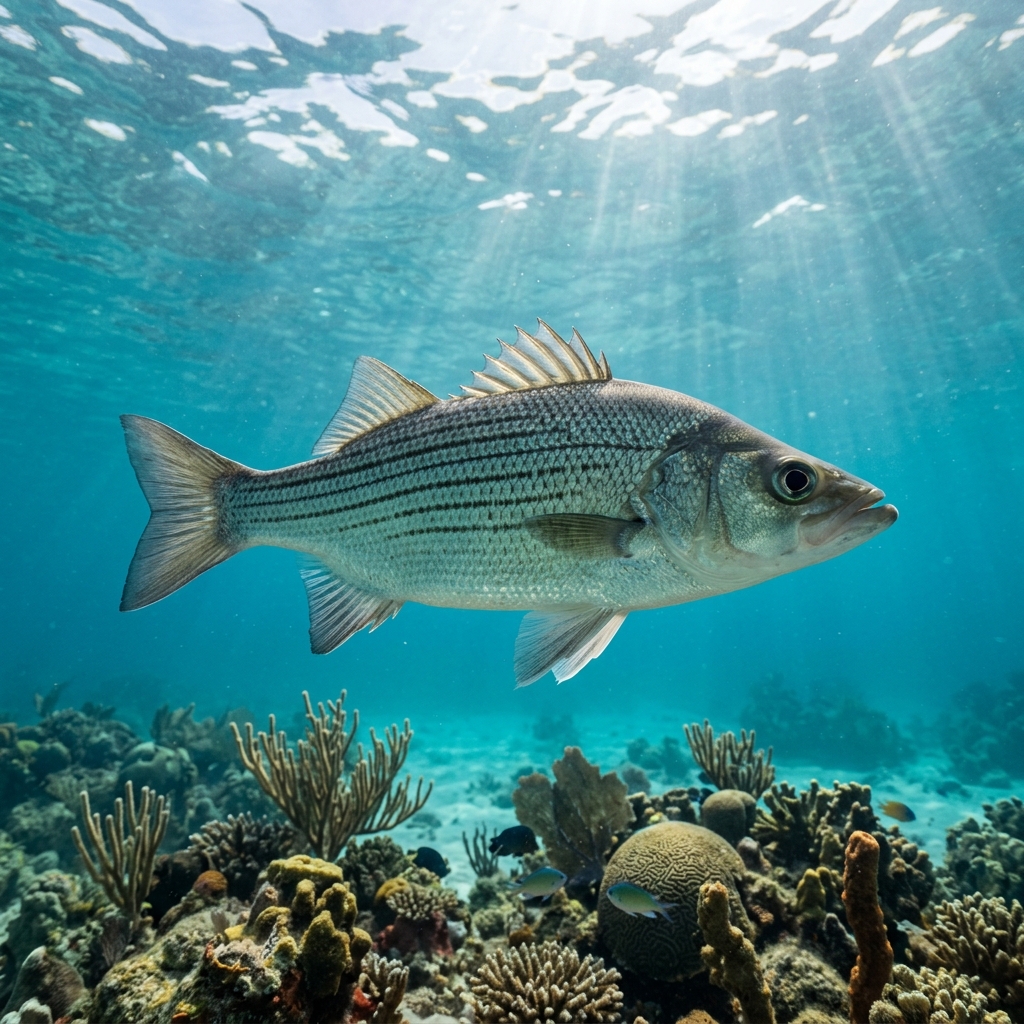
Look for a deep-bodied, silvery fish with a slightly greenish or bluish tinge on the back and a series of faint, broken horizontal stripes running along the flanks. The two dorsal fins are clearly separated, with the first being spiny and the second soft-rayed, a useful detail when you get a good side-on view. The undersides are pale white to cream, and the overall impression is of a robust, fast-looking fish. Eyes appear relatively large for the head size, which helps pick it out in murky freshwater conditions.
White Bass tend to be active, schooling fish that move through open water and along submerged structure, so divers often encounter small groups rather than solitary individuals. They are not particularly shy but will typically maintain a comfortable distance from an approaching diver rather than holding still. Keep movements slow and steady for the closest views.
White Bass are known for dramatic springtime spawning runs, when large aggregations move into tributary rivers and streams, making them far more visible and concentrated than at any other time of year.
There is not enough monthly sighting data to pin down a distinct season, so treat it as a year-round possibility. The observed water temperature range of roughly 1 to 23 °C reflects the full swing of Great Lakes conditions, suggesting this species is present across seasons rather than tied to a narrow warm-water window.
White Bass sightings are concentrated in the Great Lakes region, with the bulk of dive-logged encounters coming from sites in Ontario, Canada. There is also a recorded site in the Great Lakes and Northeast region of the United States. It is most reliably encountered at Canadian freshwater sites, where divers report it as common.
Mapping where White Bass is logged…
Dive-logged sightings come from freshwater sites in the Great Lakes region, with most encounters recorded in Ontario, Canada, and a site in the northeastern United States. These are temperate inland waters, so expect lake and river dive conditions rather than ocean reef environments.
There is no clearly defined peak season based on current diver data, so encounters are possible year-round across the Great Lakes region. Springtime spawning runs are well known from biology, and that period may naturally concentrate fish and improve sighting chances, though monthly dive logs are too sparse to confirm this statistically.
Key features are the silvery, deep body with faint broken horizontal stripes along the flanks, two clearly separated dorsal fins, and a pale white underside. The relatively large eye and robust build help distinguish it from slimmer freshwater species. Schooling behaviour is also a useful clue.
Typical size data is not available in current dive logs for this species. From known biology, adults commonly reach around 30 to 45 cm in length, though individuals can occasionally exceed that. They appear as a medium-sized, deep-bodied fish underwater.
No. White Bass pose no threat to divers. They are not aggressive and will generally move away rather than towards an approaching swimmer. Standard respectful diving behaviour is all that is needed.
White Bass are famous for their springtime spawning runs, during which large schools migrate from lakes into tributary rivers and streams to breed. These aggregations can be very dense and visible, making spring potentially the most rewarding time to observe them, even though the dive-log data does not yet confirm a seasonal peak.
Site and sighting data is aggregated from diver logs, iNaturalist and GBIF. For taxonomy and conservation status:
Sun Perch
2,182 sites