Priacanthus hamrur
Big red eyes and a rosy body under ledges: find Moontail Bullseye reliably across South Sinai and Marsa Alam, or the Maldives' Central Atolls.
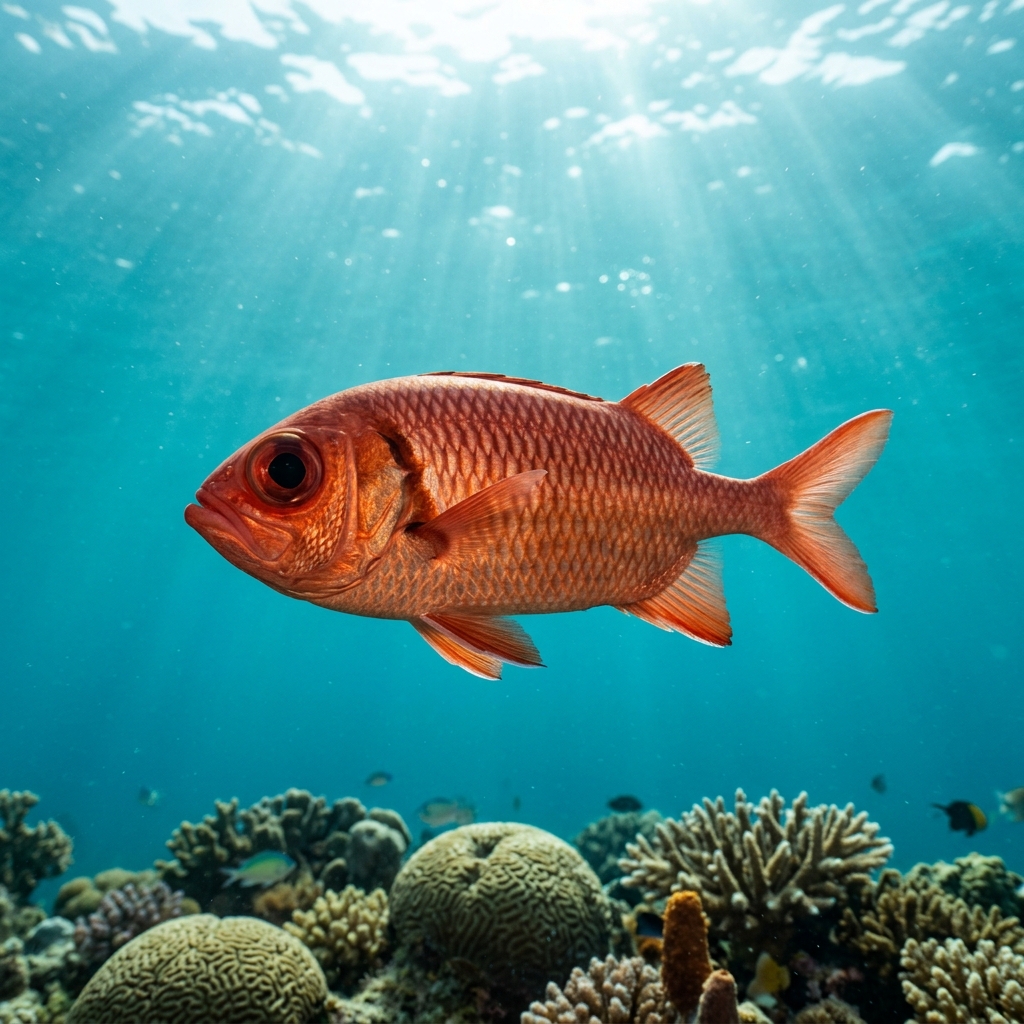
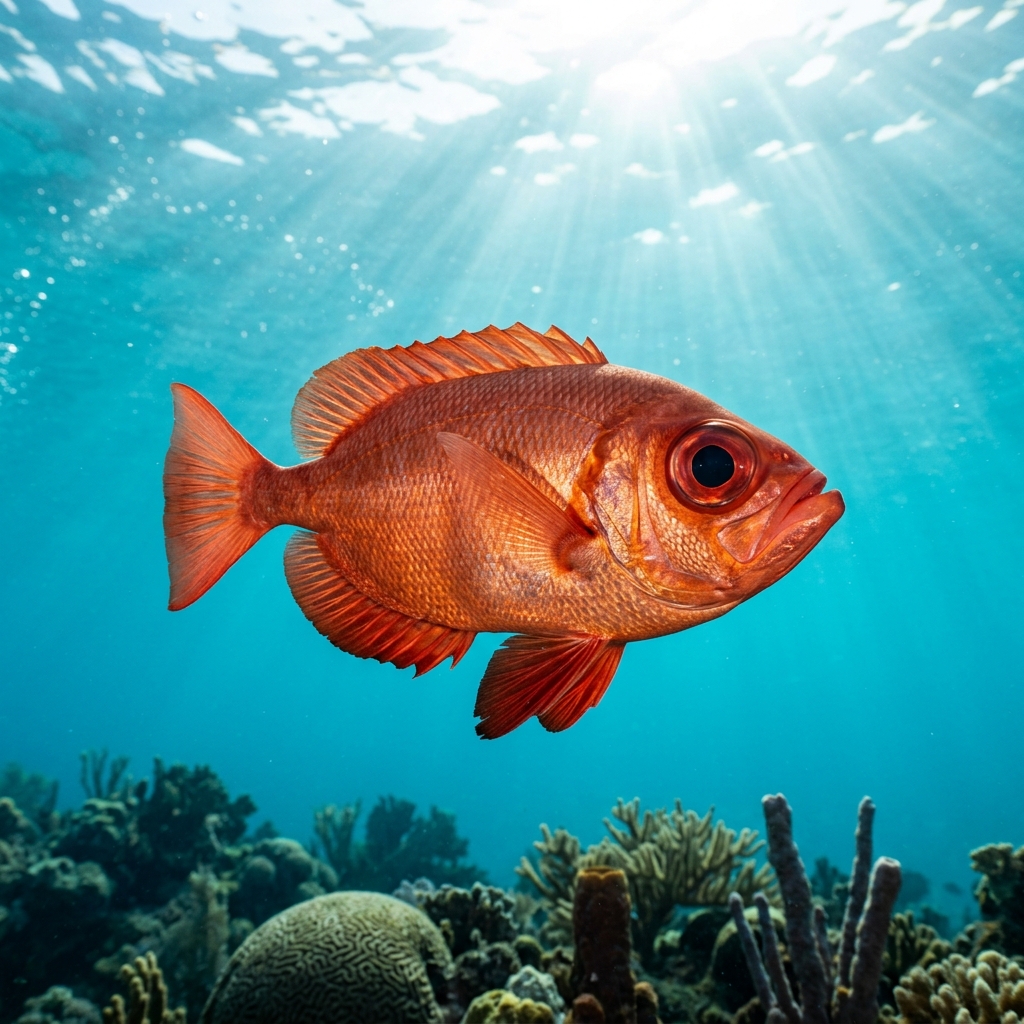
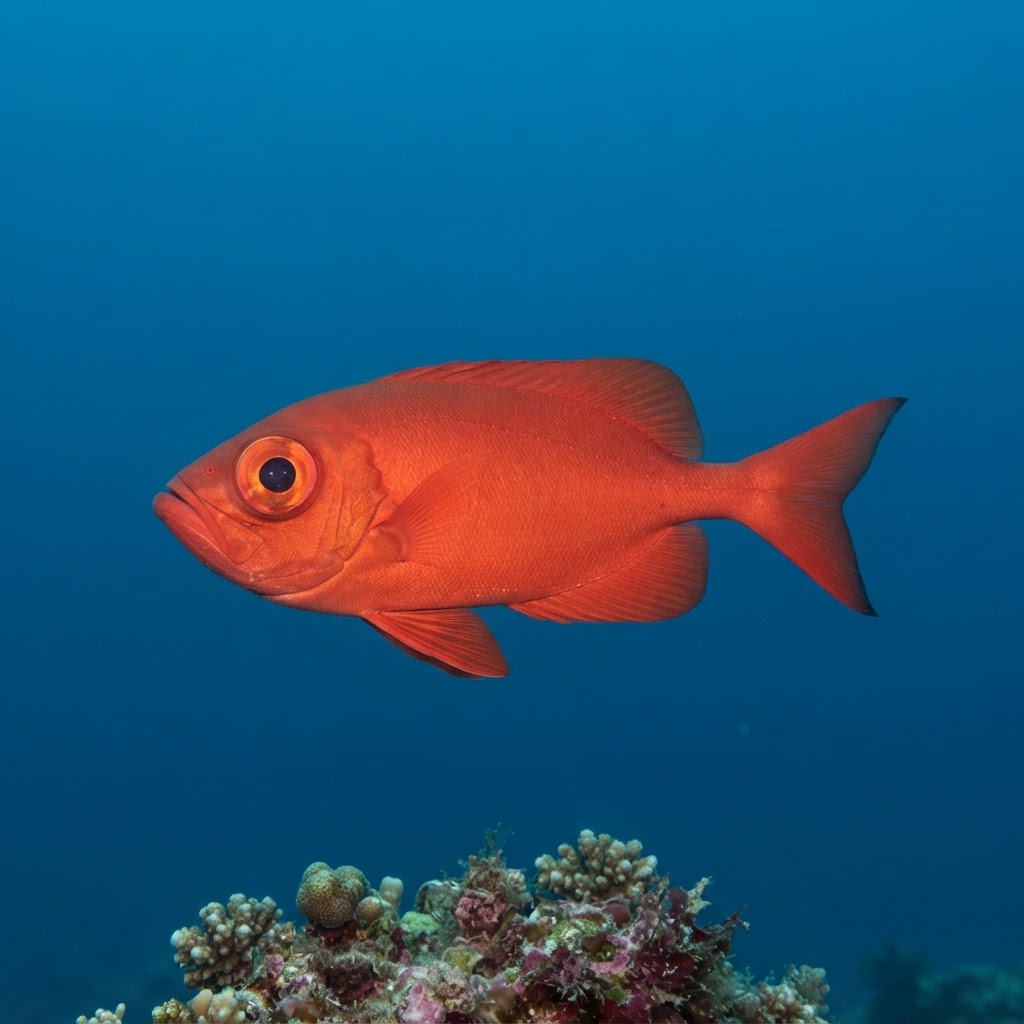
Look for a deep, oval, laterally flattened body in shades of red to pink, sometimes with faint mottling that fades depending on light and mood. The giveaway is the pair of oversized, almost cartoonish eyes, an adaptation for the low light where it hides, paired with a tail that has a distinct crescent or moon-shaped outline, hence the name. At around 31 cm it is a solid handful of fish, usually seen hovering nose-down or angled under an overhang rather than swimming openly over the reef.
Expect to find it tucked under ledges, in small caves, or hovering just inside the shade of a coral overhang, often in loose groups with others of its kind. It tends to hang nose-down or at an angle, drifting gently rather than darting, and generally tolerates a close approach before easing back into cover. Most sightings are by day, when it is resting up before its more active low-light feeding hours.
Those oversized eyes are built for feeding after dark, when it moves out from its daytime shelter to hunt small crustaceans and fish over the reef in low light.
No clear seasonal pattern shows up in the data, and with a comfortable range of roughly 19 to 28 C it turns up on reefs year-round rather than on a migration schedule. Plan around the region's general dive season rather than a specific month for this species.
Egypt's Red Sea is the strongest bet by far, with dense logging across South Sinai, Marsa Alam and the Deep South, and the Red Sea Riviera. The Maldives, especially the Central Atolls, is the next most reliable region, followed by Indonesia's Nusa Tenggara, Thailand's Khao Lak, South Africa's KwaZulu-Natal, and Sabah in Malaysia.
Mapping where Moontail Bullseye is logged…
Egypt's Red Sea is the top spot, especially South Sinai, Marsa Alam and the Deep South, and the Red Sea Riviera. It is also a reliable find in the Maldives' Central Atolls, Indonesia's Nusa Tenggara, Khao Lak in Thailand, and KwaZulu-Natal in South Africa.
There is no strong seasonal signal in sighting data, and its comfortable temperature range of about 19 to 28 C means it is present on reefs throughout the year. Dive it whenever conditions suit the region.
Look for a deep red to pink oval-bodied fish around 31 cm, with unusually large eyes and a crescent-moon-shaped tail. It is usually seen hovering under ledges or overhangs rather than out in the open.
They typically reach about 31 cm in length, a noticeably chunky, deep-bodied fish rather than a slender one.
No, they are not considered dangerous to divers. They tend to shelter under overhangs and simply ease away from a close approach.
Its oversized eyes are adapted for low-light feeding, allowing it to hunt small crustaceans and fish at night or in dim, shaded parts of the reef after resting up during the day.
Site and sighting data is aggregated from diver logs, iNaturalist and GBIF. For taxonomy and conservation status:
Soldierfish
3,612 sites