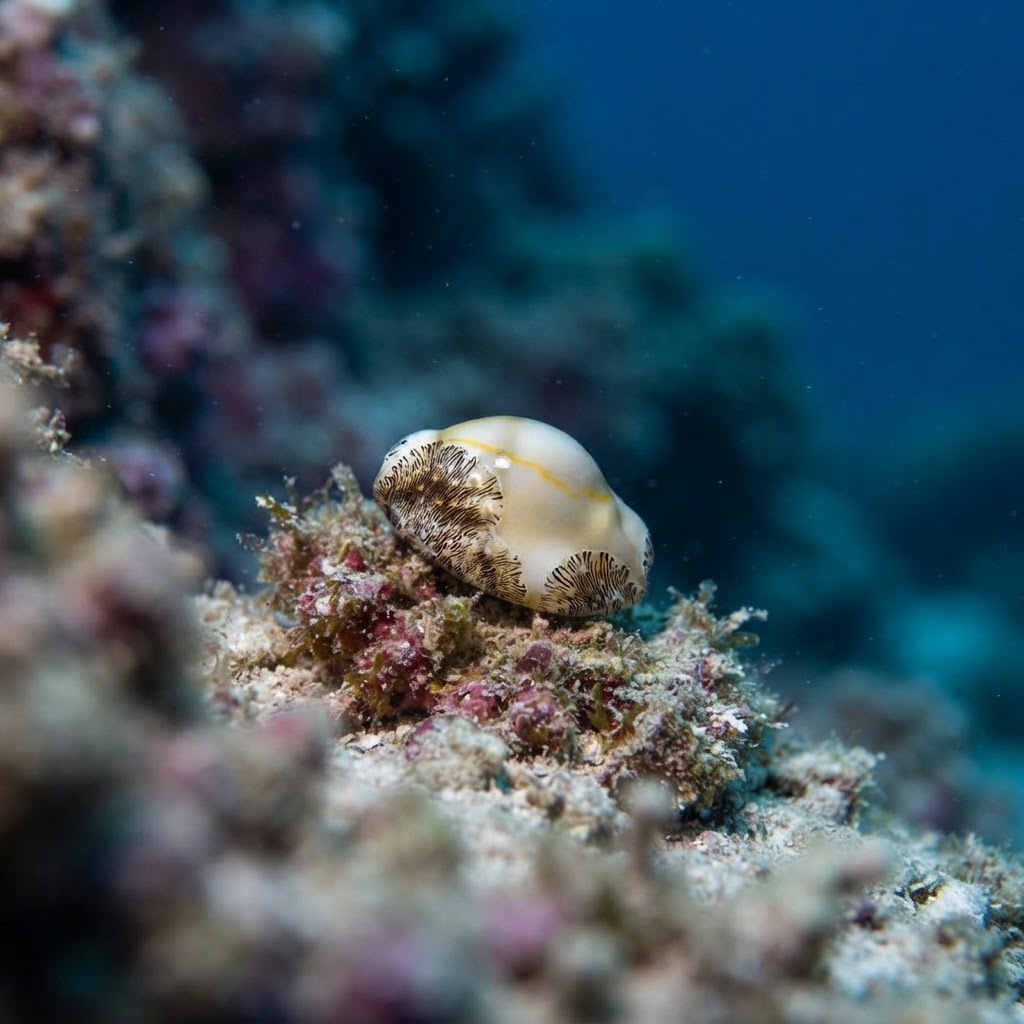
Monetaria moneta
Glossy, egg-shaped and barely 2cm long, the money cowrie turns up on reef flats from Bali to Kwajalein Atoll year-round in warm 24-30C water.
Look for a small, smooth, glossy shell about 2cm long with a rounded, egg-like shape and a flattened underside lined with fine teeth along a narrow slit-like opening. Colour runs pale yellow to tan on the back, sometimes with faint greenish or grey mottling, and the shell has a distinctive high polish that catches torchlight. When alive and undisturbed, the mantle (soft fleshy covering) may be drawn up over the shell, giving it a mottled, almost slug-like look before it retracts.
Spend most daylight hours tucked under rubble, in reef crevices or beneath rocks on shallow flats, only becoming more active and mobile after dark when it grazes over algae-covered surfaces. Divers and snorkellers usually find it by chance while poking around shallow rubble zones rather than seeing it out in the open. It shows no reaction to divers beyond withdrawing into its shell if handled.
Its shell was historically used as currency across parts of Africa, Asia and the Pacific, making it one of the few molluscs whose shell literally became money long before it became a dive-site curiosity.
Comfortable across a narrow warm band of 24 to 30C, so it's present on tropical reef flats all year with no clear seasonal peak in the data.
Most reliably found on reef flats and shallow reef in Indonesia, especially around Bali, where it turns up at more logged sites than anywhere else in the data. It's also a steady find across French Polynesia's Society Islands, the Central Atolls of the Maldives, Kwajalein Atoll in the Marshall Islands, Green Island in Taiwan, and Alofi in Niue.
Mapping where Money Cowrie is logged…
It's most commonly logged around Bali in Indonesia, with reliable sightings across French Polynesia's Society Islands, the Maldives' Central Atolls, Kwajalein Atoll in the Marshall Islands, and Green Island in Taiwan.
There's no strong season in the data. It sits in 24 to 30C water year-round on tropical reef flats, so any time you're diving those regions is fair game.
Check reef rubble and crevices for a small, glossy, egg-shaped shell around 2cm long, pale yellow to tan with a smooth polished surface and a toothed slit on the underside.
They're small, typically around 2cm long, easy to miss unless you're checking rubble and crevices closely on a shallow reef flat.
Its shell was once used as actual currency across Africa, Asia and the Pacific, giving the species its common name long before divers started spotting it on reef flats.
Site and sighting data is aggregated from diver logs, iNaturalist and GBIF. For taxonomy and conservation status:
Triton Shell
2,297 sites