Emerita talpoida
Mole crabs burrow into swash zones across Florida beaches, an uncommon but steady find year-round in 16.7 to 28C water.
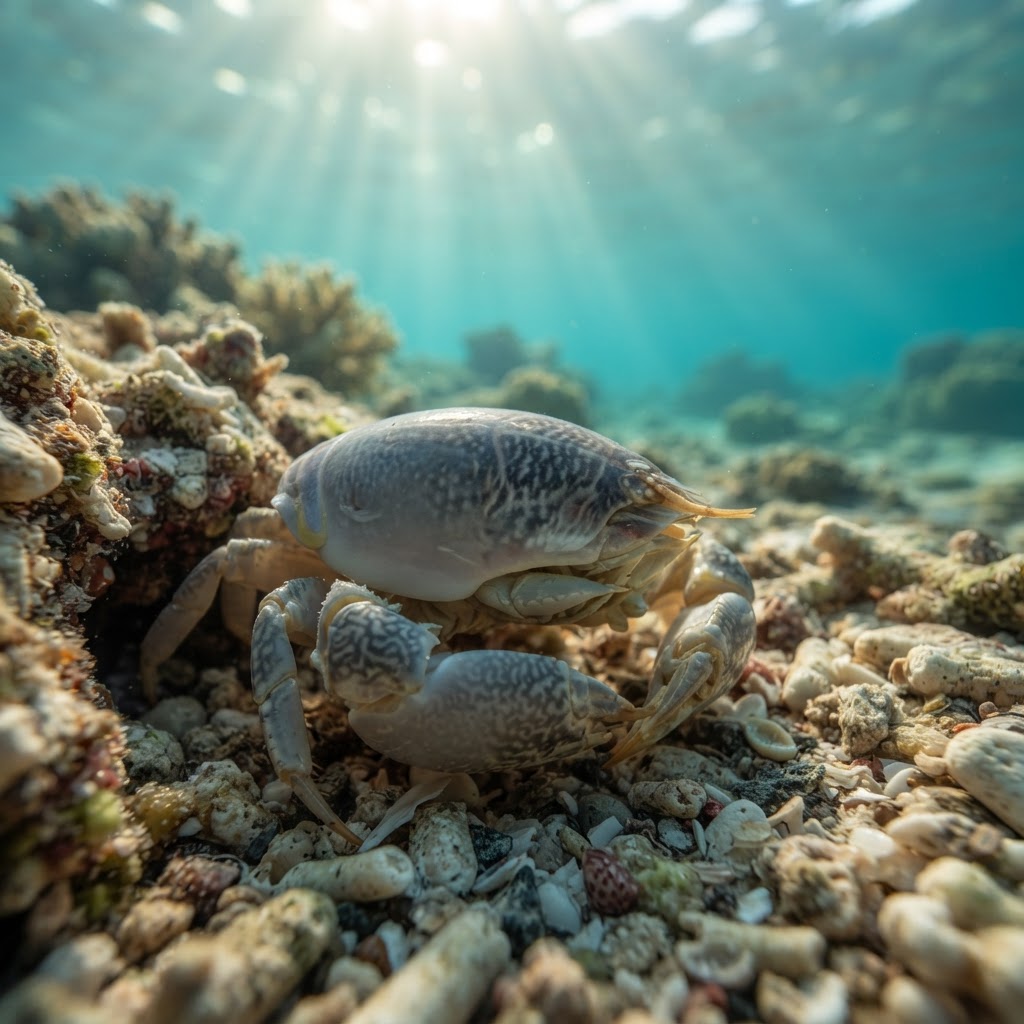
Small, egg-shaped body under a smooth, unsegmented shell in shades of grey, tan or sandy brown, built for burrowing rather than walking. No visible claws from above; the legs and feathery antennae stay tucked in or flick out briefly to filter the swash. Watch the wet sand right at the waterline for a small dome that vanishes backward into the sand within a second of a wave receding.
Found burrowing backward into wet sand in the swash zone, riding each retreating wave to resettle a little lower on the beach. It extends feathery antennae to filter plankton from the water as waves wash over, then tucks back under the sand almost instantly if disturbed. Most sightings are casual, at the water's edge rather than on a formal dive, and it reacts to a diver or waders by burrowing rather than fleeing.
Whole colonies migrate up and down the beach with the tide, staying in the narrow band of wet sand where waves break, which is why you can find dozens in one sweep of your hand and none a metre away.
Sightings show no clear seasonal pattern, and with a comfortable range of 16.7 to 28C it can be found in the surf year-round in Florida.
Almost every logged sighting comes from Florida, making it the place to find this species, with smaller numbers reported from the Carolinas further north. It turns up in the shallow surf zone rather than on offshore reefs, so it is a beach and snorkel find as much as a dive one.
Mapping where Atlantic Sand Crab is logged…
Florida accounts for the vast majority of logged sightings, with smaller numbers reported from the Carolinas. Look in the surf zone on sandy beaches rather than on reef dives.
There is no strong season in the data, and the species tolerates a wide temperature range from about 16.7 to 28C, so it is findable in Florida's surf year-round.
Look for a small, smooth, egg-shaped shell in sandy grey or tan tones at the edge of the surf. It has no visible claws and burrows backward into wet sand within moments of a wave passing.
Exact size data isn't confirmed here, but they are a small species, typically only a couple of centimetres long, easy to miss unless you are looking right at the sand.
They migrate up and down the beach with the tide in tight groups, riding waves to resettle and using feathery antennae to filter plankton each time water washes over them.
No, they pose no threat to divers or waders. They have no claws to speak of and respond to any disturbance by burrowing away rather than defending themselves.
Site and sighting data is aggregated from diver logs, iNaturalist and GBIF. For taxonomy and conservation status:
European Green Crab
2,469 sites