Chanos chanos
Silvery open-water schoolers spotted from Australia's Northern Territory to the Maldives, comfortable in 21 to 29C reef water year-round.
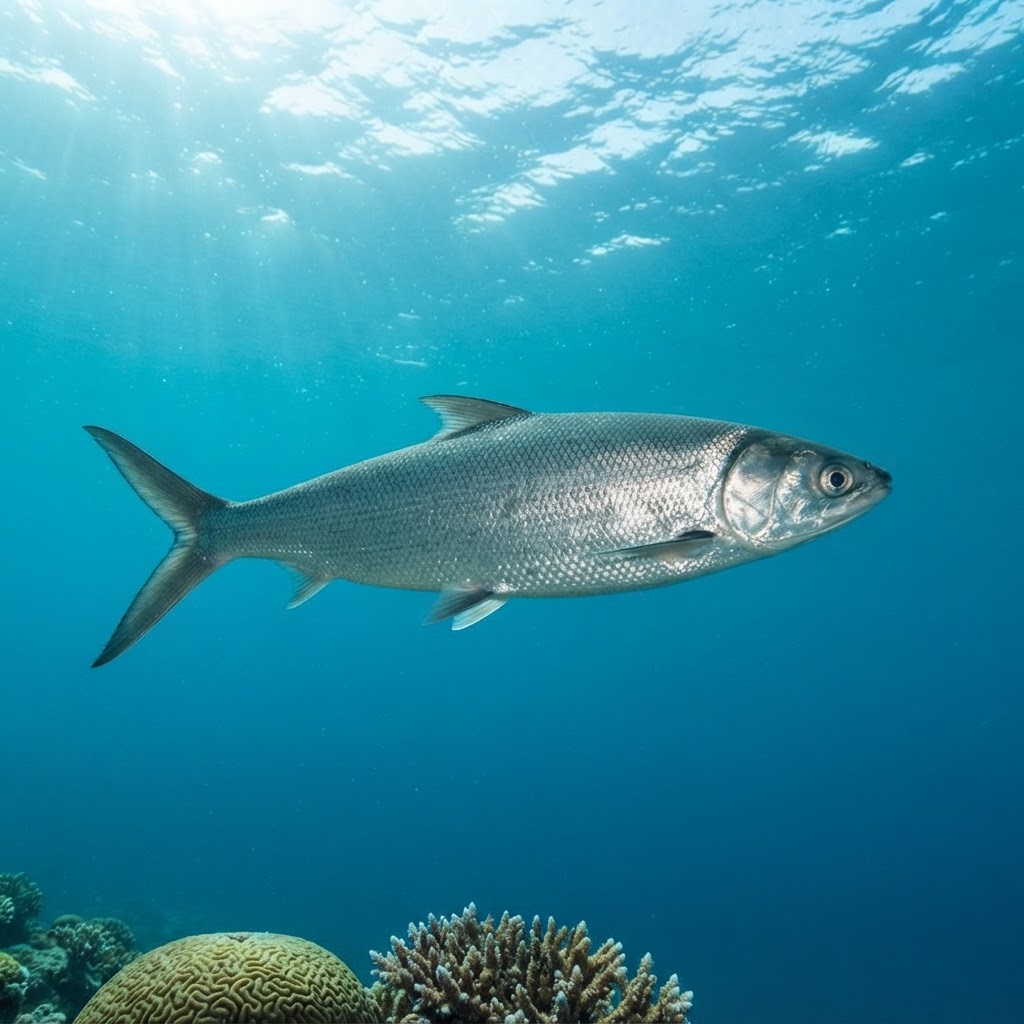
Look for a long, torpedo-shaped body up to about 1.26 metres, sheathed in bright silver scales that flash as it turns. The head is small with a blunt, rounded snout and a small mouth set low, and a single dark dorsal fin sits high on the back above a deeply forked tail. They're usually seen moving in loose schools rather than alone, cruising mid-water over sand flats and reef edges rather than hugging the bottom.
Divers typically find them cruising in loose, unhurried schools over sand flats, lagoons, and shallow reef edges, often mid-water rather than close to the bottom. They're generally indifferent to divers, holding their course rather than scattering, which makes them easy to watch but not easy to approach closely. Most logs describe them as an uncommon but steady sighting rather than a guaranteed one.
They feed largely by grazing on algae and detritus filtered from sediment, which is why they're so often seen over sand and mud flats rather than hard coral structure.
No clear seasonal pattern shows up in the data, and with a comfortable range of roughly 21 to 29C, they're a year-round encounter on tropical and subtropical reef flats rather than a seasonal special.
Most reliably logged in Australia's Northern Territory and the Southern Atolls of the Maldives, with solid numbers also out of Hawaii, Panama's Pacific Coast, and the Inner Islands of Seychelles. Divers in French Polynesia's Society Islands and, less often, Costa Rica's South Pacific coast also report sightings.
Mapping where Milkfish is logged…
Northern Territory in Australia and the Southern Atolls of the Maldives are the strongest regions in the data, with reliable sightings also in Hawaii, Panama's Pacific Coast, and Seychelles' Inner Islands.
There's no strong seasonal signal, so they're best treated as a year-round sighting on tropical reef flats where water sits between about 21 and 29C.
Look for a silvery, torpedo-shaped fish up to around 1.26 metres with a small blunt head, low-set small mouth, a single dark dorsal fin, and a deeply forked tail, usually moving in a loose school over sand or reef flats.
They reach around 1.26 metres in length, making them one of the larger silvery schooling fish you'll encounter over shallow reef flats.
No, they're not considered dangerous to divers and typically just continue cruising past rather than reacting defensively.
They feed mainly by grazing algae and detritus off sand and mud, which explains why they're spotted over flats and lagoon edges far more than over hard coral.
Site and sighting data is aggregated from diver logs, iNaturalist and GBIF. For taxonomy and conservation status:
Soldierfish
3,612 sites