Corystes cassivelaunus
Rare but real in UK waters, the masked crab burrows into sand at sites across England and Scotland in cool 9-17C seas.
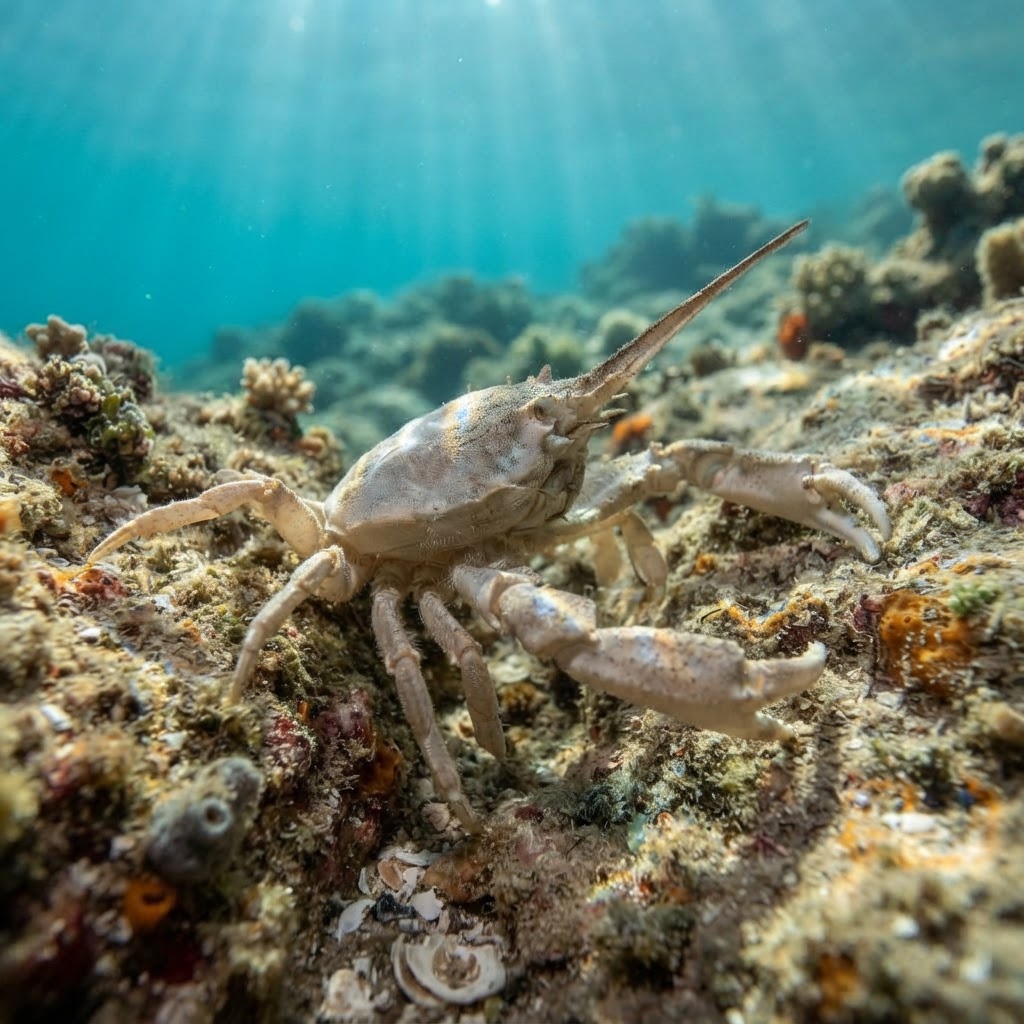
Look for an elongated, oval carapace rather than the rounded shape of most crabs, often a pale sandy or pinkish colour that blends straight into the seabed. The long, hair-fringed antennae are the real giveaway, held together and pointed forward, thought to work like a snorkel when the crab is buried. Most of what a diver actually sees is a shallow mound in the sand with just the antennae and eye stalks poking through, since this species spends most of its time burrowed rather than walking exposed on the bottom.
Expect to find it settled into soft sand or fine sediment, usually with only the antennae and eyes showing above the surface. It is not an active swimmer or forager in open view, so most sightings come from divers who spot the antennae trailing above a slight bump in the sand and then fan away the top layer to reveal the crab underneath. It tends to sit still rather than bolt, so a slow, careful look is usually enough to get a clear view before it digs back down.
Those long antennae are held together to form a tube that is thought to draw water down to the gills while the crab stays fully buried, letting it breathe without exposing itself on the open sand.
Sightings are spread across the year with no clear seasonal peak in the data, and the crab's comfort range of roughly 9 to 17C covers much of the UK diving calendar. That makes it a year-round possibility on sandy sites rather than a species tied to a particular month.
Most consistently logged in the United Kingdom, particularly across England and Scotland, with further sightings in Jersey and Guernsey and in Northern Ireland. Divers also report it from sites in France, including Occitanie and the French Riviera and Provence, and there is at least one record from Donegal in Ireland. Across all of these it stays a scarce find rather than something you can plan a dive around.
Mapping where Masked Crab is logged…
It turns up most often in the United Kingdom, especially in England and Scotland, with additional records from Jersey and Guernsey, Northern Ireland, and sites in France including Occitanie and the French Riviera and Provence.
There is no strong seasonal pattern in diver sightings, and its comfort range of roughly 9 to 17C spans most of the UK diving season, so it is a year-round possibility on sandy sites rather than a seasonal target.
Look for a sandy-coloured, oval-shaped shell mostly buried in sediment with only long, paired antennae and eye stalks visible above the surface. It rarely walks out in the open, so spotting the antennae poking from a small mound in the sand is usually the first clue.
No, they pose no danger to divers. They spend almost all their time buried in sand and have no interest in interacting with people nearby.
Burrowing hides it from predators while its long antennae stay above the surface, forming a tube that is thought to channel water down to the gills so it can keep breathing while fully covered.
Site and sighting data is aggregated from diver logs, iNaturalist and GBIF. For taxonomy and conservation status:
European Green Crab
2,469 sites