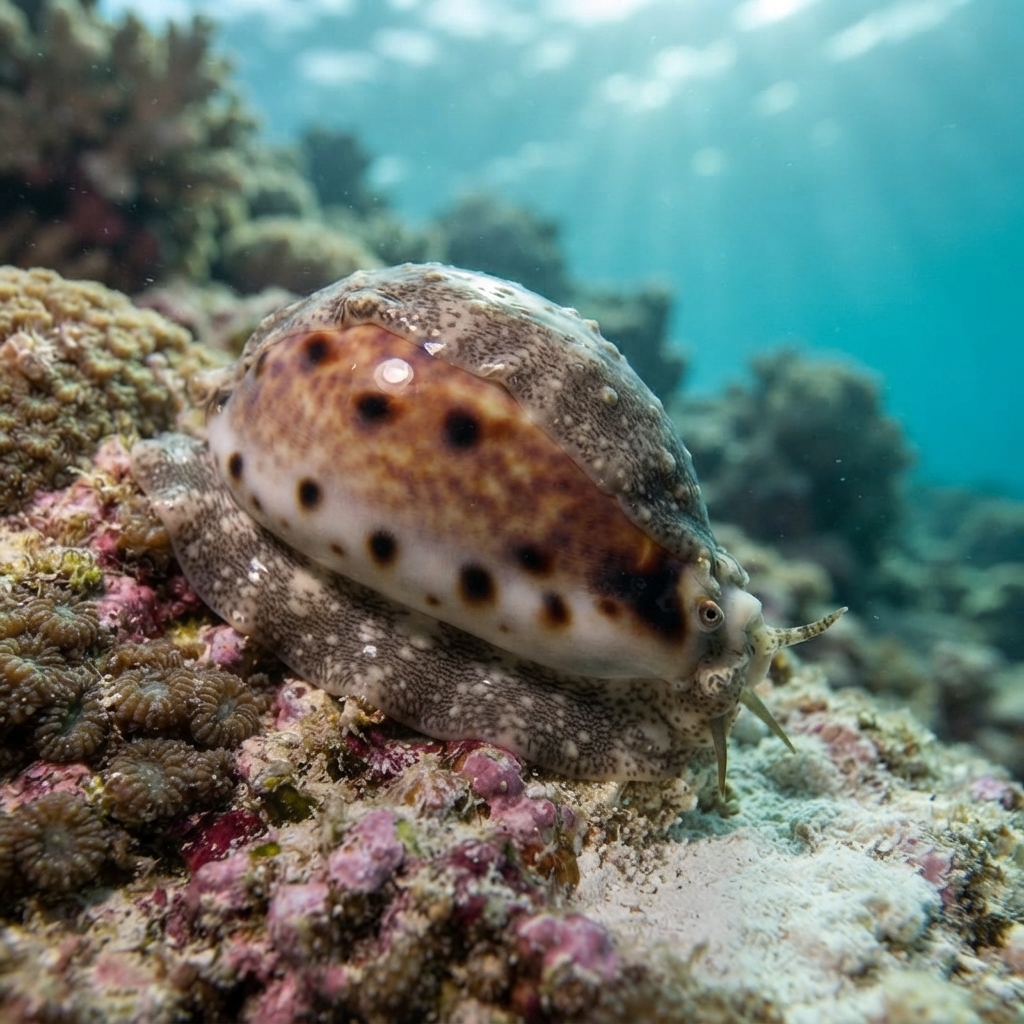
Lyncina lynx
Uncommon but findable in Bali and Zanzibar, this glossy 6cm cowrie hides on reefs year-round in 25-31C water. Here's where to look.
Look for a small, glossy shell about 6cm long, tan to orange-brown with a dense pattern of dark brown rings and spots that thins out toward the shell's edges. The shell has the classic cowrie shape: smooth, oval, and domed, with a narrow ridged slit running along the underside. When the animal is active the mantle (soft tissue) often wraps up over the shell, so what you actually see moving is a mottled fleshy covering rather than bare shell.
Expect to find it tucked into crevices, under coral rubble, or wedged against sponges by day, since cowries are largely nocturnal foragers and stay hidden until dusk. On night dives it may be seen creeping slowly across the reef surface with its mantle extended, grazing on algae and sponge tissue, and it shows little reaction to a diver's torch beyond a slow retreat.
Like other cowries, it can pull its mantle completely over its shell while feeding or resting, which is why the shell often looks blotchy or textured rather than smooth and shiny when you first spot it.
There's no clear seasonal pattern in the sighting data, and its comfort range of roughly 25 to 31C spans tropical reefs year-round, so any month is fair game where it's found.
Most reliably found across Bali and Nusa Tenggara in Indonesia, with a strong showing on Zanzibar and Pemba Island in Tanzania, and consistent sightings around Kwajalein Atoll in the Marshall Islands. Scattered logs also come from Raja Ampat in Indonesia, New South Wales in Australia, and Nouméa in New Caledonia, but Bali and Zanzibar are the places to focus a search.
Mapping where Lynx Cowrie is logged…
Bali and Nusa Tenggara in Indonesia are the most consistent spots, with Zanzibar and Pemba Island in Tanzania and Kwajalein Atoll in the Marshall Islands also holding steady populations. It turns up as an uncommon to rare find rather than a guaranteed sighting at any of these.
There's no strong seasonal signal in the sighting data, and its warm-water niche of 25 to 31C is present on tropical reefs all year, so it can be looked for in any month.
Check for a small glossy oval shell around 6cm long with a tan to orange base colour and a dense scatter of dark brown rings and spots. The mantle often covers the shell when the animal is active, giving it a mottled, fleshy look rather than a bare polished shine.
They reach around 6cm in shell length, making them a small, easy-to-overlook find that rewards a close look at rubble and crevices.
No, they pose no danger to divers. They are slow-moving grazers with no venom or defensive bite, so they're completely safe to observe up close.
It can draw its mantle entirely over its shell while active, which hides the polished shell surface and makes the animal look like a textured blob rather than a classic shiny cowrie.
Site and sighting data is aggregated from diver logs, iNaturalist and GBIF. For taxonomy and conservation status:
Triton Shell
2,297 sites