Nembrotha livingstonei
A small, jewel-toned nudibranch logged uncommonly across dive sites in Luzon, Philippines, in warm 25.6-31.6C reef water.
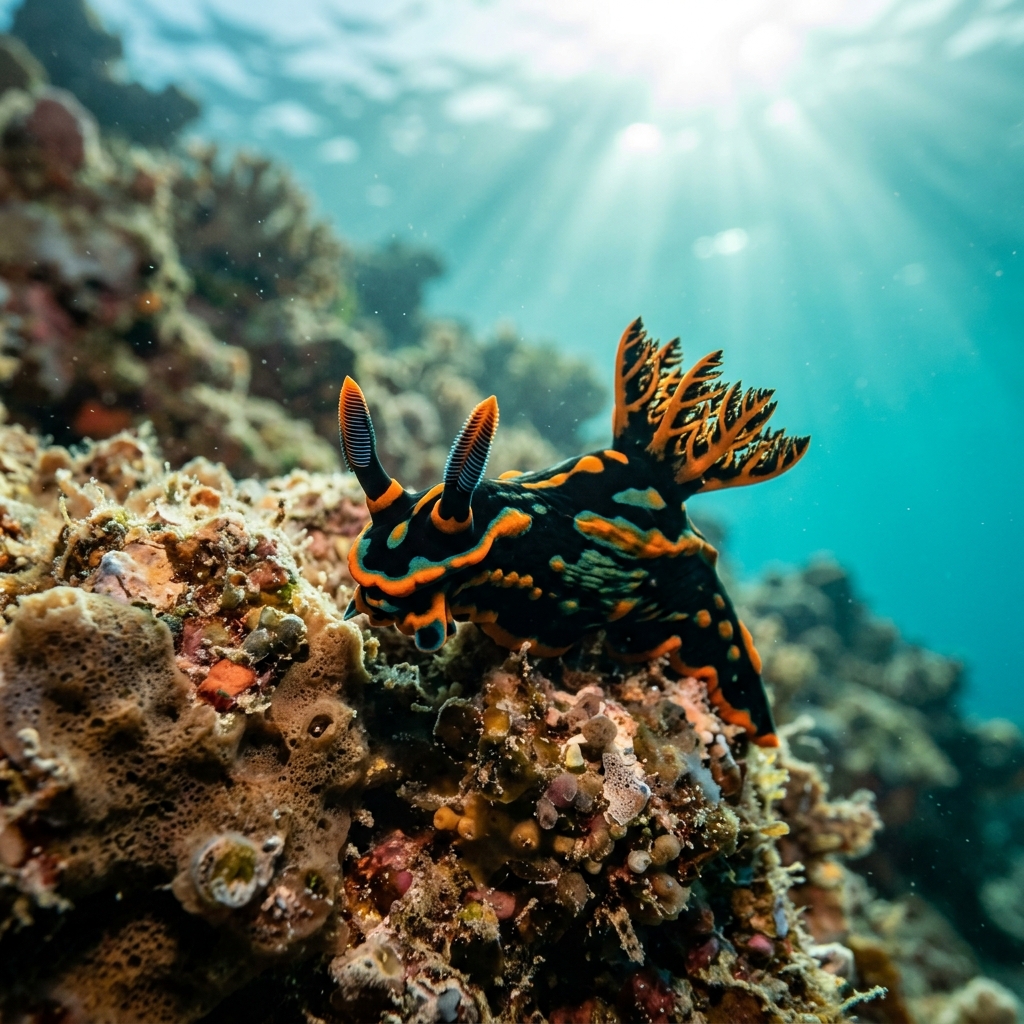
Tops out around 3 cm, a dark, almost black to deep green body with contrasting orange-tipped rhinophores (the paired sensory horns on its head) and gill plume at the rear. The skin often carries a subtle green or teal wash between the dark patches, giving it a mottled rather than flat-black look. Its slug-like body glides slowly over the substrate, and the bright appendage tips are usually the first thing that catches a diver's torch beam.
Like other Nembrotha nudibranchs, it moves slowly across rubble, rock and coral surfaces while grazing, unbothered by divers hovering close with a camera. It's logged as uncommon at the sites where it does turn up, so sightings tend to be a slow, deliberate reef-scan reward rather than a guaranteed find. Look for it on lower-light sections of reef, under ledges or on algae-covered substrate where its prey and camouflage both work in its favour.
Nembrotha nudibranchs feed on tunicates (sea squirts) and are thought to recycle some of their prey's chemical defences into their own tissue, which may explain why such brightly marked slugs move around in the open with little apparent concern for predators.
Sightings don't show a clear seasonal pattern, and the observed water temperature range of 25.6 to 31.6C fits Luzon's reefs year-round, so there's no strong reason to target a particular month. Treat it as a species you might encounter on any well-timed dive rather than a seasonal specialty.
Reef neighbours a diver could mistake it for. Use the identification notes above to tell them apart.
All logged sightings come from the Philippines, with Luzon standing out as the region where divers have reliably found it. If you are hunting for this species specifically, Luzon's dive sites are currently the strongest bet on record.
Mapping where Livingstone's Nembrotha is logged…
All confirmed sightings are from the Philippines, concentrated in Luzon. It's the region to focus on if this species is on your macro checklist.
There's no detected seasonal pattern, and the water temperatures it's been found in, roughly 25.6 to 31.6C, are typical of Luzon's reefs all year. Any time of year is reasonable to look for it.
Look for a small, dark-bodied nudibranch around 3 cm long with orange-tipped rhinophores and gill plume standing out against a mottled green-black body. It moves slowly over reef substrate rather than swimming.
They're small, typically reaching about 3 cm in length, so spotting one usually takes a slow, close look at the reef floor rather than a wide scan.
Like its Nembrotha relatives, it feeds on tunicates and may repurpose some of their chemical defences, which likely helps explain why such a boldly coloured slug can move across open reef with little concern for predators.
No. It poses no threat to divers and is best enjoyed with a careful eye and a macro lens rather than handling.
Site and sighting data is aggregated from diver logs, iNaturalist and GBIF. For taxonomy and conservation status:
Blue Dragon
3,163 sites