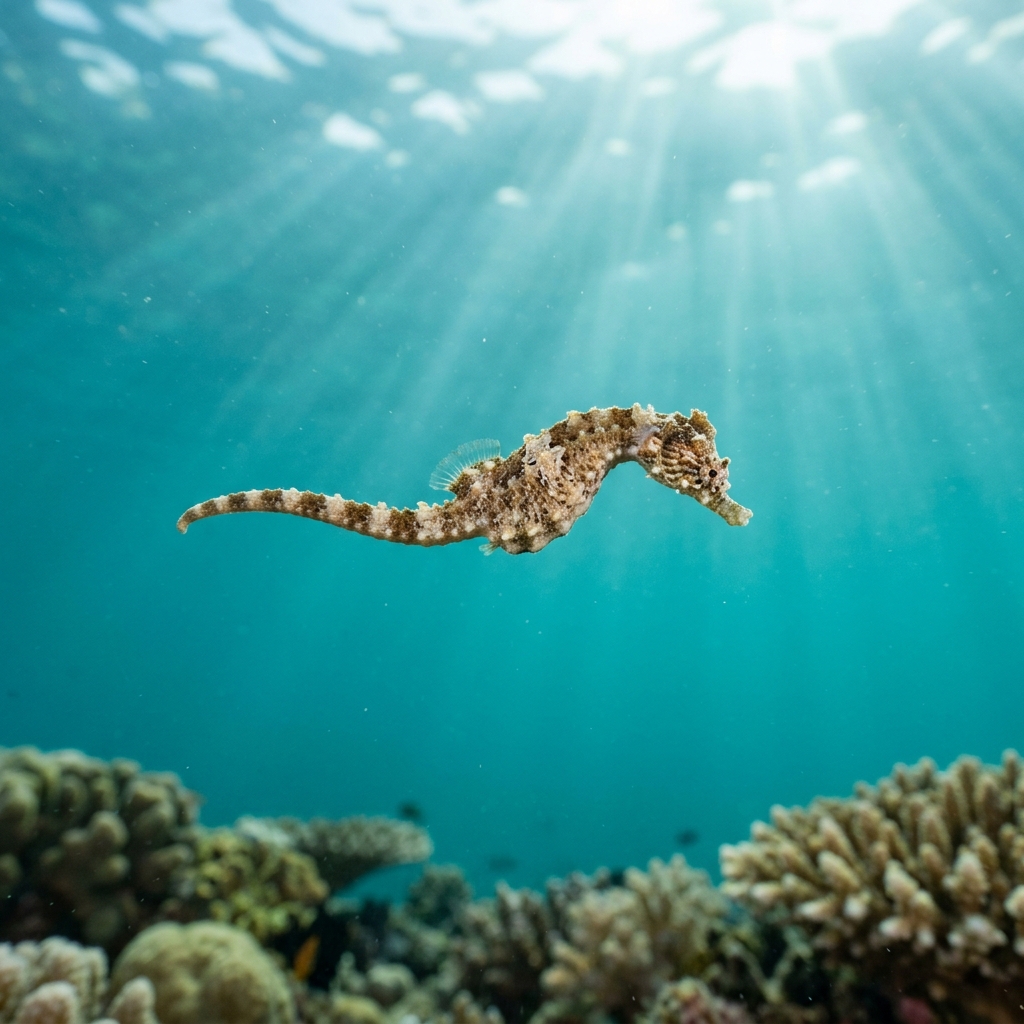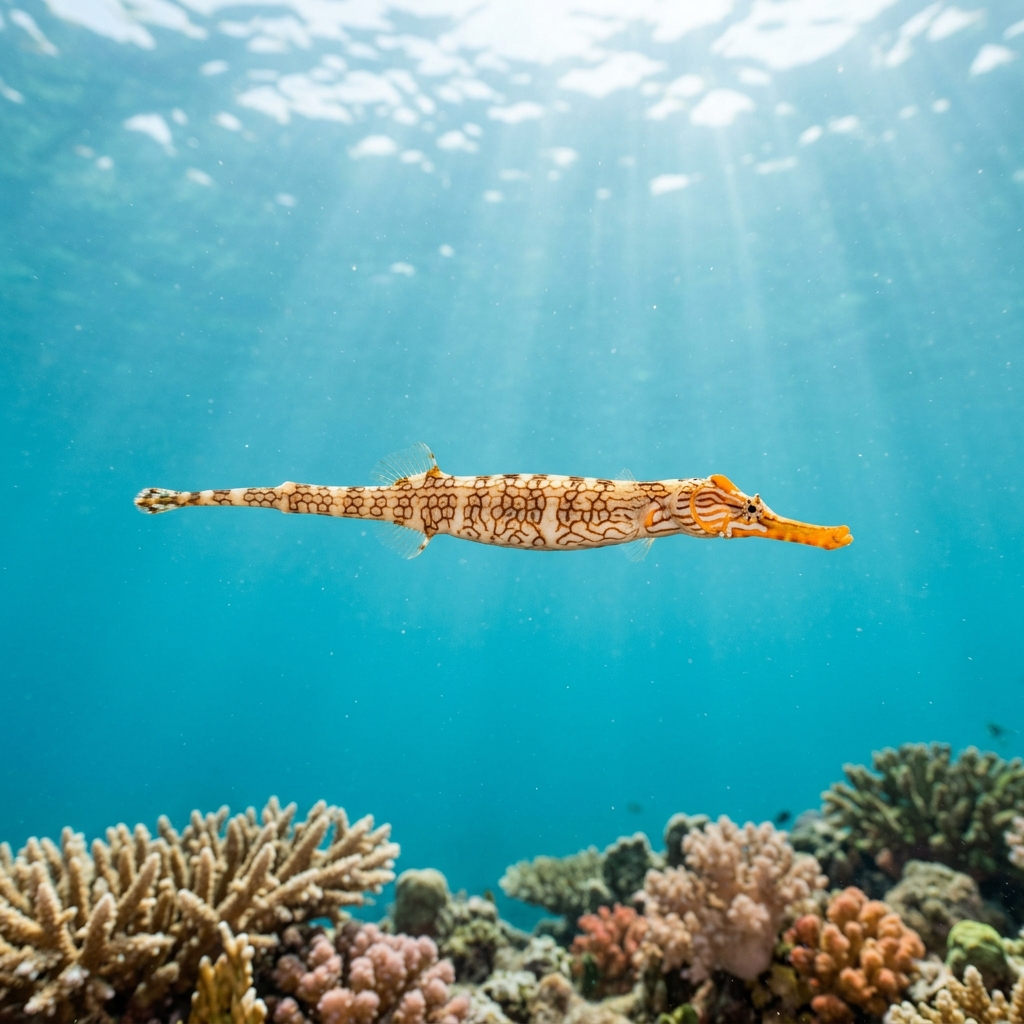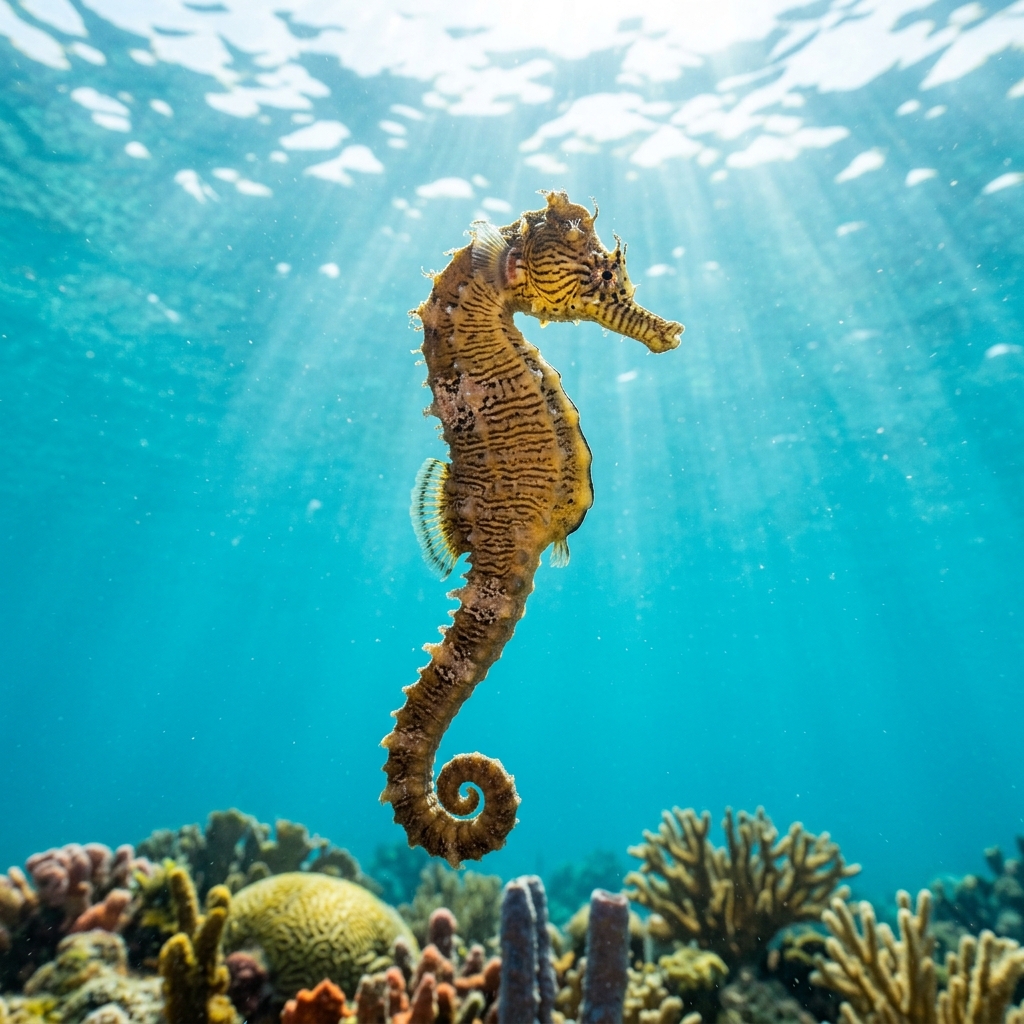
Hippocampus erectus
Spot the Lined Seahorse along Florida's coast and into Brazil, a rare but rewarding find in waters from 12 to 27 °C.
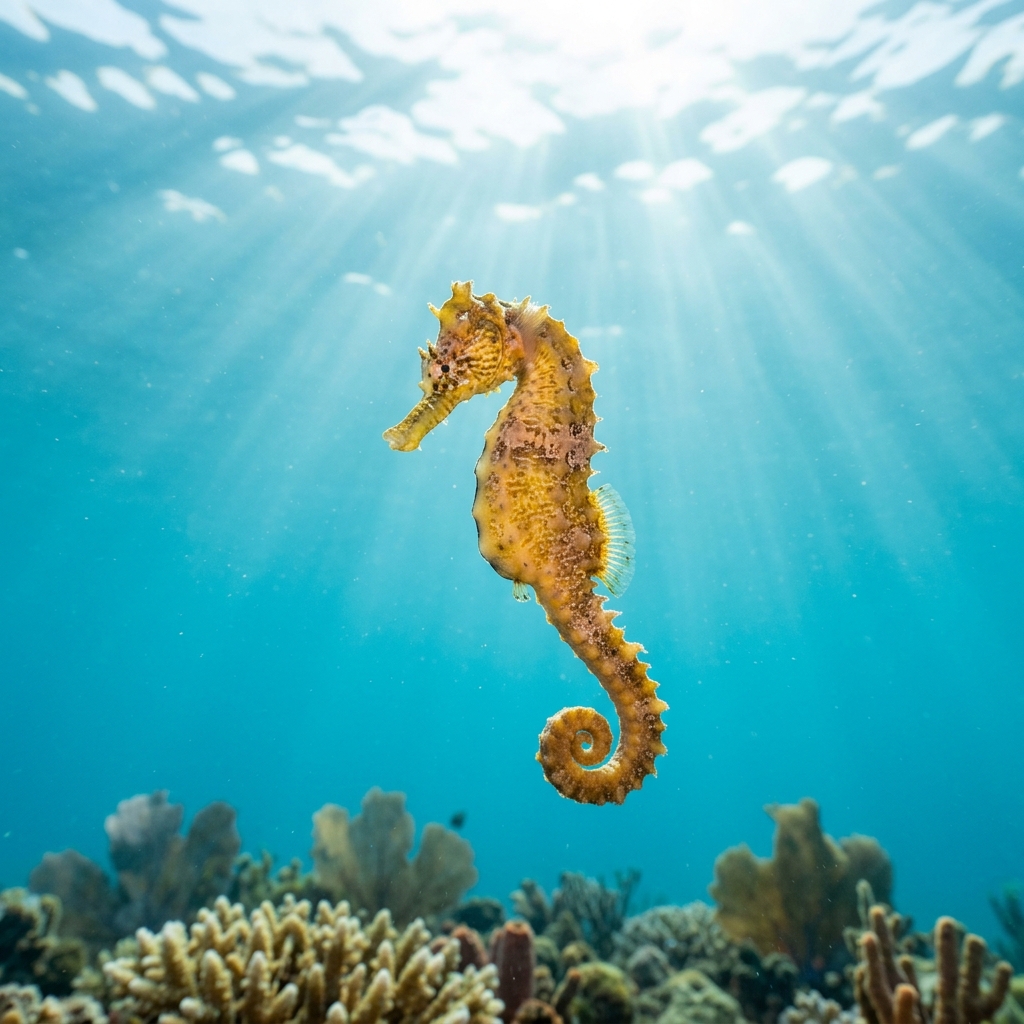
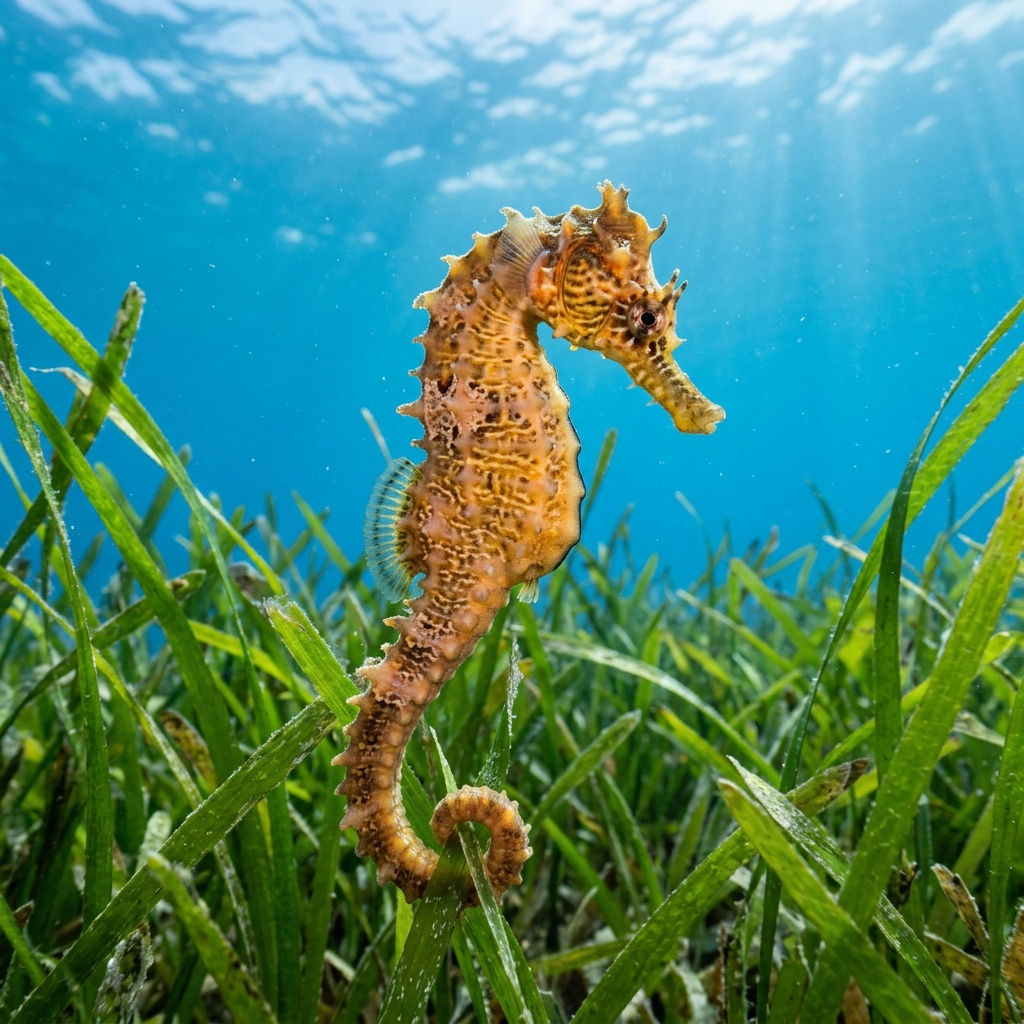
Colour is highly variable, expect anything from pale yellow and grey to dark brown, often with pale lines or spots running along the body that give the species its name. It is a medium-sized seahorse with a relatively elongated snout and a robust trunk, and it uses its prehensile tail to anchor itself to seagrass blades, algae, or gorgonian fans. Look for those faint pale streaks radiating from the eye and along the neck as the most reliable field mark when colour alone is unhelpful.
Lined seahorses spend most of their time anchored to a holdfast, seagrass, a sponge, or a wire coral, and rely on camouflage rather than flight when approached. A patient, slow approach often lets you get very close before the animal tilts away or moves a short distance to a new anchor point. They are ambush feeders, so watch for the rapid head-pivot as they snatch tiny crustaceans drifting past.
Like all seahorses, it is the male that carries the young in a brood pouch on his abdomen and gives birth, sometimes releasing hundreds of miniature juveniles in a single event.
There is not enough seasonal data to point to a peak month, so treat it as a year-round possibility wherever the habitat is right. Its temperature tolerance stretches from about 12 °C up to 27 °C, meaning it can be present from warm subtropical shallows in summer right through cooler temperate conditions further north.
Most sightings come from the western Atlantic, with Florida and the broader southeast United States accounting for the largest share of recorded sites by a wide margin. The Rio de Janeiro and São Paulo coast of Brazil is the next strongest region, followed by the Jardines del Rey area of Cuba and the Bahamas. Canada, Venezuela, and the Turks and Caicos also appear in the data, underlining just how broad a coastal range this seahorse covers.
Mapping where Lined Seahorse is logged…
The best-represented regions in diver logs are Florida and the southeast United States, the Rio de Janeiro and São Paulo coast of Brazil, Cuba's Jardines del Rey, and the Bahamas. Sightings also come in from Venezuela, Canada, and the Turks and Caicos, so any seagrass or estuarine habitat along the western Atlantic coast is worth searching.
No clear seasonal peak has emerged from diver data, so it is treated as a year-round possibility. Its wide temperature tolerance, observed from about 12 °C to 27 °C, means it stays resident through both warm and cooler months depending on latitude.
Look for pale streaks or lines radiating from the eye and running along the neck and trunk, that patterning is the most consistent field mark even when the background colour (which ranges from yellow and grey to dark brown) varies. A robust body, elongated snout, and the habit of anchoring its tail to seagrass or a fan coral are all strong clues.
Lined seahorses are considered one of the larger Atlantic seahorse species, commonly reaching around 15 cm in total length, though the data block for this page does not include a verified typical size from diver observations.
The male does. He holds a brood pouch on his lower abdomen where the female deposits her eggs. He fertilises and carries them until birth, when he can release hundreds of fully formed miniature seahorses. This makes males visibly plumper at the belly during pregnancy.
They are listed as Vulnerable by the IUCN, one step below Endangered. Seagrass and estuarine habitat loss is a major driver of decline, alongside collection pressure. Divers can help by not handling them and by reporting sightings through citizen-science platforms.
The Lined Seahorse is listed as vulnerable by the IUCN. Observe from a distance, avoid touching or feeding it, and report sightings to local marine research organisations.
Listed as Vulnerable on the IUCN Red List, largely due to habitat loss in seagrass beds and estuaries and pressure from the curio and traditional-medicine trade. If you spot one, resist the urge to handle or reposition it for a photo, even brief handling stresses them and can dislodge the mucus layer that protects against infection.
Site and sighting data is aggregated from diver logs, iNaturalist and GBIF. For taxonomy and conservation status:
Seahorse
1,346 sites