Limacia inesae
A small, uncommon nudibranch logged mainly in Andalusia, Spain, in cool water between 14.7 and 20.7 C. Here's how to find and ID it.
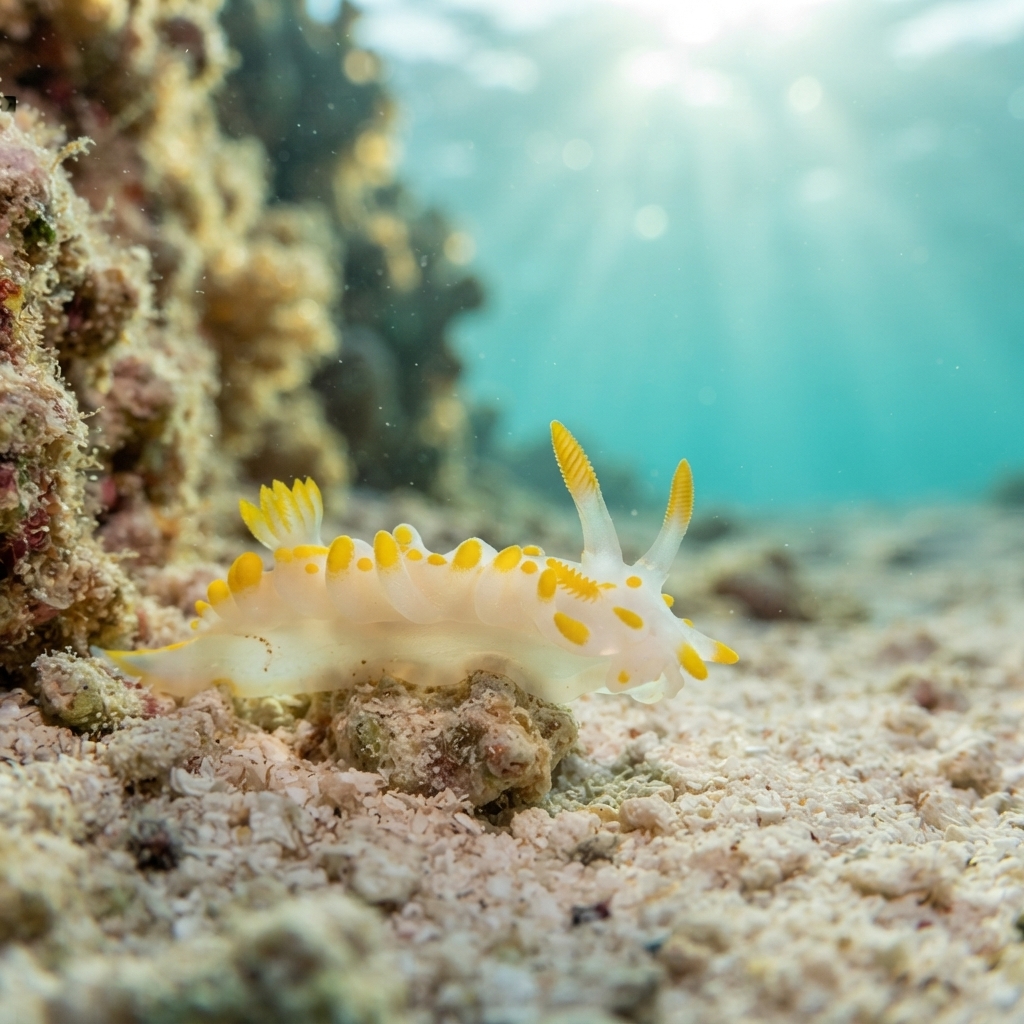
A small nudibranch (sea slug) with a translucent white to pale body studded with rows of raised, yellow-tipped tubercles (soft bumps) along its back. Look for the feathery gills (rhinophores and branchial plume) at either end of the body, both often tipped in the same yellow-orange as the tubercles. It moves slowly across rock and rubble, so once spotted it is easy to watch closely without disturbing it.
Divers find it grazing slowly over rock and rubble surfaces, likely feeding on the small encrusting organisms nudibranchs in this family target. It shows no reaction to divers and simply keeps crawling at its own pace, making it a reliable subject for close macro photography once located. Most logs come from dedicated slow, searching dives rather than chance encounters on a reef swim-through.
Like other members of the Polyceridae family, it is a hermaphrodite that can both give and receive sperm when mating, a trait common across nudibranchs.
Sightings don't show a clear seasonal pattern, and the species turns up across a temperature range of roughly 14.7 to 20.7 C, so it's best treated as a year-round find rather than a seasonal one. Cooler-water dive trips in Andalusia or Provence are as likely to turn it up as warmer months.
Reef neighbours a diver could mistake it for. Use the identification notes above to tell them apart.
Most records come from Spain, with Andalusia standing out as the strongest area for sightings, and a smaller number of logs from the French Riviera and Provence in France. Outside these two countries it has not been reliably reported, so Andalusia is the place to focus a search.
Mapping where Ines's Limacia is logged…
It is most reliably logged in Andalusia, Spain, with a smaller number of sightings from the French Riviera and Provence in France. These two regions currently account for all known dive-site records.
There isn't a detected season for this species, and it has been recorded across a wide temperature range from about 14.7 to 20.7 C. Treat it as a year-round possibility rather than planning around a specific month.
Look for a small, translucent white nudibranch with rows of yellow-tipped tubercles along its back and matching yellow-orange gill tips at each end. It moves slowly over rock and rubble, which makes close inspection easy.
Exact size data isn't available, but as with related Limacia species it is a small nudibranch, typically only reaching a couple of centimetres, so it takes a careful, close look to spot on the reef.
No. It poses no risk to divers and can be observed and photographed up close without any need for caution.
Like many nudibranchs, it is a hermaphrodite, meaning each individual carries both male and female reproductive organs and can exchange sperm with any other adult it meets.
Site and sighting data is aggregated from diver logs, iNaturalist and GBIF. For taxonomy and conservation status:
Light-spotted Aegires
3,168 sites