Ariopsis felis
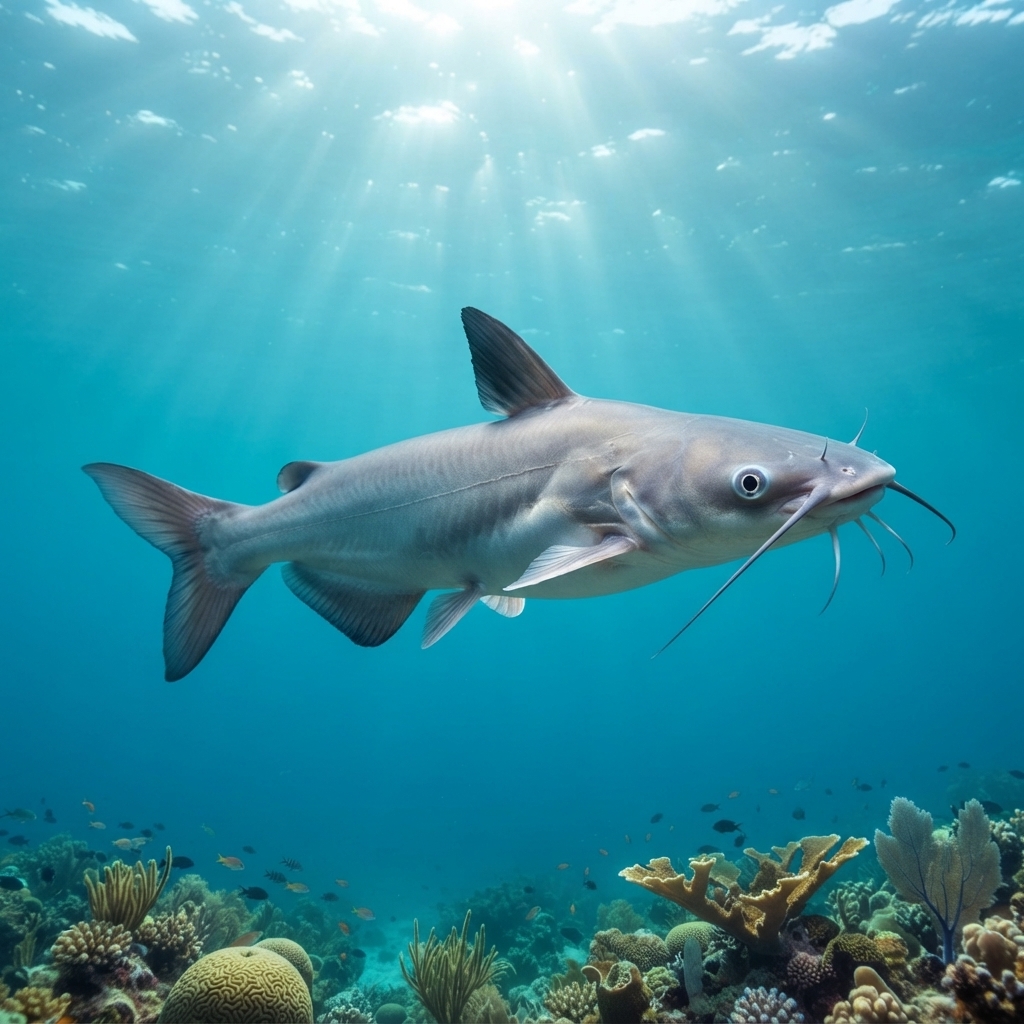
Grey-brown catfish with venomous spines, most often logged along Florida's coast in water between 23 and 28C.
Safety warning
The spines at the front of the dorsal and pectoral fins carry a mild venom that causes a sharp, throbbing sting if you brush against or handle one carelessly. Give it space rather than trying to move it, and avoid grabbing it near the fins if you need to handle a hooked or stranded fish.
If you're stung
Venomous spinesGeneral first-aid guidance, not a substitute for professional medical care. In an emergency, call your local emergency number.
Grey to brownish body with a pale belly, growing to around 49 cm, with a smooth, almost naked-looking skin rather than scales. Look for the four pairs of long, whisker-like barbels around the mouth, used to feel across sand and mud. The single serrated spine at the front of the dorsal fin and another on each pectoral fin are the real giveaway, and the source of its sting.
Usually seen cruising slowly just above sand or mud bottoms, often near piers, jetties and inshore flats rather than reef structure. It tends to ignore divers going about its business, using its barbels to probe the substrate for food, and is more active around dawn, dusk and at night. Sightings tend to be occasional rather than in large groups, matching its
Male hardhead catfish carry the fertilised eggs in their mouths until the young are ready to fend for themselves, going weeks without feeding in the process.
Sightings show no clear seasonal pattern, so treat this as a year-round encounter in the right habitat. It sits comfortably in water from about 23 to 28C, a range these coastal areas hold for much of the year.
Most commonly logged along the Florida coast, particularly in Florida itself where the bulk of sightings come from, with a smaller but steady presence in Texas. Nearly all logged sightings come from the United States, making the Gulf and Atlantic coasts of Florida the most reliable places to find one.
Mapping where Hardhead Catfish is logged…
Florida is by far the most reliable place, with steady sightings along its coast. Texas also turns up sightings, though less often than Florida.
There is no strong season in the sighting data, so they can turn up any time of year. They favour water between about 23 and 28C, which these coastal areas hold for much of the year.
They carry venomous spines on the dorsal and pectoral fins that cause a painful sting if touched. They are not aggressive toward divers, so the risk comes mainly from careless handling.
Look for a grey-brown, scaleless body up to about 49 cm long, four pairs of barbels around the mouth, and a serrated spine at the front of the dorsal fin. It is usually seen hovering low over sand or mud rather than around coral.
They typically reach around 49 cm in length, making them a medium-sized inshore fish rather than a giant.
Males brood fertilised eggs in their mouths for weeks, going without food the entire time until the young are ready to leave.
Site and sighting data is aggregated from diver logs, iNaturalist and GBIF. For taxonomy and conservation status:
Soldierfish
3,612 sites