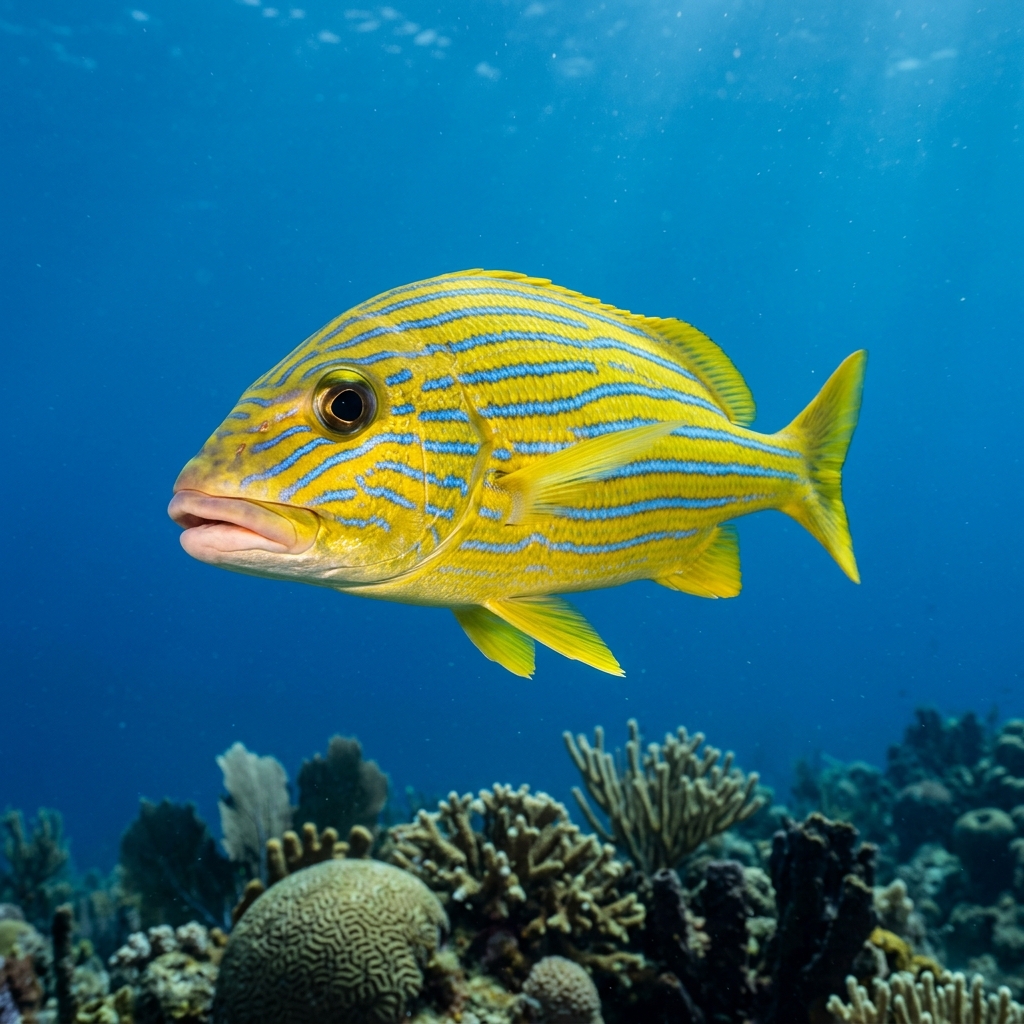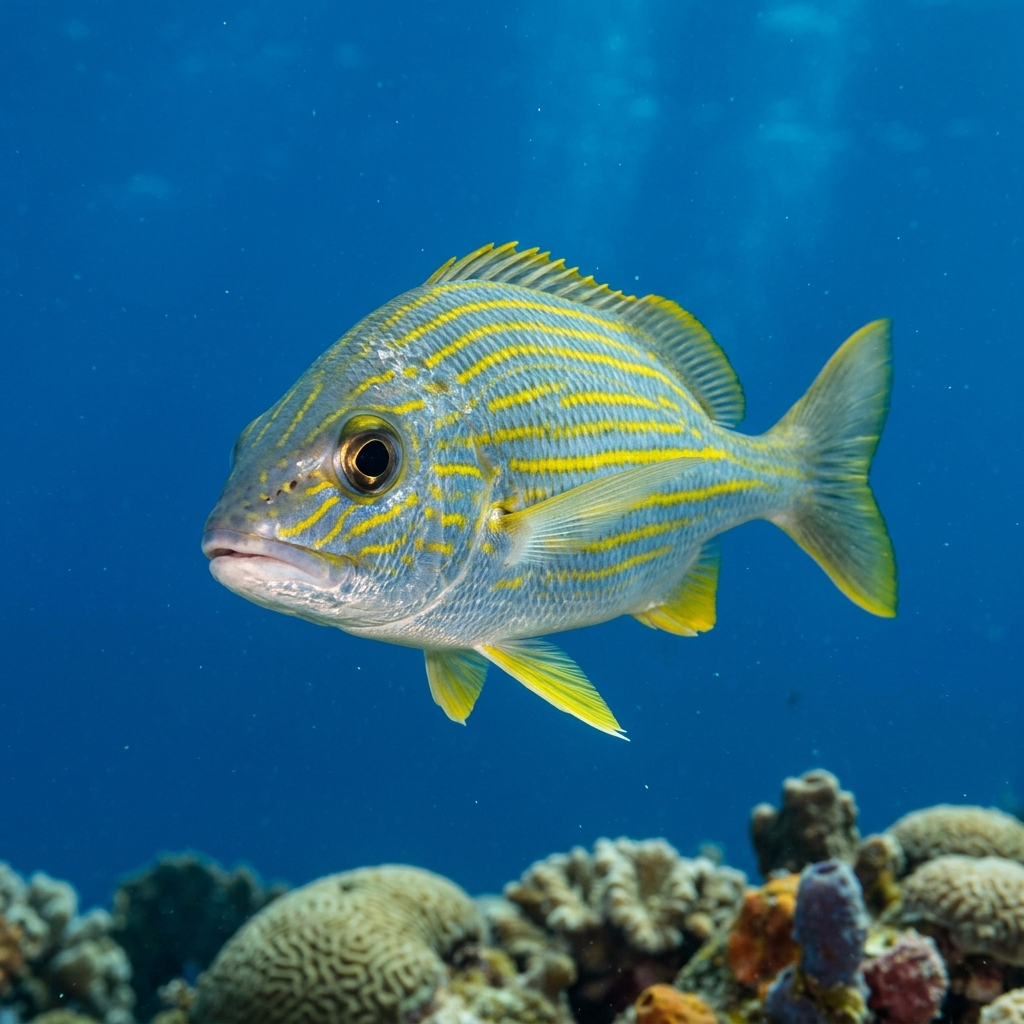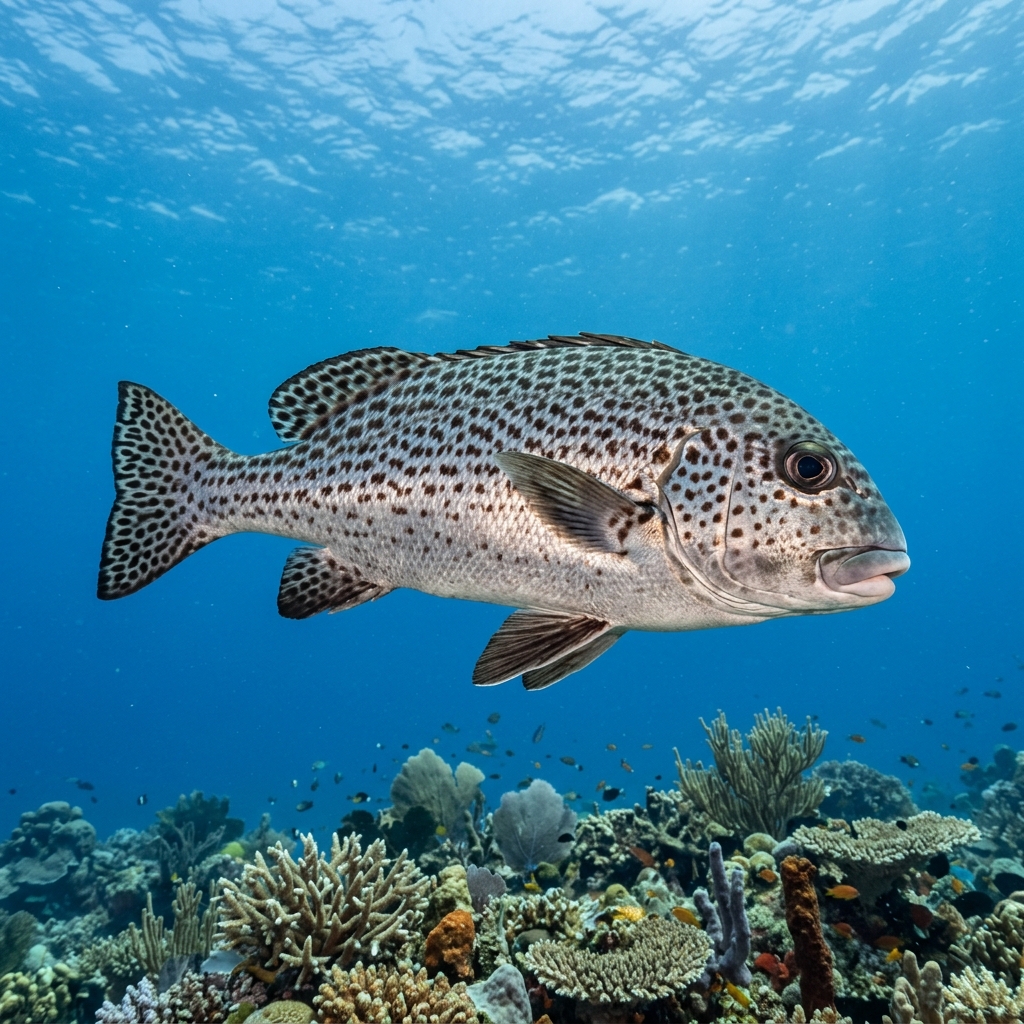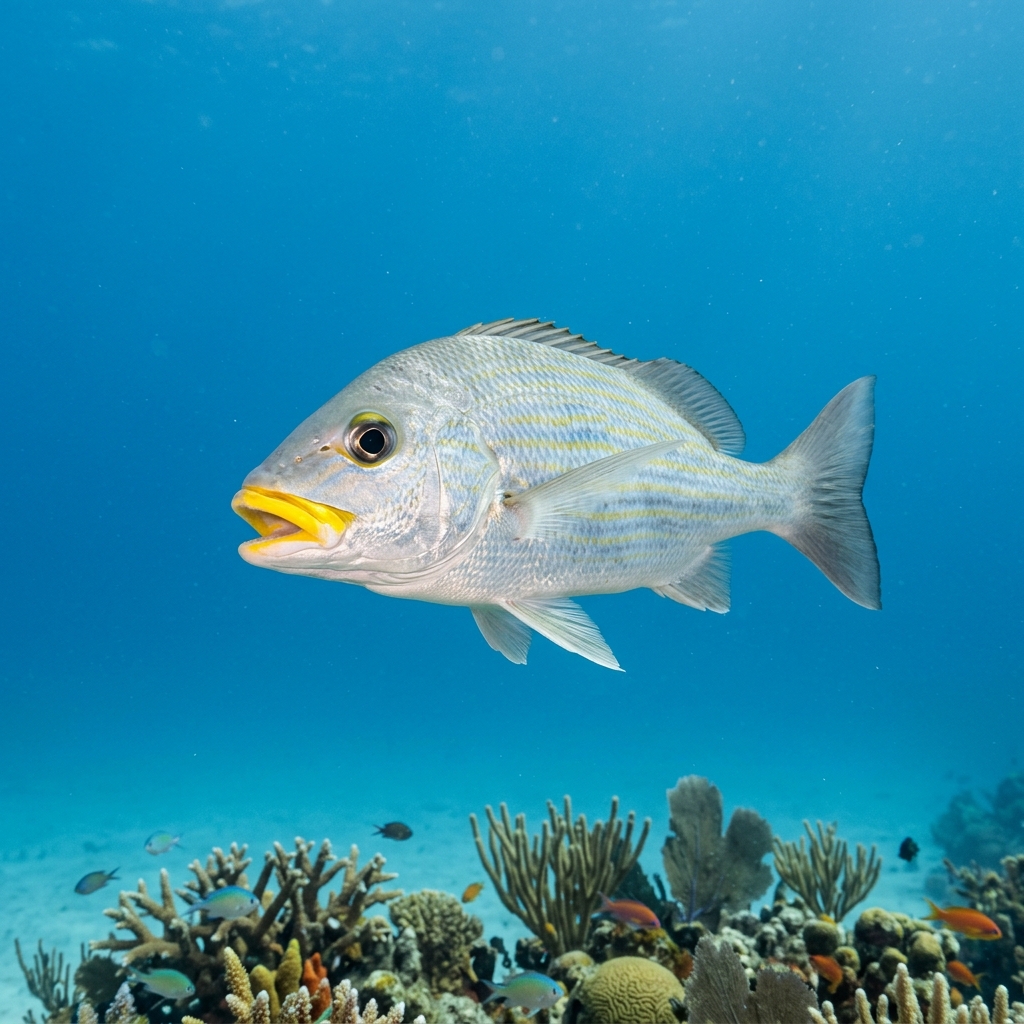
Haemulidae spp.
Grunts are logged year-round across tropical reefs from the Maldives to the Yucatán. Here's where to find them and how to tell them apart.
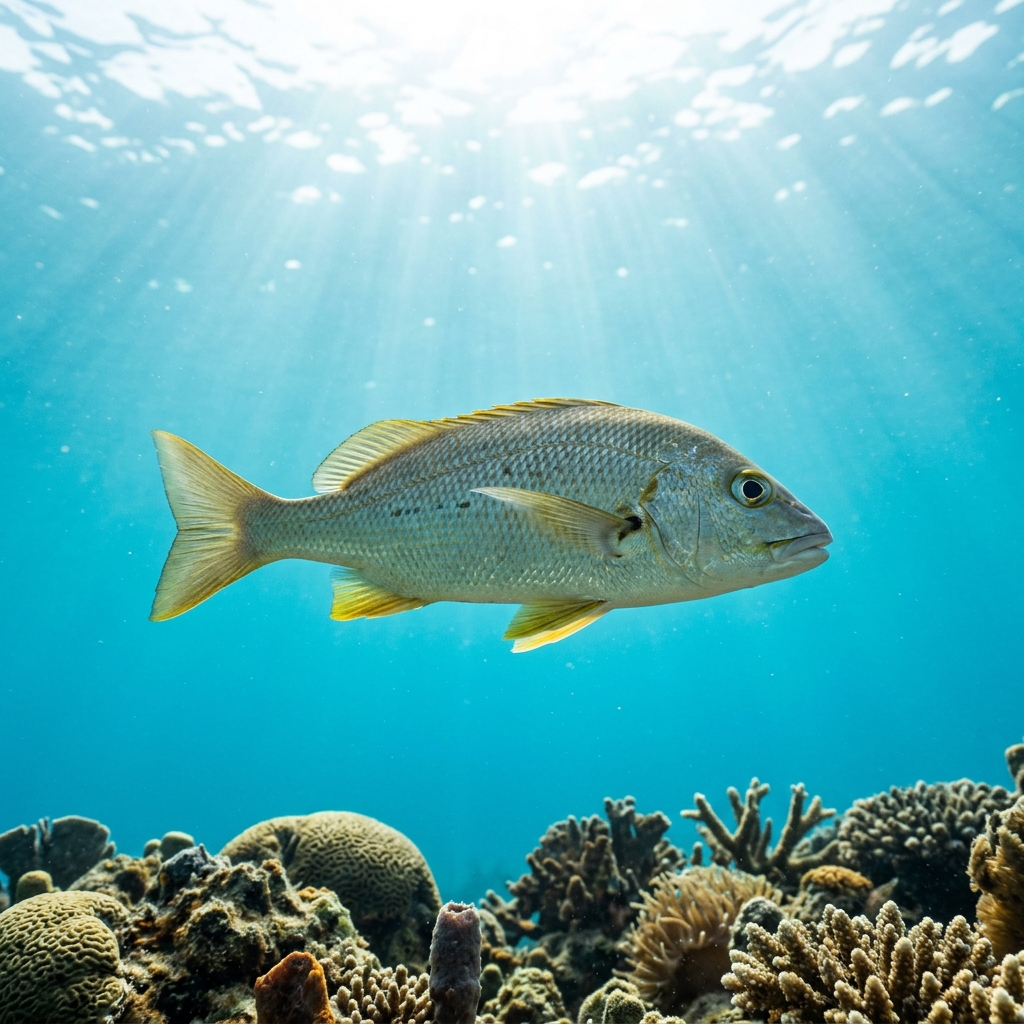
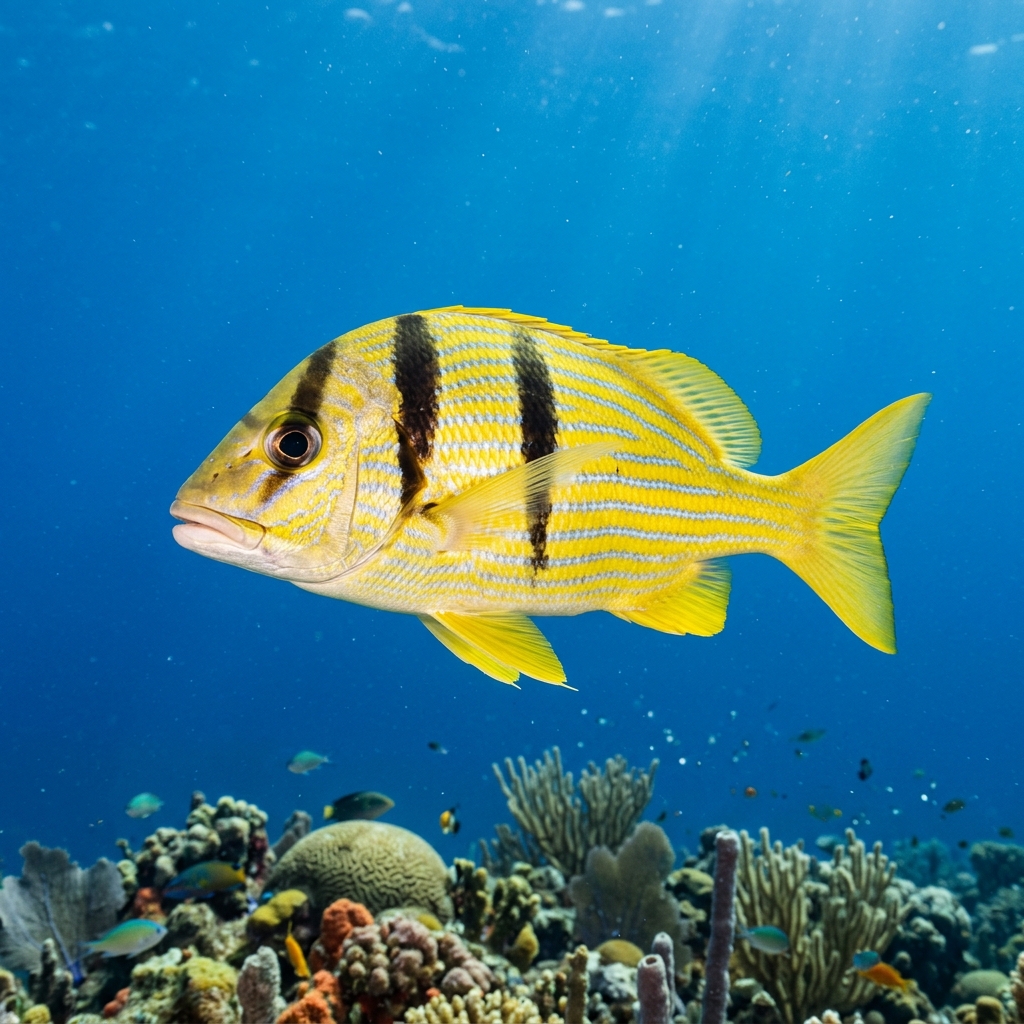
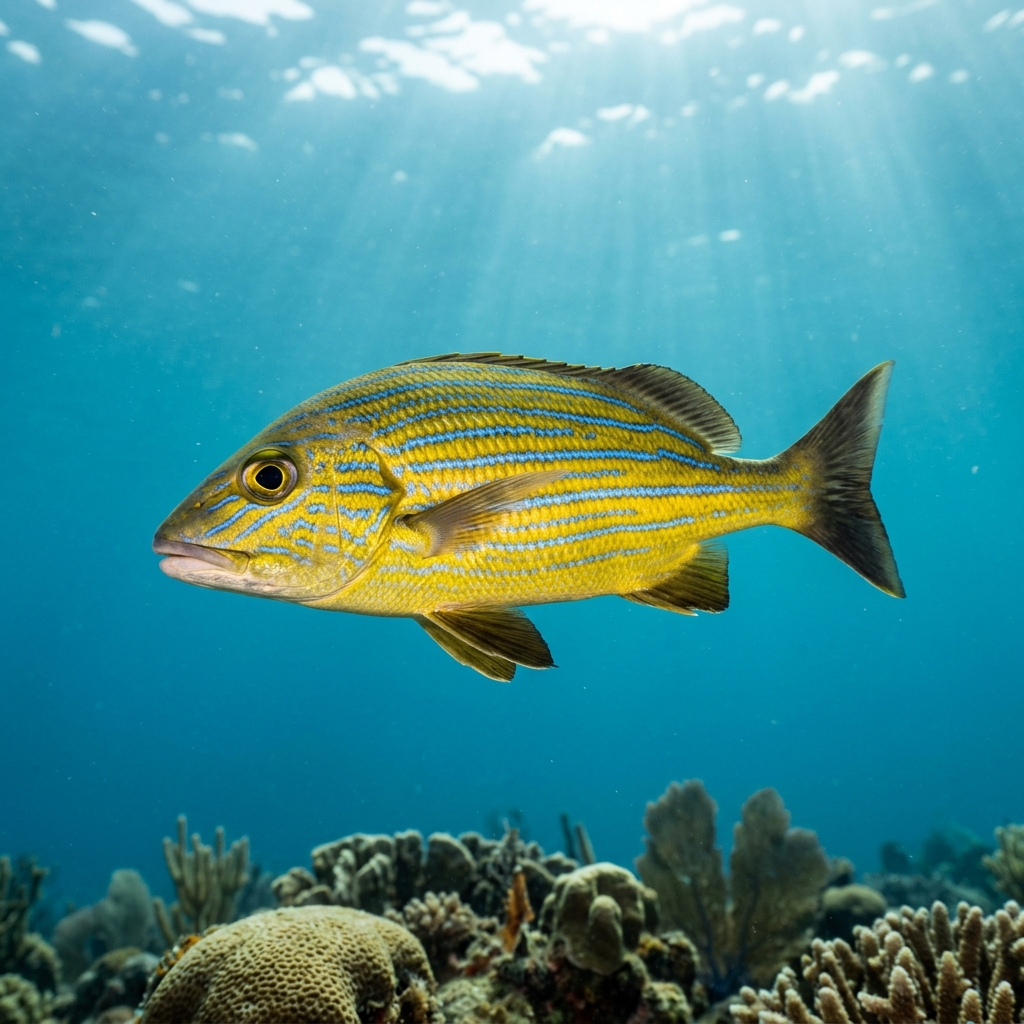
Broadly stocky, oval-bodied fish with moderately large scales, a small terminal mouth, and continuous dorsal fins. Colouration varies enormously across the family, but most adults show some combination of horizontal stripes, bold blotches, or contrasting fin edges in silver, yellow, blue, and black. Body length typically falls in the 20 to 40 cm range for the species divers most commonly encounter, giving them a palm-to-forearm presence on the reef. The easiest field clue when two are close together is the distinctive open-mouthed kissing or pressing behaviour they use to establish dominance.
During the day, grunts tend to school tightly in sheltered spots under table corals, ledges, or near reef walls, often hovering almost motionless in large, loosely rotating groups. They are relaxed around divers and will typically hold their position or drift slowly aside rather than bolt, making them easy to observe at close range. At dusk they disperse individually or in small groups to feed over sandy patches and seagrass beds, so mid-afternoon dives often catch the densest daytime aggregations.
The family name comes from the sound they make: grunts grind their pharyngeal teeth (a second set of tooth-bearing bones in the throat) together, and the swim bladder amplifies this into an audible grunt that carries underwater. Divers with good ears sometimes hear a school before they see it.
Grunts are present year-round in both hemispheres, with no concentrated season recorded in either. Comfortable across a water temperature range of roughly 24 to 29 °C, they track the warm reef zones that exist in their range throughout the calendar.
Reef neighbours a diver could mistake it for. Use the identification notes above to tell them apart.
Grunts are most consistently logged across Indonesia, the Maldives, and the Philippines, with the Male and Ari Atolls and the reefs around Bali and Sulawesi offering particularly reliable encounters. Strong representation also runs through Queensland in Australia, Florida and the wider Caribbean including the Yucatán Peninsula, and the Egyptian Red Sea around Sharm el Sheikh. In short, if you are diving a tropical coral reef almost anywhere in the world, grunts are part of the scenery.
Mapping where Grunt is logged…
Grunts are logged on tropical reefs across a huge spread of countries. The strongest sighting records come from Indonesia, the Maldives, the Philippines, and Australia, with particularly reliable encounters in the Male and Ari Atolls, the Yucatán Peninsula, and the reefs around Sharm el Sheikh in Egypt. Florida and the wider Caribbean also have healthy populations.
Grunts are present on tropical reefs throughout the year in both the northern and southern hemispheres. There is no single peak season; they are comfortably settled into the 24 to 29 °C water that defines most coral reef destinations year-round.
Look for stocky, oval fish with large scales and a small mouth, usually schooling under ledges or near coral heads during the day. Horizontal stripes or bold blotching in silver, yellow, and blue are common across the family. If two fish are pressing their open mouths together, that kissing display is a classic grunt behaviour and a reliable confirmation.
Grunts grind a pair of pharyngeal teeth located in their throat, and the swim bladder acts like a resonating chamber to amplify that sound into the distinctive grunt the family is named for. The noise is used in social interactions and can sometimes be heard by divers hovering near a large school.
Grunts pose no threat to divers. They are calm, social fish that tend to hold their ground or move aside slowly when approached. No defensive biting or aggressive behaviour has been recorded toward humans.
Site and sighting data is aggregated from diver logs, iNaturalist and GBIF. For taxonomy and conservation status:
White Grunt
1,680 sites